John Passos - Mr. Wilson's War
Здесь есть возможность читать онлайн «John Passos - Mr. Wilson's War» весь текст электронной книги совершенно бесплатно (целиком полную версию без сокращений). В некоторых случаях можно слушать аудио, скачать через торрент в формате fb2 и присутствует краткое содержание. Год выпуска: 1962, ISBN: 1962, Издательство: Doubleday, Жанр: Историческая проза, Биографии и Мемуары, на английском языке. Описание произведения, (предисловие) а так же отзывы посетителей доступны на портале библиотеки ЛибКат.
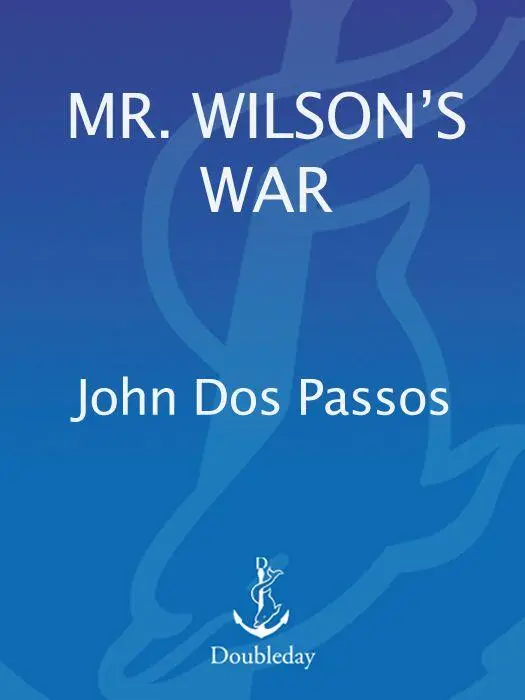
- Название:Mr. Wilson's War
- Автор:
- Издательство:Doubleday
- Жанр:
- Год:1962
- ISBN:9780385028288
- Рейтинг книги:3 / 5. Голосов: 1
-
Избранное:Добавить в избранное
- Отзывы:
-
Ваша оценка:
Mr. Wilson's War: краткое содержание, описание и аннотация
Предлагаем к чтению аннотацию, описание, краткое содержание или предисловие (зависит от того, что написал сам автор книги «Mr. Wilson's War»). Если вы не нашли необходимую информацию о книге — напишите в комментариях, мы постараемся отыскать её.
Foremost in the cast of characters is Woodrow Wilson, the shy, brilliant, revered, and misunderstood “schoolmaster”, whose administration was a complex of apparent contradictions. Wilson had almost no interest in foreign affairs when he was first elected, yet later, in proposing the League of Nations, he was to play a major role in international politics. During his first summer in office, without any…
Mr. Wilson's War — читать онлайн бесплатно полную книгу (весь текст) целиком
Ниже представлен текст книги, разбитый по страницам. Система сохранения места последней прочитанной страницы, позволяет с удобством читать онлайн бесплатно книгу «Mr. Wilson's War», без необходимости каждый раз заново искать на чём Вы остановились. Поставьте закладку, и сможете в любой момент перейти на страницу, на которой закончили чтение.
Интервал:
Закладка:
Though Count Mirbach-Harff came surrounded with German experts on Russian affairs, he seems to have been as unprepared as his British and French opponents in the diplomatic bout to deal with the revolutionary scene. He was housed in the insanely ornate mansion of a departed sugar magnate named Berg. One of his first experiences was to view from his automobile in the Red Square the May Day parade held to celebrate the proletarian triumph.
Lockhart watching Mirbach seated among his aides in an open car reported that the supercilious smirk left the German’s face as he watched the ranks and ranks of illclad illfed illorganized working men march by. There was a look of strength about them. “He looked serious,” wrote Lockhart.
With the coming of summer the tensions reached the breaking point. In spite of the protests of their Social Revolutionary partners, the Communists were enforcing Lenin’s policy of sending out “poverty committees,” made up usually of the ne’erdowells of the villages, to requisition the stored grain and other possessions of their more prosperous and hardworking neighbors. Any successful farmer was a kulak.
To the cold social mathematics of Lenin’s mind it was clear that he could never establish communism if he allowed a peasant bourgeoisie to grow up in the country. The kulaks must be eliminated.
But elimination of the best farmers would disrupt the production of food. Opposition grew among the most energetic and intelligent elements of the peasantry. In the mood pervading the villages it took only a small incident, like a match dropped in a ripe wheatfield, to set the whole of Russia blazing with civil war.
On May 14 fighting breaks out at Chelyabinsk, just east of the Urals, between a trainload of Czechoslovaks headed east and a trainload of Hungarian prisoners of war headed west. A man is killed on each side.
Trotsky immediately gives orders to disarm the Czechoslovak Legion. The Legion refuses to be disarmed and continues on its way east, seizing the railroad as it goes. East of Lake Baikal their detachments have a clear track into Vladivostok, but the large forces still on the line to the west are trapped because the Communists keep control of Irkutsk, the railroad center at the southern end of the lake.
As if at a prearranged signal all Siberia shakes off the Moscow yoke. Communists on the governing committees melt away into hiding. Moderate elements, tending to favor the Allies against the Germans, take charge again. In Manchuria, with some support from the Japanese, czarist officers are organizing an army to restore the Romanoffs. In southern Russia wherever the Germans have penetrated reactionary movements come to life. In the Ukraine the parliamentary Rada has been overthrown by an old regime general giving orders as hetman. The Don Cossacks have their own government Czarist groups with German support hold the Crimea and the towns on the Black Sea coast.
The remaining warmwater ports fall to the Allies. Vladivostok has become a Czechoslovak base. At the end of June the threat of invasion from Lapland by Mannerheim’s Germanbacked Finns forces the soviet of the Murmansk region to submit to occupation by the British. When Chicherin remonstrates over the phone the president of the Murmansk soviet calls him a pro-German and says that the comrades in Moscow are in no position to understand the situation in the north.
Insurrections follow the spring thaw. “Green” armies of anarchist peasants, “White” armies dedicated to the old regime, dissident Reds of every socialist creed collect and fight and fade into the forests. Fleeting republics and governments rise and make proclamations and disintegrate into chaos again. Villages bum. Towns are pillaged. Granaries are raided, cattle driven off. Men kill and die fighting for causes they hardly know the names of.
On July 4, 1918, the Fifth All-Russian Congress of Soviets meets in Moscow. The Left Social Revolutionaries, still represented in all the organs of the dictatorship, including the Cheka, have managed to elect a good third of the delegates. At a party caucus they decide that the parting of the ways has come. They will no longer submit to the despoiling of revolutionary peasants by the poverty committees, or to collaboration with the Germans who are shooting peasants in the Ukraine for resisting the requisition of their grain. Furthermore they demand the abolition of the death penalty.
The Congress is called to order in the old Bolshoy Theatre, where Muscovites of all factions still sit enthralled every night by the dancing of the nationalized imperial ballet which remains almost the only link to the culture of the old regime.
Lockhart, who is present in one of the boxes set aside for the Allied missions, describes the paladins of the Executive Committee seated on the stage. Sverdlov, its president, acts as chairman. At the end sits the leader of the Left Social Revolutionaries, Maria Spiridovna. Lockhart describes her as looking, with her pincenez and her dark hair pulled back smoothly on her head, for all the world like the rural schoolteacher in Tchekhov’s Three Sisters.
Maria Spiridovna is revered by all factions of the revolution. As a girl at the time of the outbreak in 1905 she shot an unpopular czarist official, suffered nameless brutalities at the hands of the cossacks and served long years at hard labor in Siberia. She shows her nervousness by ceaselessly toying with her pincenez.
The sessions are stormy to the point of madness. On the second day Maria Spiridovna makes a personal attack on Lenin:
“I accuse you,” she cries, “of betraying the peasants … of making use of them for your own ends, and of not serving their interests.” Her voice rises to a shriek. “When the peasants, the Bolshevik peasants, the Left Social-Revolutionary peasants, the Bolshevik peasants, the non-party peasants are alike humiliated oppressed and crushed — crushed as peasants — in my hand you will find the same pistol, the same bomb which once forced me to defend …”
Her words are drowned in applause and in a roar of opposing shouts and yelps and screams. Trotsky tries to speak and is howled down. Sverdlov helplessly tinkles his bell.
“Then Lenin walks slowly to the front of the stage,” writes Lockhart. “On the way he pats Sverdlov on the shoulder and tells him to put his bell away. Holding the lapels of his coat, he faces the audience — smiling, supremely self-confident. He is met with jeers and catcalls. He laughs good-humoredly. Then he holds up his hand and with a last rumble the tumult dies.”
Lenin contends that the Left Social Revolutionaries are illogical. Renewed war with the Germans will only be to the advantage of the other imperialist faction, the Allies. The Russian proletariat must quietly consolidate its power, must patiently wait for the moment when warweariness shall cause the oppressed peoples of all the countries of Europe to rise in world revolution.
In spite of Lenin’s calming speech the congress breaks out into a wild demonstration against members of the German mission seated in one of the boxes. Sverdlov adjourns the meeting.
The following afternoon, carrying identification cards signed by Dzerdzinsky and furnished them by Social Revolutionary members of the Cheka, two S.R.s call on Ambassador Mirbach on the pretext that the Cheka has discovered a conspiracy to assassinate him. He has papers says the first man. He puts his hand in his briefcase and draws out a pistol and shoots. The first shots go wild, but his companion takes careful aim and shoots Mirbach through the head. Both assassins escape through a window after exploding a couple of handgrenades in the embassy hall.
Читать дальшеИнтервал:
Закладка:
Похожие книги на «Mr. Wilson's War»
Представляем Вашему вниманию похожие книги на «Mr. Wilson's War» списком для выбора. Мы отобрали схожую по названию и смыслу литературу в надежде предоставить читателям больше вариантов отыскать новые, интересные, ещё непрочитанные произведения.

Обсуждение, отзывы о книге «Mr. Wilson's War» и просто собственные мнения читателей. Оставьте ваши комментарии, напишите, что Вы думаете о произведении, его смысле или главных героях. Укажите что конкретно понравилось, а что нет, и почему Вы так считаете.