John Passos - Mr. Wilson's War
Здесь есть возможность читать онлайн «John Passos - Mr. Wilson's War» весь текст электронной книги совершенно бесплатно (целиком полную версию без сокращений). В некоторых случаях можно слушать аудио, скачать через торрент в формате fb2 и присутствует краткое содержание. Год выпуска: 1962, ISBN: 1962, Издательство: Doubleday, Жанр: Историческая проза, Биографии и Мемуары, на английском языке. Описание произведения, (предисловие) а так же отзывы посетителей доступны на портале библиотеки ЛибКат.
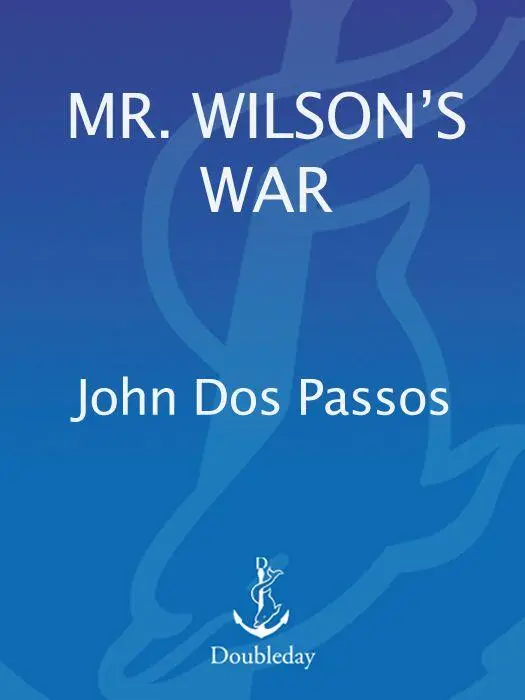
- Название:Mr. Wilson's War
- Автор:
- Издательство:Doubleday
- Жанр:
- Год:1962
- ISBN:9780385028288
- Рейтинг книги:3 / 5. Голосов: 1
-
Избранное:Добавить в избранное
- Отзывы:
-
Ваша оценка:
Mr. Wilson's War: краткое содержание, описание и аннотация
Предлагаем к чтению аннотацию, описание, краткое содержание или предисловие (зависит от того, что написал сам автор книги «Mr. Wilson's War»). Если вы не нашли необходимую информацию о книге — напишите в комментариях, мы постараемся отыскать её.
Foremost in the cast of characters is Woodrow Wilson, the shy, brilliant, revered, and misunderstood “schoolmaster”, whose administration was a complex of apparent contradictions. Wilson had almost no interest in foreign affairs when he was first elected, yet later, in proposing the League of Nations, he was to play a major role in international politics. During his first summer in office, without any…
Mr. Wilson's War — читать онлайн бесплатно полную книгу (весь текст) целиком
Ниже представлен текст книги, разбитый по страницам. Система сохранения места последней прочитанной страницы, позволяет с удобством читать онлайн бесплатно книгу «Mr. Wilson's War», без необходимости каждый раз заново искать на чём Вы остановились. Поставьте закладку, и сможете в любой момент перейти на страницу, на которой закончили чтение.
Интервал:
Закладка:
The city, while not exactly panicky, was tense. Though outwardly the Premier gave an impression of confidence he was making secret arrangements for the evacuation of the most important government offices in case of need. The nervous and the rich were leaving already. Trains for Lyons and the Midi were full of standees. At the same time the gare du Nord was choking up pitifully with refugees arriving with their bundles and boxes from the invaded north.
The people who had decided to stick it out were in good spirits. Sunday afternoon the boulevards were unusually lively. The President of the Republic visited the sites of the explosions and brought the nation’s condolences to the bereaved and the wounded. Holidaymakers were more curious than frightened about the projectiles from Big Bertha. The Parisians were pointing out to each other that they weren’t doing much damage after all.
The appointment at Doullens was for eleven in the morning. Clemenceau and his military aide, General Mordacq, arrived on the dot. A second later President Poincaré and his military aide drove up. Along with them came Monsieur Loucheur, the minister for armaments and aviation. There was no love lost between the President of the Republic and the President of the Council of Ministers, particularly since the scheme for making Clemenceau generalissimo had been bruited about, but in this extremity they greeted each other cordially. Clemenceau, noted Mordacq, was in good spirits. He seemed almost gay.
Lord Milner and General Wilson were late. Since Haig and his staff had filled up the little town hall, the French leaders remained in the prettily gardened little square outside. The day was chilly with a raw wind off the Channel, so they had to walk briskly up and down to keep warm.
Townspeople crowded around them. They were asking if they were going to allow the Germans to come as far as Doullens. Should people pack up and leave? Bitter reproaches lurked under a polite demeanor. The Tiger growled one of his usual phrases about “they shall not pass” through his mustache.
From where he stood it was all too clear that the retreat was continuing. Refugees kept coming along the main road through the square. There were countrypeople in wagons piled high with household goods, lowing cows and flocks of sheep with their tinkling bells, now and then a protesting pig being dragged along, boys pushing handcarts, babycarriages full of prized possessions with the baby in among them, old women in bonnets, old men hobbling on sticks: a sickening repetition of roadside scenes in the tragic summer of 1914.
Among them, marching sedately in step, came pinkfaced detachments of retreating British troops. The Frenchmen were amazed at their expressionless faces. Whenever there was a moment of silence they could hear the German guns like heavy surf in the distance.
The President of the Council and the President of the Republic had only time to exchange a few anxious words before they were joined by General Foch. Foch at sixtyseven was a strutting gamecock of a man with gray blue eyes and an abundant grizzled mustache. He arrived, followed by his staff, with a great air of bustle and confidence. At last he was going to attain the command he’d so long desired. He greeted the heads of the French republic and made his famous gesture of brushing away cobwebs.
“My plan is not complicated,” he exclaimed in harsh trenchant tones. “I want to fight. I’ll fight in the North. I’ll fight on the Somme. I’ll fight on the Aisne, in Lorraine, in Alsace, I’ll fight everywhere and blow after blow I’ll end by knocking out the Boche; he’s no smarter and no stronger than we are.”
Mordacq noted in his journal that Foch seemed to bring a gust of victory with him.
Pétain’s arrival was lugubrious. He came full of complaints. The British were not keeping him properly informed. How could they expect him to send in reinforcements if they wouldn’t stop retreating? “That man,” whispered Pétain to the group about him, when he caught sight of Haig’s tall figure on the steps of the town hall, “will have to capitulate in two weeks.”
The French were nervously comparing their watches with the town clock. Eleven fortyfive. Where the devil were the representatives of the British Government? The sound of the guns seemed to grow louder. Their pacing became nervous, almost feverish. Twelve o’clock struck. No sign of Milner and Wilson.
At twelve five, two British staffcars appeared at full tilt, scattering the refugees as they came. As soon as Lord Milner stepped out of his car, Clemenceau, who had the knack of putting people in the wrong, strode up to him savagely and asked if it were true that the British were planning to evacuate Amiens. Milner protested loudly that Marshal Haig intended no such thing.
He then asked if the French would excuse him for a few minutes so that he could talk to his generals in the mayor’s office. They had had no chance to confer. Marshal Haig and Generals Plumer and Byng led the way into the building. After fifteen minutes they called in the French.
The conference of Doullens began with neatly bearded little Poincaré presiding.
The Tiger snarled at Haig: was he planning to give up Amiens? Haig said that was the last thing he was planning to do but that he must have French reinforcements to cover his flank. He had no reserves ready to fight.
It was Pétain’s turn to say what he could do. Haig had already turned over to his command the elements of the Fifth Army nearest the French flank. “The Fifth Army,” began Pétain, “has ceased to exist.” He went into a long gloomy account of how for days he’d been trying to find divisions. He had found twentyfour, but most of them were tired and some frazzled from recent combat. The problems of transportation and redeployment would take a long time to solve. It would take time.
Pétain’s words threw a chill over the group. For a while nobody spoke.
Clemenceau grabbed Milner’s arm and backed him into a comer. “We must make an end of this,” he whispered. “What do you propose?”
Milner had come all primed. He immediately proposed putting the French and British armies under the command of General Foch. To sweeten the pill for Pétain and Haig, Milner brought in the word “coordinate.” Pétain announced loftily that indeed he would serve under General Foch. They all looked at Haig.
Mordacq noticed how lined and haggard Haig’s face was. He’d lost the erect look of the wooden soldier perfectly painted and polished. He muttered something about doing everything necessary to serve the general interest.
Clemenceau insisted that the decision be put in writing. Foch’s command must take effect from that moment. General Foch was charged with coordinating the British and French armies on the western front. All present signed the little document. Milner’s signature committed the British cabinet.
Pétain went back gloomily to his train. Haig and his generals returned to their distracted headquarters. The staff officers felt something had been put over on their chief. Being forced under French command was the price he had to pay for reinforcements.
The French were rubbing their hands. The air was sharp. It was two and they were accustomed to their déjeuner at twelve. All present confessed to a good appetite. The President of the Republic, and General Foch and Monsieur Clemenceau and Monsieur Loucheur and their aides and secretaries walked around the corner to a highly recommended little country restaurant, L’Hôtel des Quatre Frères Aymon, where a hangup luncheon had been ordered for them.
As they sat down to table Clemenceau and Foch, who never agreed for more than a few minutes at a time, couldn’t help a slight falling out. “Well,” growled the Tiger glaring at Foch as he tucked his napkin under his chin, “you’ve got the position you wanted so much.”
Читать дальшеИнтервал:
Закладка:
Похожие книги на «Mr. Wilson's War»
Представляем Вашему вниманию похожие книги на «Mr. Wilson's War» списком для выбора. Мы отобрали схожую по названию и смыслу литературу в надежде предоставить читателям больше вариантов отыскать новые, интересные, ещё непрочитанные произведения.


Обсуждение, отзывы о книге «Mr. Wilson's War» и просто собственные мнения читателей. Оставьте ваши комментарии, напишите, что Вы думаете о произведении, его смысле или главных героях. Укажите что конкретно понравилось, а что нет, и почему Вы так считаете.