John Passos - Three Soldiers
Здесь есть возможность читать онлайн «John Passos - Three Soldiers» весь текст электронной книги совершенно бесплатно (целиком полную версию без сокращений). В некоторых случаях можно слушать аудио, скачать через торрент в формате fb2 и присутствует краткое содержание. Жанр: Историческая проза, Детектив, на английском языке. Описание произведения, (предисловие) а так же отзывы посетителей доступны на портале библиотеки ЛибКат.
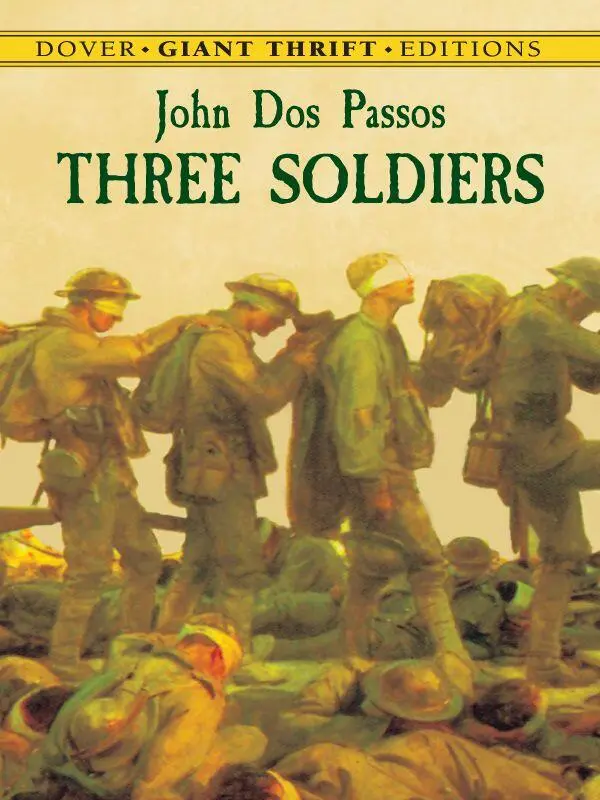
- Название:Three Soldiers
- Автор:
- Жанр:
- Год:неизвестен
- ISBN:нет данных
- Рейтинг книги:3 / 5. Голосов: 1
-
Избранное:Добавить в избранное
- Отзывы:
-
Ваша оценка:
Three Soldiers: краткое содержание, описание и аннотация
Предлагаем к чтению аннотацию, описание, краткое содержание или предисловие (зависит от того, что написал сам автор книги «Three Soldiers»). Если вы не нашли необходимую информацию о книге — напишите в комментариях, мы постараемся отыскать её.
Three Soldiers — читать онлайн бесплатно полную книгу (весь текст) целиком
Ниже представлен текст книги, разбитый по страницам. Система сохранения места последней прочитанной страницы, позволяет с удобством читать онлайн бесплатно книгу «Three Soldiers», без необходимости каждый раз заново искать на чём Вы остановились. Поставьте закладку, и сможете в любой момент перейти на страницу, на которой закончили чтение.
Интервал:
Закладка:
“There ye are.” said Judkins in a solemn tone. “He don’t even go after his pay. That guy thinks he’s the whole show, he does.”
Chrisfield flushed, but said nothing.
“He don’t do nothing all day long but talk to that ole lady,” said Small with a grin. “Guess she reminds him of his mother, or somethin’.”
“He always does go round with the frogs all he can. Looks to me like he’d rather have a drink with a frog than with an American.”
“Reckon he wants to learn their language,” said Small.
“He won’t never come to much in this army, that’s what I’m telling yer,” said Judkins.
The little houses across the way had flushed red with the sunset. Andrews got to his feet slowly and languidly and held out his hand to the old woman. She stood up, a small tottering figure in a black silk shawl. He leaned over towards her and she kissed both his cheeks vigorously several times. He walked down the road towards the billets, with his fatigue cap in his hand, looking at the ground.
“He’s got a flower behind his ear, like a cigarette,” said Judkins, with a disgusted snort.
“Well, I guess we’d better go,” said Small. “We got to be in quarters at six.”’
They were silent a moment. In the distance the guns kept up a continual tomtom sound.
“Guess we’ll be in that soon,” said Small.
Chrisfield felt a chill go down his spine. He moistened his lips with his tongue.
“Guess it’s hell out there,” said Judkins. “War ain’t no picnic.”
“Ah doan give a hoot in hell,” said Chrisfield.
The men were lined up in the village street with their packs on, waiting for the order to move. Thin wreaths of white mist still lingered in the trees and over the little garden plots. The sun had not yet risen, but ranks of clouds in the pale blue sky overhead were brilliant with crimson and gold. The men stood in an irregular line, bent over a little by the weight of their equipment, moving back and forth, stamping their feet and beating their arms together, their noses and ears red from the chill of the morning. The haze of their breath rose above their heads.
Down the misty road a drab-colored limousine appeared, running slowly. It stopped in front of the line of men. The lieutenant came hurriedly out of the house opposite, drawing on a pair of gloves. The men standing in line looked curiously at the limousine. They could see that two of the tires were flat and that the glass was broken. There were scratches on the drab paint and in the door three long jagged holes that obliterated the number. A little murmur went down the line of men. The door opened with difficulty, and a major in a light buff-colored coat stumbled out. One arm, wrapped in bloody bandages, was held in a sling made of a handkerchief. His face was white and drawn into a stiff mask with pain. The lieutenant saluted.
“For God’s sake where’s a repair station?” he asked in a loud shaky voice.
“There’s none in this village, Major.”
“Where the hell is there one?”
“I don’t know,” said the lieutenant in a humble tone.
“Why the hell don’t you know? This organization’s rotten, no good… Major Stanley’s just been killed. What the hell’s the name of this village?”
“Thiocourt.”
“Where the hell’s that?”
The chauffeur had leaned out. He had no cap and his hair was full of dust.
“You see, Lootenant, we wants to get to Châlons-”
“Yes, that’s it. Châlons sur… Châlons-sur-Marne,” said the Major.
“The billeting officer has a map,” said the lieutenant, “last house to the left.”
“O let’s go there quick,” said the major. He fumbled with the fastening of the door.
The lieutenant opened it for him.
As he opened the door, the men nearest had a glimpse of the interior of the car. On the far side was a long object huddled in blankets, propped up on the seat.
Before he got in the major leaned over and pulled a woollen rug out, holding it away from him with his one good arm. The car moved off slowly, and all down the village street the men, lined up waiting for orders, stared curiously at the three jagged holes in the door.
The lieutenant looked at the rug that lay in the middle of the road. He touched it with his foot. It was soaked with blood that in places had dried into clots.
The lieutenant and the men of his company looked at it in silence. The sun had risen and shone on the roofs of the little whitewashed houses behind them. Far down the road a regiment had begun to move.
V
AT the brow of the hill they rested. Chrisfield sat on the red clay bank and looked about him, his rifle between his knees. In front of him on the side of the road was a French burying ground, where the little wooden crosses, tilting in every direction, stood up against the sky, and the bead wreaths glistened in the warm sunlight. All down the road as far as he could see was a long drab worm, broken in places by strings of motor trucks, a drab worm that wriggled down the slope, through the roofless shell of the village and up into the shattered woods on the crest of the next hills. Chrisfield strained his eyes to see the hills beyond. They lay blue and very peaceful in the noon mist. The river glittered about the piers of the wrecked stone bridge, and disappeared between rows of yellow poplars. Somewhere in the valley a big gun fired. The shell shrieked into the distance, towards the blue, peaceful hills.
Chrisfield’s regiment was moving again. The men, their feet slipping in the clayey mud, went downhill with long strides, the straps of their packs tugging at their shoulders.
“Isn’t this great country?” said Andrews, who marched beside him.
“Ah’d liever be at an O.T.C. like that bastard Anderson.”
“Oh, to hell with that,” said Andrews. He still had a big faded orange marigold in one of the buttonholes of his soiled tunic. He walked with his nose in the air and his nostrils dilated, enjoying the tang of the autumnal sunlight.
Chrisfield took the cigarette, that had gone out half-smoked, from his mouth and spat savagely at the heels of the man in front of him.
“This ain’t no life for a white man,” he said.
“I’d rather be this than… than that,” said Andrews bitterly. He tossed his head in the direction of a staff car full of officers that was stalled at the side of the road. They were drinking something out of a thermos bottle that they passed round with the air of Sunday excursionists. They waved, with a conscious relaxation of discipline, at the men as they passed. One, a little lieutenant with a black mustache with pointed ends, kept crying: “They’re running like rabbits, fellers; they’re running like rabbits.” A wavering half-cheer would come from the column now and then where it was passing the staff car.
The big gun fired again. Chrisfield was near it this time and felt the concussion like a blow in the head.
“Some baby,” said the man behind him.
Someone was singing:
Everybody took it up. Their steps rang in rhythm in the paved street that zigzaged among the smashed houses of the village. Ambulances passed them, big trucks full of huddled men with grey faces, from which came a smell of sweat and blood and carbolic.
Somebody went on:
“Can that,” cried Judkins, “it ain’t lucky.”
But everybody had taken up the song. Chrisfield noticed that Andrews’s eyes were sparkling. “If he ain’t the damnedest,” he thought to himself. But he shouted at the top of his lungs with the rest:
They were climbing the hill again. The road was worn into deep ruts and there were many shell holes, full of muddy water, into which their feet slipped. The woods began, a shattered skeleton of woods, full of old artillery emplacements and dugouts, where torn camouflage fluttered from splintered trees. The ground and the road were littered with tin cans and brass shell-cases. Along both sides of the road the trees were festooned, as with creepers, with strand upon strand of telephone wire.
Читать дальшеИнтервал:
Закладка:
Похожие книги на «Three Soldiers»
Представляем Вашему вниманию похожие книги на «Three Soldiers» списком для выбора. Мы отобрали схожую по названию и смыслу литературу в надежде предоставить читателям больше вариантов отыскать новые, интересные, ещё непрочитанные произведения.






Обсуждение, отзывы о книге «Three Soldiers» и просто собственные мнения читателей. Оставьте ваши комментарии, напишите, что Вы думаете о произведении, его смысле или главных героях. Укажите что конкретно понравилось, а что нет, и почему Вы так считаете.