Carveth Read - Logic - Deductive and Inductive
Здесь есть возможность читать онлайн «Carveth Read - Logic - Deductive and Inductive» — ознакомительный отрывок электронной книги совершенно бесплатно, а после прочтения отрывка купить полную версию. В некоторых случаях можно слушать аудио, скачать через торрент в формате fb2 и присутствует краткое содержание. Жанр: foreign_prose, foreign_religion, Философия, foreign_psychology, foreign_antique, на английском языке. Описание произведения, (предисловие) а так же отзывы посетителей доступны на портале библиотеки ЛибКат.

- Название:Logic: Deductive and Inductive
- Автор:
- Жанр:
- Год:неизвестен
- ISBN:нет данных
- Рейтинг книги:4 / 5. Голосов: 1
-
Избранное:Добавить в избранное
- Отзывы:
-
Ваша оценка:
Logic: Deductive and Inductive: краткое содержание, описание и аннотация
Предлагаем к чтению аннотацию, описание, краткое содержание или предисловие (зависит от того, что написал сам автор книги «Logic: Deductive and Inductive»). Если вы не нашли необходимую информацию о книге — напишите в комментариях, мы постараемся отыскать её.
Logic: Deductive and Inductive — читать онлайн ознакомительный отрывок
Ниже представлен текст книги, разбитый по страницам. Система сохранения места последней прочитанной страницы, позволяет с удобством читать онлайн бесплатно книгу «Logic: Deductive and Inductive», без необходимости каждый раз заново искать на чём Вы остановились. Поставьте закладку, и сможете в любой момент перейти на страницу, на которой закончили чтение.
Интервал:
Закладка:
The Quantity of a proposition, then, is usually determined entirely by the quantity of the subject, whether all or some . Still, the quantity of the predicate is often an important consideration; and though in ordinary usage the predicate is seldom predesignate, Logicians agree that in every Negative Proposition (see § 2) the predicate is 'distributed,' that is to say, is denied altogether of the subject, and that this is involved in the form of denial. To say Some men are not brave , is to declare that the quality for which men may be called brave is not found in any of the Some men referred to: and to say No men are proof against flattery , cuts off the being 'proof against flattery' entirely from the list of human attributes. On the other hand, every Affirmative Proposition is regarded as having an undistributed predicate; that is to say, its predicate is not affirmed exclusively of the subject. Some men are wise does not mean that 'wise' cannot be predicated of any other beings; it is equivalent to Some men are wise ( whoever else may be ). And All elephants are sagacious does not limit sagacity to elephants: regarding 'sagacious' as possibly denoting many animals of many species that exhibit the quality, this proposition is equivalent to ' All elephants are some sagacious animals .' The affirmative predication of a quality does not imply exclusive possession of it as denial implies its complete absence; and, therefore, to regard the predicate of an affirmative proposition as distributed would be to go beyond the evidence and to take for granted what had never been alleged.
Some Logicians, seeing that the quantity of predicates, though not distinctly expressed, is recognised, and holding that it is the part of Logic "to make explicit in language whatever is implicit in thought," have proposed to exhibit the quantity of predicates by predesignation, thus: 'Some men are some wise (beings)'; 'some men are not any brave (beings)'; etc. This is called the Quantification of the Predicate, and leads to some modifications of Deductive Logic which will be referred to hereafter. (See § 5; chap. vii. § 4, and chap. viii. § 3.)
§ 2. As to Quality, Propositions are either Affirmative or Negative. An Affirmative Proposition is, formally, one whose copula is affirmative (or, has no negative sign), as S—is—P, All men—are—partial to themselves . A Negative Proposition is one whose copula is negative (or, has a negative sign), as S—is not—P, Some men—are not—proof against flattery . When, indeed, a Negative Proposition is of Universal Quantity, it is stated thus: No S is P, No men are proof against flattery ; but, in this case, the detachment of the negative sign from the copula and its association with the subject is merely an accident of our idiom; the proposition is the same as All men—are not—proof against flattery . It must be distinguished, therefore, from such an expression as Not every man is proof against flattery ; for here the negative sign really restricts the subject; so that the meaning is— Some men at most (it may be none) are proof against flattery ; and thus the proposition is Particular, and is rendered— Some men—are not—proof against flattery .
When the negative sign is associated with the predicate, so as to make this an Infinite Term ( chap. iv. § 8), the proposition is called an Infinite Proposition, as S is not-P (or p), All men are—incapable of resisting flattery , or are—not-proof against flattery .
Infinite propositions, when the copula is affirmative, are formally, themselves affirmative, although their force is chiefly negative; for, as the last example shows, the difference between an infinite and a negative proposition may depend upon a hyphen. It has been proposed, indeed, with a view to superficial simplification, to turn all Negatives into Infinites, and thus render all propositions Affirmative in Quality. But although every proposition both affirms and denies something according to the aspect in which you regard it (as Snow is white denies that it is any other colour, and Snow is not blue affirms that it is some other colour), yet there is a great difference between the definite affirmation of a genuine affirmative and the vague affirmation of a negative or infinite; so that materially an affirmative infinite is the same as a negative.
Generally Mill's remark is true, that affirmation and denial stand for distinctions of fact that cannot be got rid of by manipulation of words. Whether granite sinks in water, or not; whether the rook lives a hundred years, or not; whether a man has a hundred dollars in his pocket, or not; whether human bones have ever been found in Pliocene strata, or not; such alternatives require distinct forms of expression. At the same time, it may be granted that many facts admit of being stated with nearly equal propriety in either Quality, as No man is proof against flattery , or All men are open to flattery .
But whatever advantage there is in occasionally changing the Quality of a proposition may be gained by the process of Obversion (chap. vii. § 5); whilst to use only one Quality would impair the elasticity of logical expression. It is a postulate of Logic that the negative sign may be transferred from the copula to the predicate, or from the predicate to the copula, without altering the sense of a proposition; and this is justified by the experience that not to have an attribute and to be without it are the same thing.
§ 3. A. I. E. O.—Combining the two kinds of Quantity, Universal and Particular, with the two kinds of Quality, Affirmative and Negative, we get four simple types of proposition, which it is usual to symbolise by the letters A. I. E. O., thus:
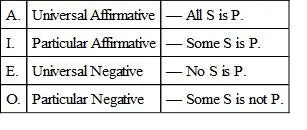
As an aid to the remembering of these symbols we may observe that A. and I. are the first two vowels in affirmo and that E. and O. are the vowels in nego .
It must be acknowledged that these four kinds of proposition recognised by Formal Logic constitute a very meagre selection from the list of propositions actually used in judgment and reasoning.
Those Logicians who explicitly quantify the predicate obtain, in all, eight forms of proposition according to Quantity and Quality:
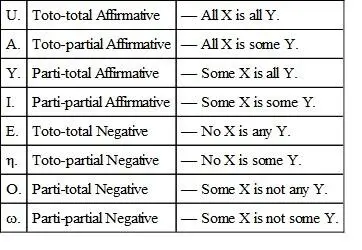
Here A. I. E. O. correspond with those similarly symbolised in the usual list, merely designating in the predicates the quantity which was formerly treated as implicit.
§ 4. As to Relation, propositions are either Categorical or Conditional. A Categorical Proposition is one in which the predicate is directly affirmed or denied of the subject without any limitation of time, place, or circumstance, extraneous to the subject, as All men in England are secure of justice ; in which proposition, though there is a limitation of place ('in England'), it is included in the subject. Of this kind are nearly all the examples that have yet been given, according to the form S is P .
A Conditional Proposition is so called because the predication is made under some limitation or condition not included in the subject, as If a man live in England, he is secure of justice . Here the limitation 'living in England' is put into a conditional sentence extraneous to the subject, 'he,' representing any man.
Conditional propositions, again, are of two kinds—Hypothetical and Disjunctive. Hypothetical propositions are those that are limited by an explicit conditional sentence, as above, or thus: If Joe Smith was a prophet, his followers have been unjustly persecuted . Or in symbols thus:
Читать дальшеИнтервал:
Закладка:
Похожие книги на «Logic: Deductive and Inductive»
Представляем Вашему вниманию похожие книги на «Logic: Deductive and Inductive» списком для выбора. Мы отобрали схожую по названию и смыслу литературу в надежде предоставить читателям больше вариантов отыскать новые, интересные, ещё непрочитанные произведения.











Обсуждение, отзывы о книге «Logic: Deductive and Inductive» и просто собственные мнения читателей. Оставьте ваши комментарии, напишите, что Вы думаете о произведении, его смысле или главных героях. Укажите что конкретно понравилось, а что нет, и почему Вы так считаете.