Jerzy Kosiński - The Painted Bird
Здесь есть возможность читать онлайн «Jerzy Kosiński - The Painted Bird» весь текст электронной книги совершенно бесплатно (целиком полную версию без сокращений). В некоторых случаях можно слушать аудио, скачать через торрент в формате fb2 и присутствует краткое содержание. Год выпуска: 1965, ISBN: 1965, Жанр: Детская проза, на английском языке. Описание произведения, (предисловие) а так же отзывы посетителей доступны на портале библиотеки ЛибКат.
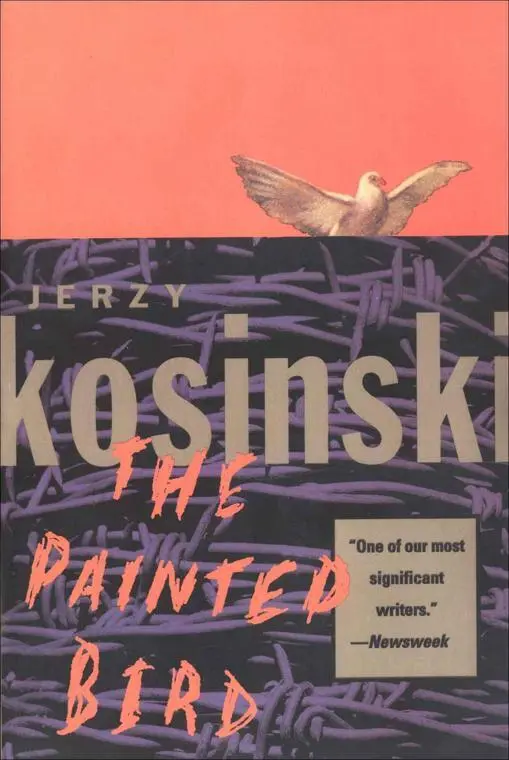
- Название:The Painted Bird
- Автор:
- Жанр:
- Год:1965
- ISBN:978-0-8021-9575-3
- Рейтинг книги:4 / 5. Голосов: 1
-
Избранное:Добавить в избранное
- Отзывы:
-
Ваша оценка:
The Painted Bird: краткое содержание, описание и аннотация
Предлагаем к чтению аннотацию, описание, краткое содержание или предисловие (зависит от того, что написал сам автор книги «The Painted Bird»). Если вы не нашли необходимую информацию о книге — напишите в комментариях, мы постараемся отыскать её.
The Painted Bird — читать онлайн бесплатно полную книгу (весь текст) целиком
Ниже представлен текст книги, разбитый по страницам. Система сохранения места последней прочитанной страницы, позволяет с удобством читать онлайн бесплатно книгу «The Painted Bird», без необходимости каждый раз заново искать на чём Вы остановились. Поставьте закладку, и сможете в любой момент перейти на страницу, на которой закончили чтение.
Интервал:
Закладка:
During my wanderings through the forest, splotches of wet snow often fell on me, threatening to choke my comet. On the second day I was halted by a cry. I crouched behind a bush, afraid to move, listening intently to the rustling trees. I heard the cry again. Above crows flapped their wings, scared by something. Moving stealthily from the cover of one tree to another, I approached the source of the sound. On a narrow, soggy road I saw an overturned cart and horse, but no sign of a person.
When the horse saw me it pricked its ears and tossed its head. I came closer. The animal was so thin that I could see its every bone. Every strand of emaciated muscle hung like wet rope. It looked at me with dim bloodshot eyes that seemed about to close. It moved its head feebly, and a froglike croak rose up in its thin neck.
One of the horse’s legs was broken above the fetlock. A sharp splinter of broken bone protruded, and every time the animal moved its leg the bone cut farther through the skin.
Ravens circled over the stricken beast, hovering upwind and downwind, persistently keeping their watch. Now and then one of them would perch in the trees and send lumps of wet, thawed snow cascading to the ground with the thud of potato pancakes flapped into a pan. At every sound the horse wearily lifted its head, opened its eyes, and looked about.
Seeing me walk around the cart, the horse switched its tail invitingly. I approached him and he put his heavy head on my shoulder, rubbing against my cheek. As I stroked his dry nostrils, he moved his muzzle, nudging me closer.
I bent down to examine his leg. The horse turned his head toward me, as if awaiting my verdict. I encouraged him to take a step or two. He tried, groaning and stumbling, but it was useless. He lowered his head, ashamed and resigned. I grasped his neck, feeling it still pulse with life. I tried to persuade him to follow me; staying in the forest could only mean his death. I spoke to him about the warm stable, the smell of hay, and I assured him that a man could set his bone and heal it with herbs.
I told him about the lush meadows still under snow, only awaiting spring. I admitted that if I succeeded in bringing him back to the local village and returning him to his owner, my relations with the local people might improve. I might even be able to stay on the farm. He listened, squinting at me from time to time to make sure that I was telling the truth.
I stepped back and urged him to walk with a gentle tap of a twig. He swayed, lifting the injured leg high. He hobbled, but finally I persuaded him to move. Progress was slow and painful. The horse occasionally stopped and slumped motionless. Then I would put my arm around his neck, hug him, and lift the broken leg. After a while he would start walking again, as if moved by some recollection, by some thought that had temporarily slipped from his mind. He missed a step, lost his balance, stumbled. Whenever he walked on the broken leg the splintered bone emerged from under the skin, so that he walked in the snow and mud almost on this stump of bare bone. Each of his pained neighs shattered me. I forgot the clogs on my feet and felt for the moment as if I were walking on the jagged edges of my shinbones, heaving a moan of pain with every step.
Exhausted, covered with mud, I reached the village with the horse. We were immediately surrounded by a pack of snarling dogs. I kept them at bay with my comet, singeing the fur of the most vicious ones. The horse stood by impassive, sinking into a torpor.
Many peasants came out of their huts. One of them was the pleasantly surprised owner of the horse, which had bolted two days previously. He chased away the dogs and examined the broken leg, after which he declared that the horse would have to be killed. His only use would be to provide some meat, a hide for tanning, and bones for medicinal purposes. Actually, in that area, the bones were the most valuable item. The treatment for a serious illness consisted of several daily draughts of an infusion of herbs mixed with ground horse bones. Toothache was treated by a compress made of a frog’s thigh with some powdered horse teeth. Burnt horse hoofs were certain to cure colds within two days, while the hipbones of a horse, placed on an epileptic’s body, helped the patient to avoid seizures.
I stood aside while the peasant checked the horse. My turn came next. The man looked me over carefully and asked me where I had been before and what I had done. I answered as cautiously as possible, anxious to avoid any stories which might arouse his suspicions. He wanted me to repeat what I had said several times and laughed at my unsuccessful attempt to speak the local dialect. He asked me time and again if I were a Jewish or Gypsy orphan. I swore on everything and everybody I could think of that I was a good Christian and an obedient worker. Other men were standing nearby watching me critically. Nevertheless, the farmer decided to take me on as a workhand in the yard and in the fields. I fell to my knees and kissed his feet.
Next morning, the farmer took two big, strong horses out of his stable. He hitched them to a plow and drove them to the crippled horse waiting patiently by a fence. Then he threw a noose over the crippled horse’s neck and tied the other end of the rope to the plow. The strong horses twitched their ears and looked with indifference at the victim. He breathed hard and twisted his neck, which was being squeezed by the tight rope. I stood by wondering how I could save his life, how I could convince him that I had no idea that I would be bringing him back to the farm for this . . . When the farmer approached the horse to check the position of the noose, the cripple suddenly turned his head and licked the farmer’s face. The man did not look at him, but gave him a powerful, open-handed slap on the muzzle. The horse turned away, hurt and humiliated.
I wanted to throw myself at the farmer’s feet and beg for the horse’s life, but I caught the animal’s reproachful look. He was staring straight at me. I remembered what would happen if a man or animal about to die counted the teeth of the person responsible for his death. I was afraid to utter a word as long as the horse was looking at me with that resigned, terrible look. I waited, but he would not drop his eyes from me.
Suddenly the farmer spat on his hands, grabbed a knotted whip, and lashed the rumps of the two strong horses. They bolted forward violently, the rope grew taut, and the noose tightened on the neck of the condemned. Wheezing hoarsely, he was dragged down and fell like a fence blown over by the wind. They pulled him over the soft ground brutally for a few more paces. When the panting horses stopped, the farmer walked up to the victim and kicked him a few times on the neck and on the knees. The animal did not stir. The strong horses, scenting death, stamped their feet nervously as though trying to avoid the stare of the wide-open, dead eyes.
I spent the rest of the day helping the farmer skin off the hide and cut up the carcass.
Weeks went by and the village left me alone. Some of the boys said occasionally that I should be delivered to the German headquarters, or’that the soldiers should be told about the Gypsy bastard in the village. Women avoided me on the road, carefully covering the heads of their children. The men looked me over in silence, and casually spat in my direction.
They were people of slow, deliberate speech who measured their words carefully. Their custom required them to spare words as one spares salt, and a loose tongue was regarded as a man’s worst enemy. Fast talkers were thought devious and dishonest, obviously trained by Jewish or Gypsy fortunetellers. People used to sit in a heavy silence broken only infrequently by some insignificant remark. Whenever speaking or laughing, everyone would cover his mouth with a hand to avoid showing his teeth to ill-wishers. Only vodka managed to loosen their tongues and relax their manners.
Читать дальшеИнтервал:
Закладка:
Похожие книги на «The Painted Bird»
Представляем Вашему вниманию похожие книги на «The Painted Bird» списком для выбора. Мы отобрали схожую по названию и смыслу литературу в надежде предоставить читателям больше вариантов отыскать новые, интересные, ещё непрочитанные произведения.




Обсуждение, отзывы о книге «The Painted Bird» и просто собственные мнения читателей. Оставьте ваши комментарии, напишите, что Вы думаете о произведении, его смысле или главных героях. Укажите что конкретно понравилось, а что нет, и почему Вы так считаете.