ROBERT PARKER - Appaloosa
Здесь есть возможность читать онлайн «ROBERT PARKER - Appaloosa» весь текст электронной книги совершенно бесплатно (целиком полную версию без сокращений). В некоторых случаях можно слушать аудио, скачать через торрент в формате fb2 и присутствует краткое содержание. Город: NY, Год выпуска: 2006, ISBN: 2006, Издательство: Berkley, Жанр: Вестерн, на английском языке. Описание произведения, (предисловие) а так же отзывы посетителей доступны на портале библиотеки ЛибКат.
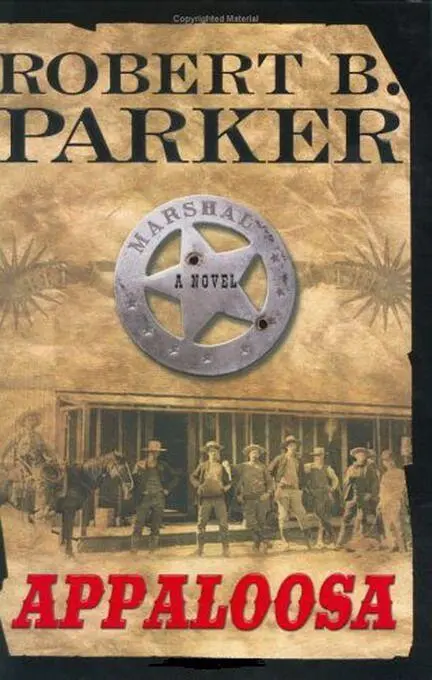
- Название:Appaloosa
- Автор:
- Издательство:Berkley
- Жанр:
- Год:2006
- Город:NY
- ISBN:0-425-20432-4 / 978-0-425-20432-0
- Рейтинг книги:4 / 5. Голосов: 1
-
Избранное:Добавить в избранное
- Отзывы:
-
Ваша оценка:
Appaloosa: краткое содержание, описание и аннотация
Предлагаем к чтению аннотацию, описание, краткое содержание или предисловие (зависит от того, что написал сам автор книги «Appaloosa»). Если вы не нашли необходимую информацию о книге — напишите в комментариях, мы постараемся отыскать её.
It was a long time ago, now, and there were many gunfights to follow, but I remember as well as I remember anything the first time I saw Virgil Cole shoot. Time slowed down for him. Always steady, and never fast...
When it comes to writing, Robert B. Parker knows no boundaries. From the iconic Spenser detective series and the novels featuring Sunny Randall and Jesse Stone, to the groundbreaking historical novel Double Play, Parker's imagination has taken readers from Boston to Brooklyn and back again. In Appaloosa, fans are taken on another trip, to the untamed territories of the West during the 1800s.
When Virgil Cole and Everett Hitch arrive in Appaloosa, they find a small, dusty town suffering at the hands of renegade rancher Randall Bragg, a man who has so little regard for the law that he has taken supplies, horses, and women for his own and left the city marshal and one of his deputies for dead. Cole and Hitch, itinerant lawmen, are used to cleaning up after opportunistic thieves, but in Bragg they find an unusually wily adversary-one who raises the stakes by playing not with the rules, but with emotions.
This is Robert B. Parker at his storytelling best.
Appaloosa — читать онлайн бесплатно полную книгу (весь текст) целиком
Ниже представлен текст книги, разбитый по страницам. Система сохранения места последней прочитанной страницы, позволяет с удобством читать онлайн бесплатно книгу «Appaloosa», без необходимости каждый раз заново искать на чём Вы остановились. Поставьте закладку, и сможете в любой момент перейти на страницу, на которой закончили чтение.
Интервал:
Закладка:
I got a spyglass out of my saddlebag and handed it to Cole. He telescoped it open and looked down at the movement. His eyes weren’t no better than mine. But it was his woman they took.
“Four riders,” Cole said after a while. “And a pack animal. One of the riders is a woman.”
He handed me the glass and I looked. They were too far to make out that it was Allie, but who the hell else would it be.
“Picked up a third man,” I said. “Musta been waiting someplace with the packhorse.”
Cole didn’t answer. He sat motionless on his horse, staring down at the plain.
“We can work our way down to the river easy enough,” he said, “without them seeing us.”
I lowered the glass.
“Then we can sit tight and rest the animals, and us, until the sun goes down and they make camp. Then we can ride out and get close.”
Below us, in the foothills to the north of the river, there was movement.
“That way, we can lay flat and get the lay of how things are,” Cole said. “ ’Fore we go in.”
I put the glass back up to my eye and looked at the movement in the foothills. It was Indians, riding close together among the pine trees, staying behind the hills. It was too hard to count through the glass with much accuracy. But I guessed twelve. I handed the glass to Cole and pointed. He studied the Indians without expression.
“Southern Cheyenne?” he said.
“Maybe,” I said. “Maybe Kiowa. I think they’re carrying them little medicine shields like Kiowas have.”
Cole looked some more.
“Might be,” he said. “Make any difference?”
“Nope. Neither one of ’em likes us.”
“Got no reason to,” he said. “How many you count?”
“Twelve.”
“About what I count,” Cole said. “Maybe a few more.”
“They’re doggin’ those folks,” I said.
“Yep,” Cole said.
“They’ll be a problem.”
“Speculate that they will,” Cole said. “Nothin’ we can do about it.”
“No,” I said.
“So we’ll just keep doing what we’re doing,” Cole said, and moved his horse forward and let it begin to pick its way down the side of the valley, with the extra saddle horse behind him.
I followed with the mule. As we got down into the valley, the Indians were out of sight behind the hills. We wouldn’t see them again until we got out of the valley. Then we might see more of them than we wanted to. If the thought was bothering Cole, he didn’t mention it. Nor did he show any sign of being in a hurry. He was going where he was going to go at the pace he needed to go at, and he was taking me with him.
36
We camped at the bottom of the foothills, just before we reached the plain, next to the river, in a grove of trees. It was still daylight, and we had an early, cold supper. No whiskey this day.
“I need some coffee,” I said.
“Yes,” Cole said.
“We get through with this and I’m going to drink ten cups,” I said. “For breakfast.”
“Won’t be dozin’ much that day,” Cole said.
The animals grazed in the shade. We took turns washing ourselves and our clothes in the river, and spread the wet clothes on the grass at the edge of the trees, away from the river, to dry in the sun. I had a change of clothes. But Cole didn’t. While his clothes dried, Cole walked around in a pair of clean drawers I gave him, with his gun belt on.
“Them Indians show up now, Virgil, you ain’t gonna have to shoot ’em,” I said. “They gonna die from laughin’.”
At sundown, with clean clothes, Cole’s nearly dry, we set out along the river as quiet as we could. The sun was down, but the moon wasn’t up yet, and all the light there was lingered from the set sun. Cole went first. He had the lead from the riderless horse tied to his saddle, and his Winchester out of the sheath and cocked. I rode the same way, with the mule. I was listening so hard that I was getting tired, like it was a muscular effort. To our right, the river was still running turbulent out of the mountains. Ahead of us, I knew, it would broaden and meander on the flat plain. Aside from the river, the only sounds we heard were our own as we moved west on the south side of the river. The land flattened, and the pines gave way to cottonwoods along the river. After another hour or so of soft riding, Cole stopped and sat still. I sat beside him.
“Smell it,” he said quietly.
“Campfire,” I said.
We moved on, slower, staying close to the edge of the river, among the cottonwoods. In the moonlight, we could see up ahead where the river bent in an almost U-shaped meander, and on the tip of the point of land it created, we could see the fire. We stood still. Occasionally, we could see movement as someone passed between us and the fire. We tied the animals and went forward as quiet as we could move. The tree cover gave out maybe fifty yards from the camp. But it was close enough. We could both see that it was the Sheltons. I took the glass out and handed it to Cole. He lengthened it and put it to his eye. He slowly swept the glass over the campsite. Without the glass, I could see that there were three people sitting by the fire with a bottle. None was Allie. I looked around. Near the river, there was a cluster of brush, and behind it, in the river, near the bank, there was movement. Cole settled the glass on it. I waited. As Cole watched, I heard the sound of a woman laughing. It was so unexpected that I almost didn’t know what the sound was. Cole watched for a time. Then, without a sound, he handed me the glass. I adjusted it a little and brought Allie and Ring Shelton into focus. They were standing thigh-deep in the river. They were naked. I put the glass down and collapsed it. I didn’t look at Cole. We heard Allie laugh again, and we saw their indistinct shapes come out of the river and sink to the ground behind the brush cluster, and we couldn’t see them. But in the still, night air, we could hear them. I turned and walked several feet back toward the horses and stopped, and walked back, and stood next to Cole.
“Along the river,” Cole said. “Beyond the camp.”
The Indians had found the Sheltons.
“Must have been a ford downstream,” I said. “They went on down the north side of the river, and forded and came back.”
“Bring the animals up,” Cole said.
“Mule, too?”
“Yep.”
I turned and went. It took a little to maneuver three horses and a mule through the trees quietly, but the sound of the river helped cover our sounds. When I got back, the Indians were in the camp, all of them armed. Most of them with Winchesters. All of them sitting their horses, looking silently down at the three men around the campfire. Cole had retreated a few yards back, in among the trees. Three of them detached from the main body and walked their horses over to the brush where Ring and Allie were. They looked down solemnly for a while and then one of them said something to the other two and all three laughed. The first rider was carrying an old Sharps rifle, that must have killed the buffalo we found. He gestured Ring and Allie should join the others. Ring bent over and picked up his pants. He looked silently back at the Indian with the Sharps rifle as he slowly slid one leg on, then the other, and buttoned them up. Allie bent down to pick up her dress, and the Indian leaned from his saddle, with the rifle in one hand, steady on Ring, and took the dress away and flung it into the river. When Ring had finished buttoning, he gestured again with the rifle, toward the campfire. One of the other Indians jumped down from his horse and picked up one of Allie’s undergarments. He tied it carefully onto his lance and jumped back up astride the horse and waved the lance triumphantly over his head. All of the Indians laughed. I was pretty sure they were Kiowas. Ring and Allie walked to the fire. Allie stood naked in the middle of four white men and maybe a dozen bucks.
Читать дальшеИнтервал:
Закладка:
Похожие книги на «Appaloosa»
Представляем Вашему вниманию похожие книги на «Appaloosa» списком для выбора. Мы отобрали схожую по названию и смыслу литературу в надежде предоставить читателям больше вариантов отыскать новые, интересные, ещё непрочитанные произведения.

Обсуждение, отзывы о книге «Appaloosa» и просто собственные мнения читателей. Оставьте ваши комментарии, напишите, что Вы думаете о произведении, его смысле или главных героях. Укажите что конкретно понравилось, а что нет, и почему Вы так считаете.