ROBERT PARKER - Appaloosa
Здесь есть возможность читать онлайн «ROBERT PARKER - Appaloosa» весь текст электронной книги совершенно бесплатно (целиком полную версию без сокращений). В некоторых случаях можно слушать аудио, скачать через торрент в формате fb2 и присутствует краткое содержание. Город: NY, Год выпуска: 2006, ISBN: 2006, Издательство: Berkley, Жанр: Вестерн, на английском языке. Описание произведения, (предисловие) а так же отзывы посетителей доступны на портале библиотеки ЛибКат.
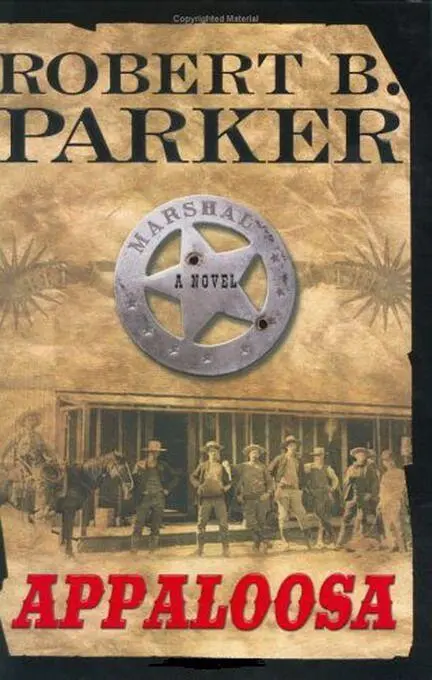
- Название:Appaloosa
- Автор:
- Издательство:Berkley
- Жанр:
- Год:2006
- Город:NY
- ISBN:0-425-20432-4 / 978-0-425-20432-0
- Рейтинг книги:4 / 5. Голосов: 1
-
Избранное:Добавить в избранное
- Отзывы:
-
Ваша оценка:
Appaloosa: краткое содержание, описание и аннотация
Предлагаем к чтению аннотацию, описание, краткое содержание или предисловие (зависит от того, что написал сам автор книги «Appaloosa»). Если вы не нашли необходимую информацию о книге — напишите в комментариях, мы постараемся отыскать её.
It was a long time ago, now, and there were many gunfights to follow, but I remember as well as I remember anything the first time I saw Virgil Cole shoot. Time slowed down for him. Always steady, and never fast...
When it comes to writing, Robert B. Parker knows no boundaries. From the iconic Spenser detective series and the novels featuring Sunny Randall and Jesse Stone, to the groundbreaking historical novel Double Play, Parker's imagination has taken readers from Boston to Brooklyn and back again. In Appaloosa, fans are taken on another trip, to the untamed territories of the West during the 1800s.
When Virgil Cole and Everett Hitch arrive in Appaloosa, they find a small, dusty town suffering at the hands of renegade rancher Randall Bragg, a man who has so little regard for the law that he has taken supplies, horses, and women for his own and left the city marshal and one of his deputies for dead. Cole and Hitch, itinerant lawmen, are used to cleaning up after opportunistic thieves, but in Bragg they find an unusually wily adversary-one who raises the stakes by playing not with the rules, but with emotions.
This is Robert B. Parker at his storytelling best.
Appaloosa — читать онлайн бесплатно полную книгу (весь текст) целиком
Ниже представлен текст книги, разбитый по страницам. Система сохранения места последней прочитанной страницы, позволяет с удобством читать онлайн бесплатно книгу «Appaloosa», без необходимости каждый раз заново искать на чём Вы остановились. Поставьте закладку, и сможете в любой момент перейти на страницу, на которой закончили чтение.
Интервал:
Закладка:
He sat down. Judge Callison looked at him for a moment and half smiled.
“Eloquent, Mr. Bragg. But unconvincing,” he said. “I find you guilty of these charges and sentence you to hang at Yaqui Prison at a time to be decided by the prison warden.”
He banged his gavel and said, “Court’s adjourned.”
And that was Bragg’s trial. Stringer and Cole and I and the other deputies took him back to his cell.
30
There was no one at the train siding in Appaloosa. The westbound train to Yaqui was twenty minutes late, and by the time we got Bragg, in handcuffs and leg shackles, onto the train and into the last passenger car, it was 6:20 in the morning. Cole sat beside him, and I sat across the aisle with Stringer and his three deputies in front of us. All of us were yawning. I had a shotgun; everyone else had Winchesters. All of us carried sidearms. There was no one else in the car except a couple of drummers up front, both of whom were asleep.
The conductor came through. Stringer gave him a county voucher for all of us.
“Be about seven hours to Yaqui,” the conductor said. “Be stopping for water at Chester.”
Cole nodded.
Stringer said, “I know. I’ve done this before.”
The conductor looked at Bragg.
“He ain’t going to be no trouble, is he?” the conductor said.
“If he is, it won’t be for long,” Cole said.
Bragg stared out the window as the train slowly began to move, and he kept looking as we picked up speed. I had not heard him say anything since the trial. Cole ignored him.
“Anything gonna happen,” Cole said to me, “it’ll be at Chester. Takes ’em a while to fill that boiler, and we’re pretty much sitting ducks while they do.”
“That why we’re along?” I said. “Because you think something might happen.”
“Yep. Usually, I’d just let them boys take him over to Yaqui.”
“You think it’ll be the Sheltons?”
“Yep.”
I looked at the four deputies.
“These are four pretty good boys, Virgil.”
“They are,” Virgil said.
The train moved heavily along the tracks that ran beside the river, across Bragg’s ranch. We could see the ranch house and some of the outbuildings off to the right side of the train. I thought for a minute what it might be like to sit in shackles on your way to hang and look out at your home and not be able to go there. I decided there was nothing to be gained thinking about that, so I stopped. A few of Bragg’s steers stood near the tracks, staring at us as we went by.
We stayed in the flatlands pretty much, following the course of the river, the tracks snaking along around the hills. Out the left side, at a distance, I could see the Appaloosa stallion herding his mares toward a draw. The sun was higher now, and the train was getting warm. One of the deputies opened the windows that would open and let the air move in as we chugged along. A couple of antelope stood on one of the hills above us as we went west, and on another hill, among the rock outcroppings, six or eight coyotes sat staring down at us, and we bumped and rattled past them. One of the train hands came through after a while and gave us coffee. Bragg, too. All of us took it.
“Be some sandwiches at Chester,” the train hand said.
“How soon?” one of the deputies said.
“Chester? Hell,” he said. “I dunno, ask the conductor.”
The deputy nodded as if he’d expected the answer. A half hour later, the conductor strolled through and took out a big watch and studied it for a minute and told us we’d be in Chester in one hour and thirty-six minutes.
“When we start the upgrade,” the conductor said, “you’ll feel us slow down. It ain’t a hell of a grade, but it’s a long one, and the locomotive labors a little.”
“How long after we hit the grade?” Cole said.
“Ten minutes or so, ain’t far, but the engine’s strugglin’.”
“Anybody there.”
“Nope.”
“Thanks,” Cole said.
I looked at Bragg. He was still staring out the window without expression. If he expected action at Chester, he wasn’t letting on.
“When we get there,” Cole said to me, “I’ll go to the front of the car. You take the rear. Outside. I don’t want us sitting in here like a tom at a turkey shoot.”
“Sure,” I said.
COLE WASthe first to sense the start of the upgrade. Of course. He always knew things first. I hadn’t felt the train slow at all, when Cole was on his feet.
“You boys stay here with the prisoner,” he said to Stringer. “Me ’n Everett will do some recognicence.”
He picked up his Winchester, pointed me toward the back of the train, and walked toward the front. As I walked toward the rear coupling space between my car and the caboose, I could feel the train beginning to lurch up the grade. Virgil disappeared out onto the front. The strong-smelling smoke from the engine streamed back over the train. I held the handrail and swung out and looked ahead. At the top of the rise, I could see the water tower and beside it, higher, the windmill that kept it full. I could also see Virgil’s head as he looked out past the cars in front of us. I scanned the dry scrubland around us. There was nothing moving. The train wasn’t moving fast enough to generate any breeze, and the thick air was oppressive. I turned and looked on the other side of the train. Nothing moved over there, either. There was nothing behind us.
As we went over a small bridge over a shallow dry wash, three riders trailing a saddled, riderless horse on a lead appeared beside the train tracks up ahead. Two of them were the Sheltons; the other, riding between them, was Allie. Ring held the lead from the riderless horse. They rode slowly beside the train letting our car draw even with them. There was a rope around Allie’s neck. The other end was looped around Ring’s saddle horn. On the other side of her, Mackie held a double-barreled shotgun resting on her shoulder, pressed against her neck. Everything slowed down. I could see the locomotive top the rise and level out as it approached the water tower. The train slowed, then halted, with the water spout over the boiler cap. I saw Cole step down from the train and stand stock-still, holding the Winchester, barrel down, in his left hand, looking at the three riders. I realized that I had stepped down, too, still holding the shotgun. There was no movement in the well shack next to the water tower, only the slow revolution of the windmill above it.
The three riders halted in front of Cole. He was motionless. So was I. The fireman had climbed onto the top of the cab to set the spout. He pulled the rope to drop it and stepped back as the water poured in, sending a slash of steam up. When he saw us all, he stopped and stared and stayed put. There was no sound but that of steam hissing from the idle engine.
“You see how this is going to go, Virgil,” Ring Shelton said.
Cole looked at the three riders without any sign. Between the two Shelton brothers Allie looked red-eyed and pale. Her face seemed crumpled.
“Any sign of trouble from anybody,” Ring said, “and Mackie gives her both barrels. The horses will then head off in different directions, and what’s left of her will be yanked off of hers, and her neck will break and she’ll drag for miles through the mesquite. Less Mackie blows her head clean off, then the rope’ll probably slip loose.”
He talked slowly and carefully, as if to be sure everyone understood what was being said. I didn’t move. Cole looked at the three riders, unblinking. Stringer had moved out of the car and stood above the coupling behind Cole. He had his Winchester leveled at Ring. Mackie’s horse swished his tail at a fly that buzzed his flank. He shifted slightly when he did, but Mackie adjusted and the shotgun stayed easy and straight against Allie’s neck.
Читать дальшеИнтервал:
Закладка:
Похожие книги на «Appaloosa»
Представляем Вашему вниманию похожие книги на «Appaloosa» списком для выбора. Мы отобрали схожую по названию и смыслу литературу в надежде предоставить читателям больше вариантов отыскать новые, интересные, ещё непрочитанные произведения.

Обсуждение, отзывы о книге «Appaloosa» и просто собственные мнения читателей. Оставьте ваши комментарии, напишите, что Вы думаете о произведении, его смысле или главных героях. Укажите что конкретно понравилось, а что нет, и почему Вы так считаете.