PENNY JORDAN - Silk
Здесь есть возможность читать онлайн «PENNY JORDAN - Silk» — ознакомительный отрывок электронной книги совершенно бесплатно, а после прочтения отрывка купить полную версию. В некоторых случаях можно слушать аудио, скачать через торрент в формате fb2 и присутствует краткое содержание. Жанр: unrecognised, на английском языке. Описание произведения, (предисловие) а так же отзывы посетителей доступны на портале библиотеки ЛибКат.
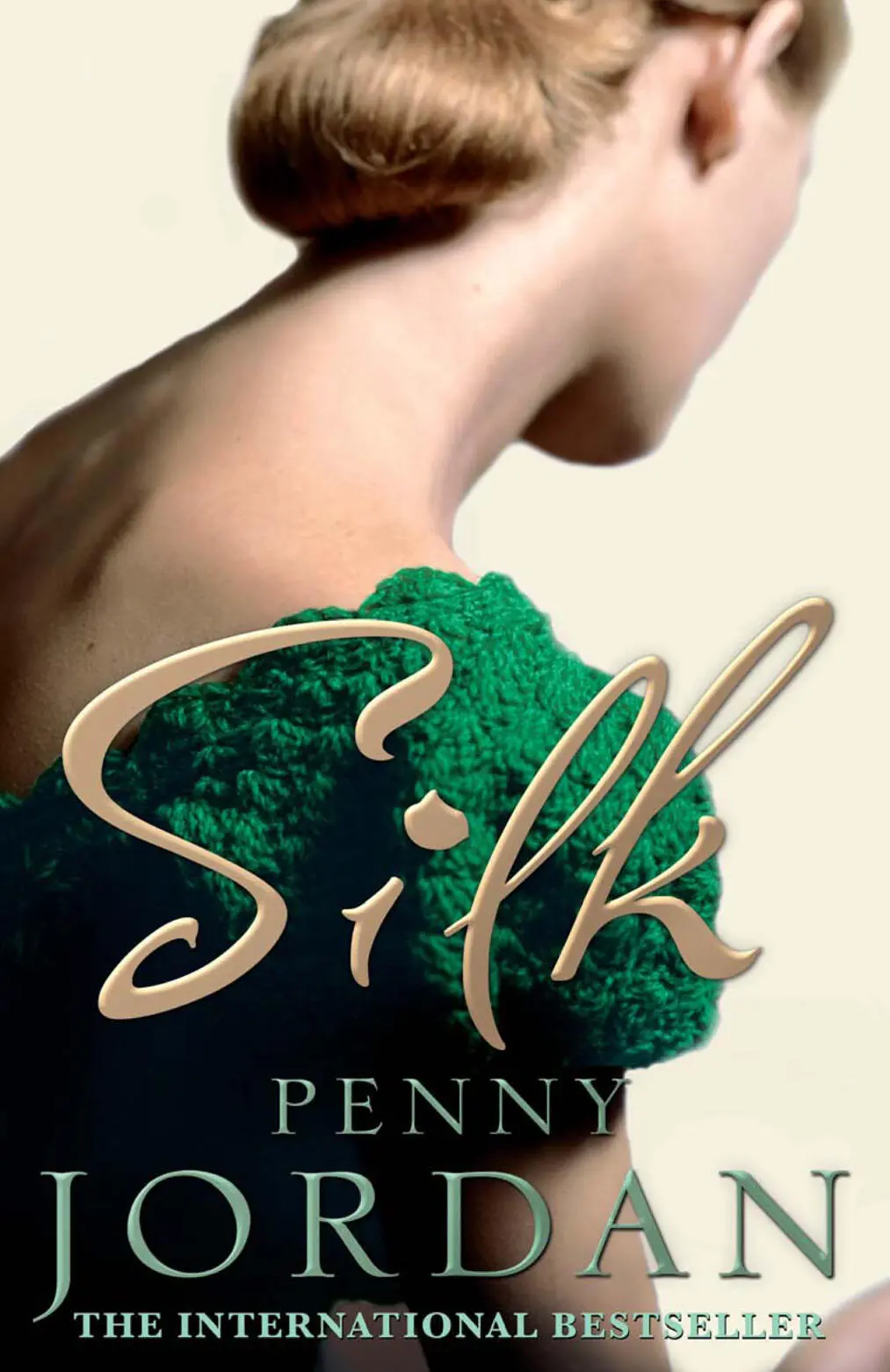
- Название:Silk
- Автор:
- Жанр:
- Год:неизвестен
- ISBN:нет данных
- Рейтинг книги:4 / 5. Голосов: 1
-
Избранное:Добавить в избранное
- Отзывы:
-
Ваша оценка:
Silk: краткое содержание, описание и аннотация
Предлагаем к чтению аннотацию, описание, краткое содержание или предисловие (зависит от того, что написал сам автор книги «Silk»). Если вы не нашли необходимую информацию о книге — напишите в комментариях, мы постараемся отыскать её.
Silk — читать онлайн ознакомительный отрывок
Ниже представлен текст книги, разбитый по страницам. Система сохранения места последней прочитанной страницы, позволяет с удобством читать онлайн бесплатно книгу «Silk», без необходимости каждый раз заново искать на чём Вы остановились. Поставьте закладку, и сможете в любой момент перейти на страницу, на которой закончили чтение.
Интервал:
Закладка:
‘Yes,’ Amber admitted. ‘Louise – that’s Lady Rutland’s daughter – says it’s because I’m not … because I haven’t got … well, she says one needs breeding in order to be able to curtsy properly.’
‘Ah, breeding. Your friend, it seems, has yet to learn that true breeding is a state of mind and cannot be conferred via a coronet.’
He was making fun of her now, Amber was sure of it, but he looked serious.
‘Should we introduce ourselves?’ he asked her. ‘You are … ?’
‘Amber,’ Amber told him shyly. ‘Amber Vrontsky.’
He reached for Amber’s hand, taking it in his own as he stood up and then made a small half-bow.
‘Pray allow me to present myself to you. I am Herr Aubert,’ he told her, adopting a stilted foreign accent that made Amber giggle, in spite of herself. ‘I have the honour to be the world’s best teacher of ze Austrian Curtsy, if you will allow me to demonstrate.’
And then, before Amber could stop him, he released her hand and sank into a perfect curtsy, complete with a simpering expression on his face that made Amber want to laugh again.
‘Come now, Miss Vrontsky, enough of this unseemly levity. You will pay ze attention and copy me, if you please.’
The gallery was empty and, somehow or other, Amber found that she was on her feet too and joining in the game. She dropped into a deep curtsy and then rose from it as effortlessly and as perfectly as though she had been doing it for ever.
Half an hour later, breathless with laughter as her unusual and unrepentant ‘teacher’ insisted she repeat her curtsy half a dozen or more times, Amber shook her head and protested, ‘I can’t do any more. I’ve got a stitch from laughing so much.’
‘Laughing? What is this laughing? You are here to learn ze curtsy. You do not laugh.’
When she did, he feigned outrage, and told her firmly in his normal voice, ‘And now I think we should celebrate your great victory over the curtsy with tea at the Ritz.’
Amber’s face fell. ‘Oh, no, I couldn’t.’
‘Of course you can, and you shall.’
It was very wrong of her to go with him, of course, but somehow or other it was impossible to refuse.
They took a cab to the Ritz, and as they entered, the doorman bowed and said, ‘Good afternoon, Lord Robert. Mr Beaton is waiting for you at your usual table.’
‘Thank you, Mullins,’ he responded, instructing Amber, ‘Come, child.’
Lord Robert, the doorman had called him, Amber noted.
Amber had been to the Ritz before, with her grandmother, but she was still awed by its magnificence.
As they approached the table occupied by another young man, two waiters sprang forward to pull out chairs for them.
‘Cecil, my dearest.’ Lord Robert was speaking in a lazy drawl now, and it seemed to Amber that his whole manner had changed subtly. No longer was it teasing and amused but instead, languid and elegant. ‘I am sorry to be late but you will forgive me when you learn that I have been the saviour of this poor wretched child.’
‘It is not a child, Robert, it is a young woman,’ the other man’s voice was waspish.
‘Ah, yes, but a young woman who studies Lorenzo’s portrait because she wishes to analyse the quality of his silk coat. I suspect she fears that such a vivid shade owes more to the artist’s palette than the dye shops of Bruges.’
‘Indeed.’ This was said with a sharp glance in Amber’s direction.
‘Cecil here is obsessed with colour, princess – the poor models he photographs for Vogue are driven to madness by him.’
Cecil? This was Cecil Beaton! She was actually in the presence of the great photographer whose work she had gazed at with such admiration in Vogue . Amber was tongue-tied with awe.
‘You are talking nonsense, Robert. Now tell me properly, who is this child?’ the photographer demanded.
Amber gave Lord Robert a pleading look but it was no use.
‘She is Amber Vrontsky, her father was Adam Vrontsky, and she is to be one of this season’s débutantes. I found her in tears in the gallery over the ordeal of The Curtsy. However, now all is well, isn’t it?’ There was a look of wicked amusement in the beautiful man’s eyes.
‘A Vrontsky? Indeed?’ Cecil Beaton’s gaze had narrowed. ‘Well, child, was your father the prince or the count, because I recollect that they share the same name.’ He was opening his cigarette case as he spoke to her, offering it to her. Amber shook her head, watching as he turned to Lord Robert, who took one of the Black Russian cigarettes.
‘My father was neither,’ she told the photographer, who was watching her, his eyes narrowed as he blew out a cloud of strongly scented smoke. ‘He was an artist and fabric designer.’
She held her breath, waiting for the familiar disdain, but after the merest indrawn breath, Cecil Beaton said smoothly, ‘A prince amongst men indeed then.’
‘Yes, he was,’ Amber agreed proudly. ‘And I wish more than anything else that my grandmother would have let me go to art school as he wanted.’
‘You wish to become an artist?’
‘No,’ Amber replied. ‘I want to do what my father did and create new designs for our silk – my grandmother owns a silk mill.’
The tea things arrived, and after their tea had been poured the two men began discussing a social event they were both attending, leaving Amber free to study her surroundings, whilst keeping one ear on their conversation. Here and there she managed to grasp a name, only to recognise with awe that it belonged to someone famous, but for Amber, far more exhilarating and exciting than the conversation were the women’s clothes, and her senses fed greedily on them. What had previously been only sketches and photographs she had seen in Vogue had come alive, moving with the bodies they were adorning. She felt a pang to see Chanel’s jersey demanding obeisance to its dominance, as virtually everyone seemed to be wearing it, but then she saw a woman walking in wearing Schiaparelli and she was lost, her breath catching and her gaze bewitched by the fluid movement of the silk dress with the most beautifully cut and elegant matching silk jacket worn over it. Everything and everyone else was forgotten as Amber absorbed every detail, her heart pounding in homage to both the fabric and the creative genius of the designer.
‘You prefer the Schiaparelli to the Chanel?’
Amber was startled. She had been so engrossed in the outfit that she hadn’t seen Cecil Beaton turn towards her.
‘It’s silk,’ she told him simply, ‘and the colour …’ She shook her head, unable to find the words to explain the effect of seeing such stunningly vibrant colour at first hand instead of merely seeing a sketched impression of it in a magazine. It was so strong, so powerful, that it almost had its own physical presence. To get an acid yellow so pure was a work of art in itself.
‘I was wondering what dye they used. I’ve seen the outfit in Vogue but I hadn’t realised how different the reality would be.’ Just in time she realised that the photographer was looking slightly offended and assured him truthfully, ‘Your photographs are wonderful and truly capture the reality in a way that a sketch cannot.’
Lord Robert had summoned a waiter and was ordering cocktails.
‘Dubonnet and gin for Mr Beaton and myself,’ he told the waiter, ‘half and half, and shaken very cold, and, er, a lemonade for the young lady.’
‘That is why photographs are the future of fashion magazines.’ Cecil Beaton was smiling approvingly at Amber now. ‘I keep on telling Vogue this, but do they listen to me? No, they do not, because they cannot move with the times. They are fools, but I shall be proved right. The camera can capture reality so much more sharply and clearly than a workaday draughtsman with his tubes of paint. Schiaparelli’s gowns are a case in point. As you have just said, it is impossible to replicate the true colour of her clothes without a camera. She is, of course, a true artist and a gifted one, but be warned, child, if you are looking to her for the future of your silk, then you are looking in the wrong place. It is my belief that Chanel, with her practical jersey and her clever mock simplicity, holds the key to the future of fashion. If you will take my advice you would be wise to direct your attentions towards silks that can be used to ornament the home rather than the human body.’
Читать дальшеИнтервал:
Закладка:
Похожие книги на «Silk»
Представляем Вашему вниманию похожие книги на «Silk» списком для выбора. Мы отобрали схожую по названию и смыслу литературу в надежде предоставить читателям больше вариантов отыскать новые, интересные, ещё непрочитанные произведения.







Обсуждение, отзывы о книге «Silk» и просто собственные мнения читателей. Оставьте ваши комментарии, напишите, что Вы думаете о произведении, его смысле или главных героях. Укажите что конкретно понравилось, а что нет, и почему Вы так считаете.