Jonathan Buckley - Ghost MacIndoe
Здесь есть возможность читать онлайн «Jonathan Buckley - Ghost MacIndoe» — ознакомительный отрывок электронной книги совершенно бесплатно, а после прочтения отрывка купить полную версию. В некоторых случаях можно слушать аудио, скачать через торрент в формате fb2 и присутствует краткое содержание. Жанр: unrecognised, на английском языке. Описание произведения, (предисловие) а так же отзывы посетителей доступны на портале библиотеки ЛибКат.
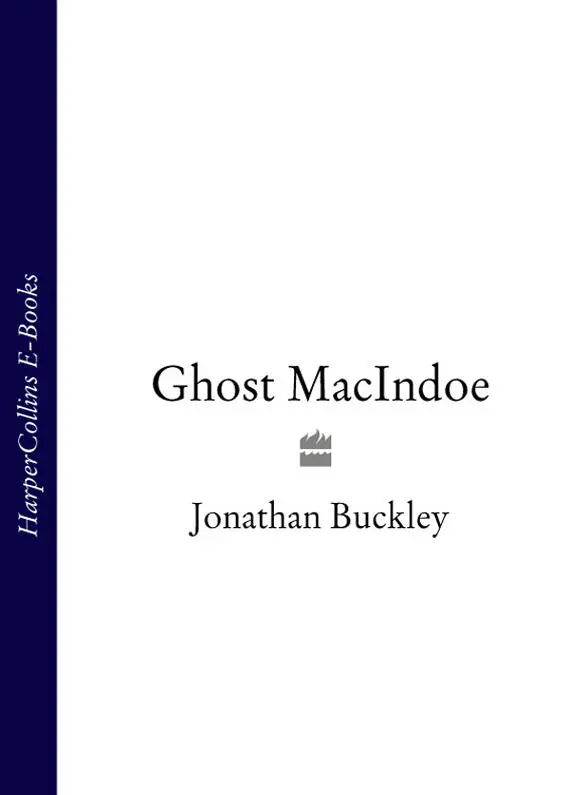
- Название:Ghost MacIndoe
- Автор:
- Жанр:
- Год:неизвестен
- ISBN:нет данных
- Рейтинг книги:4 / 5. Голосов: 1
-
Избранное:Добавить в избранное
- Отзывы:
-
Ваша оценка:
Ghost MacIndoe: краткое содержание, описание и аннотация
Предлагаем к чтению аннотацию, описание, краткое содержание или предисловие (зависит от того, что написал сам автор книги «Ghost MacIndoe»). Если вы не нашли необходимую информацию о книге — напишите в комментариях, мы постараемся отыскать её.
Ghost MacIndoe — читать онлайн ознакомительный отрывок
Ниже представлен текст книги, разбитый по страницам. Система сохранения места последней прочитанной страницы, позволяет с удобством читать онлайн бесплатно книгу «Ghost MacIndoe», без необходимости каждый раз заново искать на чём Вы остановились. Поставьте закладку, и сможете в любой момент перейти на страницу, на которой закончили чтение.
Интервал:
Закладка:
‘Would I be disturbing you, son and heir?’ his father enquired, in the butler’s voice he often used when he was joking. ‘I would not? Well and good. We shall study together,’ he replied to Alexander’s smile, and he placed the chair on the patch of concrete to the side of the kitchen door, under the honeysuckle that grew across the wall that year. He went back inside and emerged again with a sheaf of square-ruled paper and the big tin tray, which he laid across the arms of the chair to make a desk. ‘This is very agreeable,’ he remarked, examining the point of a pencil approvingly. He unbuttoned his collar and slipped his feet out of his broad-strapped sandals.
Askance Alexander watched his father working, drawing graphs and reckoning figures across the gridded paper, placing the completed sheets neatly upon the pile underneath the chair. His mother brought a pitcher of lemonade and poured a glass for each of them; his father kissed her fingers and his mother made a curtsy, holding out the hem of her dress so the shape of a leg showed through the red and white checks, as Alexander would remember.
‘Alexander, come inside when you’ve finished your drink,’ she said.
‘He’s fine, Irene,’ said his father. ‘Quiet as a monk, aren’t you?’
So Alexander continued to roam the pink expanses of the maps, measuring the distances between names that seemed to have been invented for their melody, tracing systems of rivers that looked like roots. From time to time he turned to the first page of the atlas, where his great-grandfather’s name was written in a script that resembled blades of grass, with ink that was chestnut brown and gave the book an aura which the name of Duncan Manus MacIndoe deepened with its ancient, clannish sound. With a forefinger he stroked the loops and limbs of the writing, as if to encourage a visible presence to rise like a genie from the paper.
Occasionally his father broke the silence, stopping his pencil and enquiring quietly, without looking up: ‘Eight times thirteen?’ or ‘Twenty-two nines?’ or some other sum. Alexander would give his answer, and whenever the answer was correct his father would say, with pretended briskness and still without looking at him, ‘Carry on,’ then get back to his work.
Late in the afternoon the clouds began to cluster on the city side of the sky. Alexander watched the sun fall behind them, turning parts of them to tangerine foam as it sank. The white shirts on the neighbours’ washing line, hanging with arms raised in the breezeless air, took on the tint of skin. As if soaking a dye from the horizon, the clouds became tangerine right through, a colour that brought to Alexander a sensation that seemed a foretaste of the pleasure he would have at the funfair that evening. It was a sensation so strong that for many years this quality of sunlight in a cumulus sky would elicit a moment of anticipatory happiness, and sometimes he would glimpse the tomato-red metal panels of the merry-go-rounds under loops of electric bulbs, and hear the jubilant, malicious music of the steam organ above the hum of the generators.
Following his father, he passed between the caravans that formed a wall around the fair, and stepped onto grass that had been mashed into arrowhead tracks and heel shapes. Beside the Hall of Mirrors there was a coconut shy, where his father handed his jacket to Alexander before hurling three wooden balls into the netting behind the coconuts, and close by was a stall at which his mother threw two black rubber rings at hooks on a wall that was painted with red fish, then handed the third ring to Alexander, whose throw struck a hook and bounced off. They bought toffee apples from a man with blurred tattoos of a dagger and a red snake on his right arm. Standing by the test-your-strength machine, Alexander raised his half-eaten apple in the direction of the Big Wheel.
‘Can we go on that?’ he asked.
‘You’re not getting me on that, I can tell you that right now,’ said his mother to his father.
‘Can I go?’ Alexander asked his father.
‘You wouldn’t like it,’ his father told him.
‘Have you been on one?’
‘No.’
‘Then how do you know I wouldn’t like it?’
‘I know.’
‘How?’
‘Don’t be contrary, Alexander,’ said his mother.
‘No, he’s right,’ said his father, raising one forefinger in judgement. ‘But don’t say you weren’t warned. You’ll get no sympathy from me if you get up there and find it’s too high. Do you want me to go on with you?’ his father asked, in a tone that Alexander took as a challenge.
‘Not if you don’t want to,’ Alexander replied, and his father pressed a couple of coins into his hand, as if he were handing over an important message for him to deliver.
A woman with curlers in her hair took the money. ‘Just for you, lover?’ she asked, letting the coins slide down her hip into the pouch that was slung across her dress. Alexander looked at his mother, who looked at his father, who was studying the wheel. ‘Shouldn’t really, you being a little ‘un,’ said the woman; then, after a teasing pause, ‘but go on.’ She touched his cheek with her inky fingertips as he crossed the steel ramp to the empty car. ‘Hold tight,’ she told him, pressing his hands onto the iron bar that she fastened across his belly, and then she turned towards the man in the sentrybox at the foot of the ramp and cried ‘Up and away,’ letting her voice trail off like someone falling a long distance.
With a jolt he rose backwards and in a second he was above the stalls and then pitching down towards them, through air that smelled of onions and hot sugar. His parents appeared and receded, and he looked over his shoulder, down on the tarpaulin roofs, which glowed like multicoloured lampshades. He saw the gigantic shadows of the stallkeepers quivering on the tents as he swooped towards his parents. At the top he looked across the fairground, and was fascinated to see how orderly it appeared from this height, but the wheel was now gathering speed. A wind was whirring in his ears. Becoming frightened, he closed his eyes. The car swung as it was flung over the apex, and swung again at the end of its fall. A woman in a car behind him let out a gleeful yell, urging the wheel to turn faster. Alexander screwed his eyes so tightly shut that he could no longer sense the fairground lights. He heard his mother’s voice say his father’s name. ‘Make it stop. Please make it stop,’ he prayed, and then it did stop.
The car rocked, suspended at the start of its descent. On the rim of the footplate a line of red lightbulbs bobbed like fishing floats, then came to rest. Under him something metallic clanged against another piece of metal. The wheel juddered forward an inch, another inch, another inch, and stopped again. ‘Alexander!’ his mother cried out. She ran into his sight, waving her arms; miniature black cars circled behind her, on a roundabout for small children. ‘Keep calm,’ she called. ‘Alexander. Can you hear me? They’ll get it going in a minute. Stay calm, Alexander. Stay calm,’ she kept repeating, but there was no need, for he was no longer upset, not in the slightest. He gazed over the Heath, where the blades of grass seemed to stand to attention in the headlights of the cars, and then he surveyed the fairground, carefully, as if it were an interesting picture spread out below him. Here and there stood groups of people who were looking in his direction; new groups were forming on every path, and from the farther parts of the fairground they were coming nearer. The hats and headscarves moved between the stalls like leaves flowing on water towards a drain. Over the wall of the park he could see the paths that ran under the black foliage of the trees. Wings clattered somewhere among the leaves, but no birds appeared; he imagined the grass alive with nocturnal animals, foraging on the slopes where people cycled in the day. The park was transformed into an enclave of forest, but he understood that he could only observe this forest and never be in it, because it would cease to be a forest if anybody was in it. He told himself that he would be happy to stay all night where he was, and see the sun come up over the houses, and the park become a park again.
Читать дальшеИнтервал:
Закладка:
Похожие книги на «Ghost MacIndoe»
Представляем Вашему вниманию похожие книги на «Ghost MacIndoe» списком для выбора. Мы отобрали схожую по названию и смыслу литературу в надежде предоставить читателям больше вариантов отыскать новые, интересные, ещё непрочитанные произведения.





Обсуждение, отзывы о книге «Ghost MacIndoe» и просто собственные мнения читателей. Оставьте ваши комментарии, напишите, что Вы думаете о произведении, его смысле или главных героях. Укажите что конкретно понравилось, а что нет, и почему Вы так считаете.