Gordon Stevens - Peace on Earth
Здесь есть возможность читать онлайн «Gordon Stevens - Peace on Earth» — ознакомительный отрывок электронной книги совершенно бесплатно, а после прочтения отрывка купить полную версию. В некоторых случаях можно слушать аудио, скачать через торрент в формате fb2 и присутствует краткое содержание. Жанр: unrecognised, на английском языке. Описание произведения, (предисловие) а так же отзывы посетителей доступны на портале библиотеки ЛибКат.
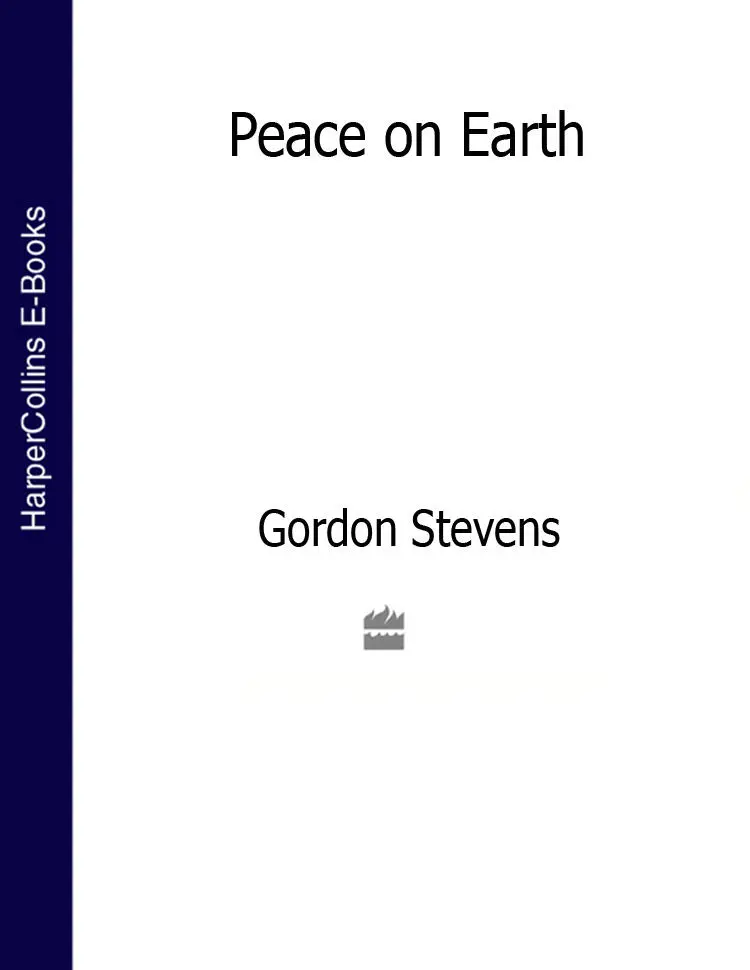
- Название:Peace on Earth
- Автор:
- Жанр:
- Год:неизвестен
- ISBN:нет данных
- Рейтинг книги:3 / 5. Голосов: 1
-
Избранное:Добавить в избранное
- Отзывы:
-
Ваша оценка:
Peace on Earth: краткое содержание, описание и аннотация
Предлагаем к чтению аннотацию, описание, краткое содержание или предисловие (зависит от того, что написал сам автор книги «Peace on Earth»). Если вы не нашли необходимую информацию о книге — напишите в комментариях, мы постараемся отыскать её.
Peace on Earth — читать онлайн ознакомительный отрывок
Ниже представлен текст книги, разбитый по страницам. Система сохранения места последней прочитанной страницы, позволяет с удобством читать онлайн бесплатно книгу «Peace on Earth», без необходимости каждый раз заново искать на чём Вы остановились. Поставьте закладку, и сможете в любой момент перейти на страницу, на которой закончили чтение.
Интервал:
Закладка:
He followed the line of passengers off the plane, through the walkways and connecting doors, and into the large impersonal hall lined, at the far end, by the immigration desks. Four queues, he saw immediately, knowing he would have no problem, looking anyway for his insurance. The queues were longer than he had anticipated, with three officials on duty at each desk. Normally two, he thought, wondering why the security was tighter than he had expected, and glanced again at the desks. One official checking passports, a second looking over his shoulder at the person at the desk, looking for the tell-tale signs, the third concentrating on the queue itself. He moved forward, wondering again about the increase in security and looking again for the insurance he needed.
A flood of passengers from another flight began spilling into the hall. There was a moment of confusion as the new group mingled with those already in the hall, deciding which queue to join. He looked round, ignoring the mêlée, and saw the woman. She was young, in her mid-twenties, of Arab appearance, with olive skin and dark piercing eyes, taller than average with long black hair. She also had the one quality above all, the single characteristic he was looking for: that of arrogance. In the way her eyes flashed, the way she held herself. He knew the men at the desks were already looking at her.
The woman was moving towards the third queue from the far side of the hall. He hurried after her, waited till she had almost joined the queue, then stepped in front of her, almost bumping into her. He turned and apologised, politely, not friendly. The queue moved forward. He knew again they had already seen her, already singled her out. The queue to his right was moving faster, already growing shorter. Stay behind me, he spoke silently to the woman, stay where you are, give me cover. The queue shuffled forward, he reached the desk, gave the official his passport, entry visa on page five.
‘Name?’ The voice was harsh. He knew the other two men at the desk were looking at the woman and gave the name in his false passport.
‘What are you doing in London?’
‘Business. I’m a petroleum analyst.’ He thought about the appointments he had arranged in case they questioned him, knew it was a formality, felt himself relax, did not let it show, controlling the degree of eye contact that would give the woman away even though she was entirely innocent. Abruptly the official stamped his passport, snapped it shut and handed it back to him. Forty-five minutes later he had retrieved his one suitcase, cleared customs, collected his hire car, and was driving down the M4 motorway into London. Behind him, he knew, the first tentacles of the security net were beginning to tighten round the woman, the first arrangements for a Special Branch surveillance, the first requests, formal or informal, for a telephone intercept wherever she was staying.
By two thirty he had checked in at the Holiday Inn in Swiss Cottage, unpacked his suitcase and showered. The telephone in the room was direct dial. He checked the number he had been given in Damascus, and phoned the London office of the Palestine Liberation Organisation in Green Street.
‘Good afternoon,’ he spoke politely. ‘This is Mohsen Masri from An-Nahar. ’ He named a prominent Middle Eastern publication. ‘Is it possible to speak with Mr Nabulsi?’
The receptionist was equally polite. ‘I’m sorry, Mr Nabulsi is away at the moment, can anyone else help?’
He thanked her, but said he needed to speak to the PLO representative personally and asked when she suggested he should phone again.
‘He flies in tomorrow and will be back in the office on Friday. Can I get him to contact you then?’
‘Don’t worry.’ Haddad kept his voice friendly and informal. ‘I’ll try him then.’
‘Make it early,’ she answered. ‘He’s busy after eleven.’
He thanked her and put the phone down. Abu Nabil was right, he thought, Abu Nabil was always right.
The traffic in London’s West End, where the offices of the PLO were situated, was congested, made worse by Christmas. It took Haddad twenty minutes to drive from the hotel to the office and another ten to find a parking space, even though it was on a yellow line. If a traffic warden came, he knew he would only have to move.
The black Ford Granada was parked outside the building which housed, amongst other offices, that of the London office of Yasser Arafat’s faction of the Palestinian movement. It was interesting, he thought, that the chauffeur came to work even when the representative himself was away, even more interesting that he came in the Granada. On a car radio he heard the sound of a Christmas carol. He waited, lost in the crowd of shoppers, the afternoon losing its light and the Christmas lights already on, shining in the dusk.
At five o’clock a man he supposed was the chauffeur left the building and unlocked the car. The man, he noted, checked neither around nor underneath the vehicle. Either, he imagined, because the car was visible from the front windows of the PLO office, or because the man assumed that because the representative was away, there was no security risk.
It was interesting, thought Haddad, how often people made the wrong assumption.
The traffic was heavy. He followed the car across Oxford Street, skirting behind Marylebone station and through the side streets to the west of Regent’s Park. At the intersection on the corner dominated by the cricket ground at Lord’s, he had checked on the street map, the chauffeur should drive straight on, towards the representative’s house in St John’s Wood and the security of the garage, electronically protected, at the side of the house. He knew what the man would do, that when the end came it would be so sudden and unexpected that the chauffeur would have no time to question when he had made his mistake. In front of him, the man turned right, away from St John’s Wood, towards Camden Town.
Ten minutes later Haddad watched the chauffeur reverse the Granada into the garage below the mews flat where the man lived with his wife. In front of the entrance to the flat was a Ford Escort which he assumed was their own vehicle. He parked the hire car and walked down the mews, the air cold, his hands pushed into his pockets, taking his time, as if he had every right to be there. The chauffeur was concentrating on his driving, taking care not to scratch the Granada as he backed it into the narrow space, giving Haddad plenty of time to see what he needed to know. No security, no tell-tale wires, not even a burglar alarm, or the pretence of one. Just the wooden door with the Yale lock.
He returned to the hotel, had another coffee, and waited till it was time to make the telephone call. The same number, Nabil had instructed him, the same time each evening.
At seven o’clock exactly he dialled the number. To his surprise, the voice which answered was American. West Coast, he thought. ‘Hello, John,’ he began, using the names of the code. ‘Is that you?’
‘Yes,’ replied the American in the public telephone kiosk. ‘Is that you, Peter?’ The same public telephone kiosk, his masters in Belfast had told Jimmy Roberts, the same time each evening.
‘Yes, it’s Peter.’ Haddad wondered why it surprised him that the IRA contact was an American. Definitely West Coast, he was thinking, the accent too soft to be anywhere else.
Roberts waited for the next part of the code, and wondered why the IRA should give a bomb to the Arabs, why the Arabs needed it, had asked for it specifically, even the type, when he knew they had plenty of their own.
The same thought had occurred to Haddad when he had been briefed by Nabil in Damascus. He had not queried it, assuming there was a reason; with Abu Nabil there was always a reason. ‘Look, John,’ he continued the coded conversation, ‘I’ve got a couple of girls and I need someone to help me out with them.’
Читать дальшеИнтервал:
Закладка:
Похожие книги на «Peace on Earth»
Представляем Вашему вниманию похожие книги на «Peace on Earth» списком для выбора. Мы отобрали схожую по названию и смыслу литературу в надежде предоставить читателям больше вариантов отыскать новые, интересные, ещё непрочитанные произведения.











Обсуждение, отзывы о книге «Peace on Earth» и просто собственные мнения читателей. Оставьте ваши комментарии, напишите, что Вы думаете о произведении, его смысле или главных героях. Укажите что конкретно понравилось, а что нет, и почему Вы так считаете.