Tony Abbott - The Forbidden Stone
Здесь есть возможность читать онлайн «Tony Abbott - The Forbidden Stone» — ознакомительный отрывок электронной книги совершенно бесплатно, а после прочтения отрывка купить полную версию. В некоторых случаях можно слушать аудио, скачать через торрент в формате fb2 и присутствует краткое содержание. Жанр: unrecognised, на английском языке. Описание произведения, (предисловие) а так же отзывы посетителей доступны на портале библиотеки ЛибКат.
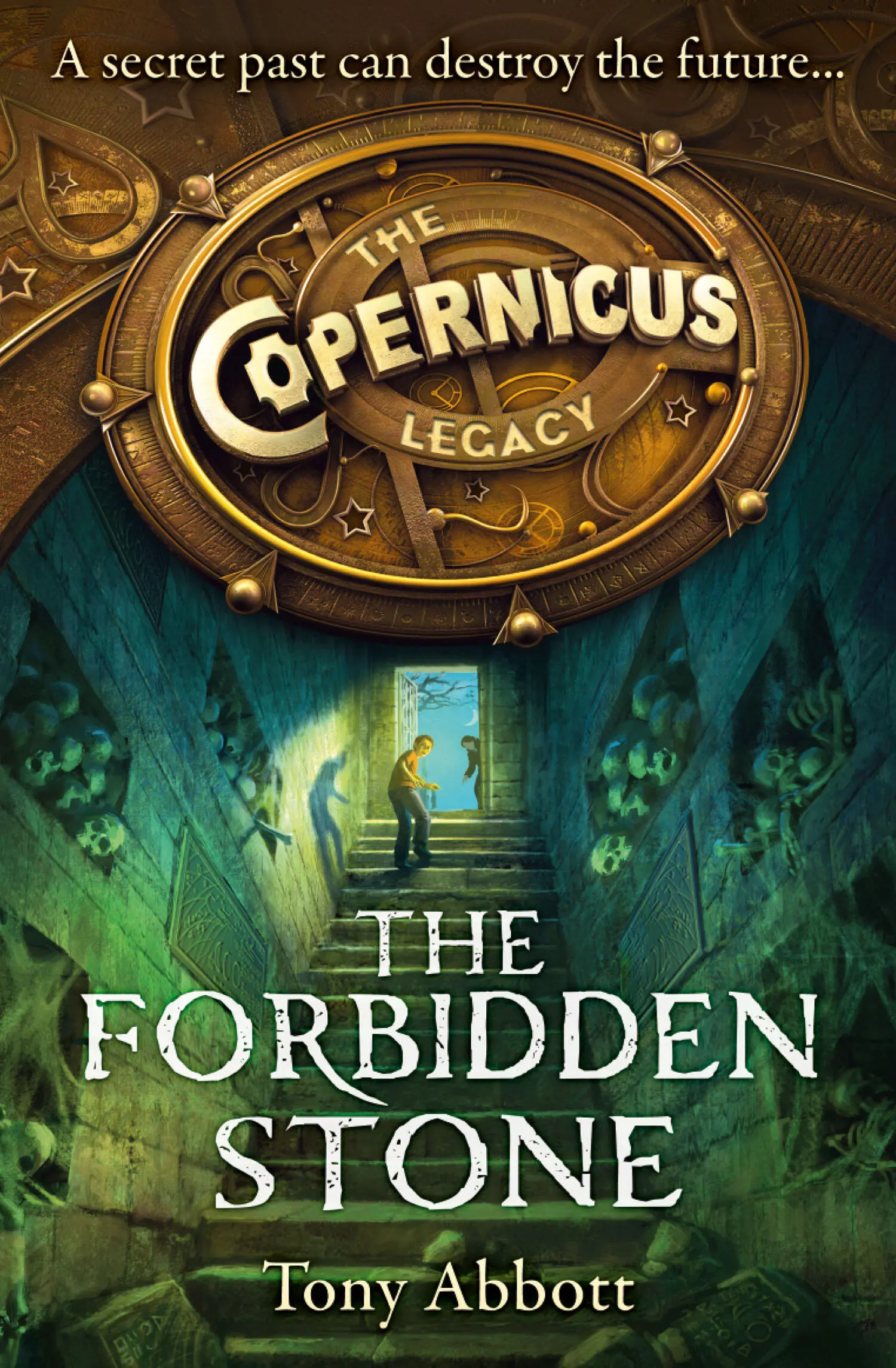
- Название:The Forbidden Stone
- Автор:
- Жанр:
- Год:неизвестен
- ISBN:нет данных
- Рейтинг книги:5 / 5. Голосов: 1
-
Избранное:Добавить в избранное
- Отзывы:
-
Ваша оценка:
The Forbidden Stone: краткое содержание, описание и аннотация
Предлагаем к чтению аннотацию, описание, краткое содержание или предисловие (зависит от того, что написал сам автор книги «The Forbidden Stone»). Если вы не нашли необходимую информацию о книге — напишите в комментариях, мы постараемся отыскать её.
The Forbidden Stone — читать онлайн ознакомительный отрывок
Ниже представлен текст книги, разбитый по страницам. Система сохранения места последней прочитанной страницы, позволяет с удобством читать онлайн бесплатно книгу «The Forbidden Stone», без необходимости каждый раз заново искать на чём Вы остановились. Поставьте закладку, и сможете в любой момент перейти на страницу, на которой закончили чтение.
Интервал:
Закладка:
“Heinrich was a good man,” Roald said firmly. “A good human being. Let’s pay our respects. And then we’ll see what we see. You’re right about not being any trouble, Lily. You four are not leaving my sight. Not for a second.”
He breathed calmly, smiled at each of them, then slid his student journal from his jacket pocket, pulled his glasses up, and started reading.
The food carts began rattling down the aisle, and Becca leaned back to read Moby-Dick . She stopped pages later when the ship’s crew neared the environs of the great white whale.
With greedy ears I learned the history of that murderous monster against whom I and all the others had taken our oaths of violence and revenge.
Monster . Moby Dick was a giant whale, a sea monster. As she read the words over, she wondered once again what Uncle Henry meant in his message when he said kraken .
For as long as he could stand it, Ebner von Braun was immersing the thin burned fingers of his left hand in a bowl of ice water that he carried with him.
Ceramic. Venetian. Thirteenth century.
Four very odd years with Galina Krause had taught him something of the arts of ages past. “Use this,” she had said, a baffling act of compassion, he’d thought, until she added, “and stop whining about your disgusting fingers.”
The elevator stopped. Subbasement Three.
The door slid aside and, as usual, the dull white ceiling lights of the laboratory made him oddly nauseated. The lab smelled of temperature control, clean-room disinfectant, and fear.
Not to mention the infernal buzzing, a white noise that Ebner wasn’t certain came from the lab or from him. His ears had begun to ring nearly four years earlier, after one of the Order’s experiments. It was now like a continuous waterfall of ball bearings from a great height into the center of his head. The sound was always there. An evil companion. A familiar spirit, as the old stories of Doctor Faustus termed it.
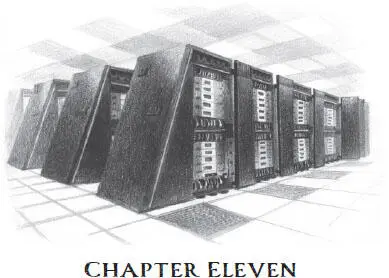
Like seven similar installations across the globe, this control room was large and white and completely devoid of personality. Unless you counted the artfully unshaven young scientist sitting at a long bank of computers.
Ebner had chosen Helmut Bern from the most brilliant of recent graduates, but while he was certain of Bern’s uncommon talent for digital surveillance and electronic decryption, Ebner was still unsure about the darkness of the young man’s soul. He watched the slender hands move over the keyboard. Swift, yes. Accurate, undoubtedly. But how dedicated?
“Sir?” Helmut said, twisting his chair around.
“Is the computer ready?”
“It is, sir.” The young scientist tapped a slim silver briefcase on the counter next to him. “It contains everything you requested. Battery life is essentially infinite. No blind spots anywhere across the globe. I’m curious, why did you have me construct such a thing at this particular time?”
Ebner glared. “You’re curious? I’m curious. Have you reconstructed Vogel’s hard drive?”
Seeming disappointed, the scientist glanced at the ceramic bowl Ebner cradled in the crook of his arm. “Very soon. Sir.”
On the neighboring monitor was a live-camera feed of the former Edificio Petrobras in Rio de Janeiro. Construction crews and crime scene investigators swarmed the crumbled gray stone and glass in what Ebner knew would be a futile effort to find the cause of the collapse.
“Vogel’s final email?”
“Coded.”
“Crack the code.”
“By morning.”
“Morning?”
“At the latest.”
While Ebner might have adored the speed of this conversation in a film, spare questions and clipped commands were his thing.
Young Helmut Bern, no matter how brilliant he may have been in his own unshaven way, had no business mimicking his style. It stunk of irony. Only those in command were allowed the privilege of irony. Workers, no matter how little or how much they were paid, were still workers, unwashed masses of common folk, and their duty was to obey him with smarmy respect. Even sniveling was preferable to snarkiness.
Smiling to himself, Ebner drew his hand from the ice bowl, shook his fingers, and set the bowl on the young scientist’s desk. Slowly, he took out from his breast pocket a blue leather-bound notebook, turned to the first blank page, and wrote the name “Helmut Bern.” Next to it he set down the words “Iceland. Station Four.” He added a question mark for good measure and closed the notebook.
“The tanker off the coast of Cypress?”
“Good news,” Bern said, clacking his keyboard. The image dissolved into text, and he read from it. “Our divers have already made contact with the hull, and undersea building has begun. Habitation can occur as early as next week. Would you care to examine our current experiment?”
So many experiments. So many missions around the world undertaken on Galina Krause’s specific orders. His ears shrieked.
“The Australian Transit? Yes.” Ebner stepped toward the inner laboratory. It was walled in tinted glass to shield the radioactivity of the light beams.
“Excuse me, Doctor …?”
Ebner paused, half turned his head. “Yes?”
“The twelve items. I mean, why now? After all this time.”
Ebner wondered if he should say anything. Would it be unguarded to speak? Silence was a kind of power, after all. Miss Krause had taught him that.
But bringing someone into your confidence, that was power, too. He decided, for the moment, to be distant. “Miss Krause recognizes an urgency. There is a singular alignment of causes.”
Helmut Bern stroked his unshaven chin. “Do you mean to say there is a timetable?”
I say what I mean to say!
Ebner brushed it off. “Life is a timetable. You should concern yourself with your own.” He liked the way that sounded, even if he was unsure exactly what it meant. It had its desired effect nevertheless. Helmut Bern bit his tongue, turned to the screen, and said no more.
Ebner walked through the open door of the inner lab.
The gun—if he could call it that, a ten-foot spoked wheel of platinum alloy in whose center stood a long, narrow cylinder of steel, coiled with a helix of ultrathin glass fiber—occupied one half of the room. In the other sat a cage of white mice, the most intelligent of their experimental patients. Ebner laughed to himself. Little good will intelligence do them where they’re going.
The elevator door slid aside in the first room. The nameless driver leaned in, spotted Ebner. “Time,” he said.
Ebner withdrew from the inner laboratory.
Time. It’s always time.
He passed Helmut Bern’s desk, dipped his hand into the bowl of lukewarm water, removed it, and shook the drops from his fingers. “I must return this priceless bowl to Miss Krause now,” he said, staring down at Bern. “It must be empty.”
“Sir?”
“Remove the water,” Ebner said as softly as he could.
Bern pushed back his chair. “Sir?”
“Here. Now.”
The young unshaven scientist, glancing from the nameless driver at the door to Ebner, lifted the bowl. He brought it to his lips and drank down the water.
“You’re welcome,” said Ebner.
“Uh …” Bern murmured. “Thank you, Dr. von Braun.”
Ebner could not help his own lips. They curved into a thin smile. He now wondered whether Iceland was in fact the proper place for Helmut Bern.
Taking the empty bowl and the silver-cased computer, he joined the driver in the elevator, pressed Up, and left.
Читать дальшеИнтервал:
Закладка:
Похожие книги на «The Forbidden Stone»
Представляем Вашему вниманию похожие книги на «The Forbidden Stone» списком для выбора. Мы отобрали схожую по названию и смыслу литературу в надежде предоставить читателям больше вариантов отыскать новые, интересные, ещё непрочитанные произведения.










Обсуждение, отзывы о книге «The Forbidden Stone» и просто собственные мнения читателей. Оставьте ваши комментарии, напишите, что Вы думаете о произведении, его смысле или главных героях. Укажите что конкретно понравилось, а что нет, и почему Вы так считаете.