Richard Fletcher - The Conversion of Europe
Здесь есть возможность читать онлайн «Richard Fletcher - The Conversion of Europe» — ознакомительный отрывок электронной книги совершенно бесплатно, а после прочтения отрывка купить полную версию. В некоторых случаях можно слушать аудио, скачать через торрент в формате fb2 и присутствует краткое содержание. Жанр: unrecognised, на английском языке. Описание произведения, (предисловие) а так же отзывы посетителей доступны на портале библиотеки ЛибКат.
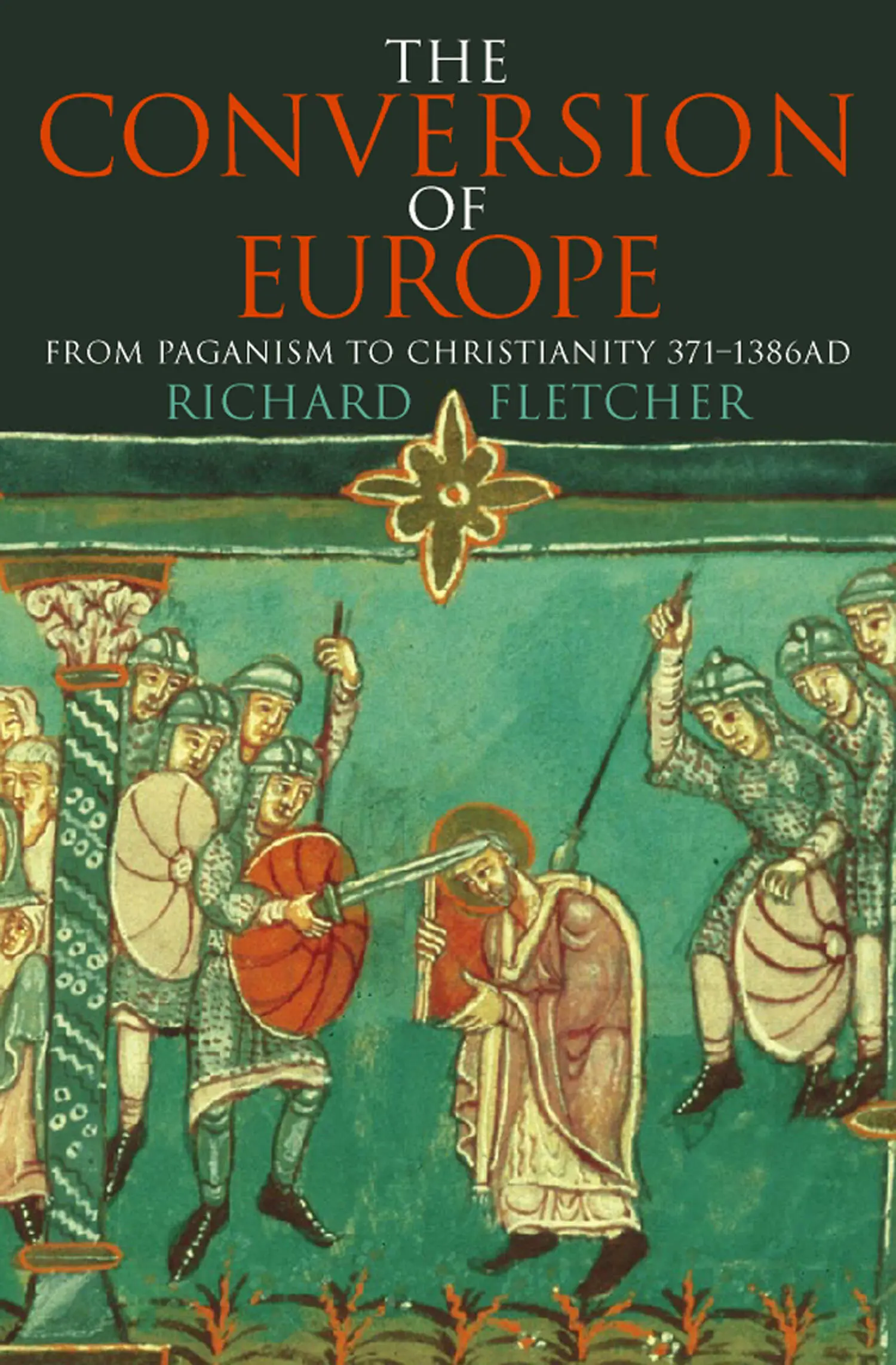
- Название:The Conversion of Europe
- Автор:
- Жанр:
- Год:неизвестен
- ISBN:нет данных
- Рейтинг книги:5 / 5. Голосов: 1
-
Избранное:Добавить в избранное
- Отзывы:
-
Ваша оценка:
The Conversion of Europe: краткое содержание, описание и аннотация
Предлагаем к чтению аннотацию, описание, краткое содержание или предисловие (зависит от того, что написал сам автор книги «The Conversion of Europe»). Если вы не нашли необходимую информацию о книге — напишите в комментариях, мы постараемся отыскать её.
The Conversion of Europe — читать онлайн ознакомительный отрывок
Ниже представлен текст книги, разбитый по страницам. Система сохранения места последней прочитанной страницы, позволяет с удобством читать онлайн бесплатно книгу «The Conversion of Europe», без необходимости каждый раз заново искать на чём Вы остановились. Поставьте закладку, и сможете в любой момент перейти на страницу, на которой закончили чтение.
Интервал:
Закладка:
Historians have often written dismissively of ‘pagan survivals’, old beliefs and practices tolerated by a sagely easy-going church, which would subside harmlessly into the quaint and folkloric. But this is to miss the point. The men of the sixth century – and not just the sixth century by any means – were engaged in an urgent and a competitive enterprise. In a European countryside where over hundreds of years diverse rituals had evolved for coping with the forces of nature, Christian holy men had to show that they had access to more efficacious power. The element of competition emerges clearly in the tale of Aquilinus, or in the story about Samson and the Cornish boy killed in a fall from his horse: and, it may be said, in many others too. Competition involves an element of comparability, even of compromise. Thus there is scope for all sorts of nice questions about where and how to draw lines round the limits of the tolerable. Competition also involves the risk of overlapping perceptions of identity. How like to an ariolus was, say, Emilian or Friardus or Caluppa – in the eyes of contemporaries? Or in the eyes of historians?
Because this chapter has concentrated upon the period between the third and the sixth centuries the incautious reader might be left with the impression that the challenge of converting the countryside to Christianity was one that was faced and surmounted during that period. Not so. A start had been made; but the operation was one which would continue to tax the energies of bishops for centuries to come. Country people are notoriously conservative. We may be absolutely certain that more than a few generations of episcopal exhortation or lordly harassment would be needed to alter habits inherited from time out of mind. Ways of doing things, ways that grindingly poor people living at subsistence level had devised for managing their visible and invisible environments, were not going to yield easily, perhaps were not going to yield at all, to ecclesiastical injunction. But even granite will be dented by water that never ceases to drip. This is one way in which ’something will start to happen’. If there were country churches (as in Touraine), and if there were clergy to serve them (a big ‘if’, that one), and if the laity attended church (a practice for which we have only sporadic evidence) – would the people then become more Christian? The question mark stays in place because at this point a spectre rises to haunt us, the most troubling of the problems laid out in Chapter 1: what makes a Christian? Did Martin ‘make Christians’ by smashing a temple at Levroux? Sulpicius Severus thought so. Were the lakeside dwellers of Javols ‘made Christian’ when they diverted their offerings of local produce from lake to church? Gregory of Tours thought so. Did Samson ‘make Christian’ the people of Trigg by raising a boy from the dead and killing a snake? Count Guedianus thought so, if Samson’s anonymous biographer is to be believed, for he ordered them all to be baptized. This is what our sources tell us; we have to make of it what we can.
CHAPTER THREE
Beyond the Imperial Frontiers
Fish say, they have their Stream and Pond;
But is there anything Beyond?
RUPERT BROOKE, ‘Heaven’, 1914
IN THE LATE ANTIQUE PERIOD, as we saw in Chapter 1, it was standard practice for Christian communities which had put down roots outside the frontiers of the Roman empire to be provided with bishops on request. To Patrophilus, bishop of Pithyonta in Georgia, who attended the council of Nicaea in 325 (see above p. 26) we can add others. There was Frumentius, for example, consecrated by Athanasius of Alexandria, author of the Life of St Antony , in about 350 as the bishop of a Christian community based at Axum in Ethiopia. There was Theophilus ‘the Indian’, apparently a native of Socotra in the Gulf of Aden, who was sent at much the same time to be the bishop of Christian communities in southern Arabia which seem to have originated as trading settlements. Patrophilus, Frumentius and Theophilus operated far to the east or south of the Roman empire. They are shadowy figures who have left but the faintest of traces. Most scholars, however, are agreed that they did exist and that they are witnesses to the flourishing of some very far-flung branches of the Christian church. They had western counterparts, marginally better documented, beyond the imperial provinces of the fourth and fifth centuries, who are the subject of this chapter. Among the earliest of them known to us was a man named Ulfila – or Wulfila, or Ulfilas; it is variously spelt. His name was Germanic and means ‘Little Wolf’ or ‘Wolf Cub’. Much later, he would come to be known as ‘the Apostle of the Goths’. This is not quite what he was, though his achievements were remarkable enough. To provide him with a background and a context we must go back for a moment to third-century Pontus and to Bishop Gregory the Wonder-worker.
The Canonical Letter of Gregory the Wonder-worker (above p. 35) was prompted by a crisis in the provinces of northern Asia Minor in the middle years of the third century. Upon this sleepy corner of the empire there had unexpectedly fallen the cataclysmic visitation of barbarian attack. Goths settled on the north-western shores of the Euxine (or Black) Sea had managed to requisition ships from the Hellenistic sea ports – such places, presumably, as Chersonesus (Sevastopol) in the Crimea – which enabled them to raid the vulnerable coastline of Asia Minor. The earliest raids took place in the mid-250s. The invaders came to pillage, not to settle. In their eyes human booty was as desirable as temple treasures or the jewel-cases of rich ladies; captives, some of whom might buy their release, others of whom would be carried off into a life of slavery. In the wake of these devastations and collapse of order Bishop Gregory was approached by a colleague, possibly the bishop of Trapezus (Trebizond), and invited to pronounce on the disciplinary issues which arose from the conduct of the Christian provincials during the disturbances. His reply has come down to us because its rulings came to be regarded as authoritative and were incorporated into the canon law of the eastern or Orthodox branch of the church. 1
Gregory’s letter casts a shaft of light upon the human misery and depravity occasioned by the raids as well as upon the responsibilities assumed by a bishop in trying to pick up the pieces of shattered local life in their wake. Had captives been polluted by eating food provided for them by the barbarians? No; for ‘it is agreed by everyone’ – Gregory had evidently made enquiries – ‘that the barbarians who overran our regions did not sacrifice [food] to idols.’ Women who had been the innocent victims of rape were guiltless, following the precepts of Deuteronomy xxii.26–7: ‘But unto the damsel thou shalt do nothing … for he found her in the field, and the damsel cried, and there was none to save her.’ It was different, however, noted the bishop, with women whose past life had shown them to be of a flighty disposition: ‘then clearly the state of fornication is suspect even in a time of captivity; and one ought not readily to share in one’s prayers with such women.’ One can only speculate about the grim consequences of this ruling in the tight little communities of the towns and villages of Pontus. Gregory’s sense of outrage is vividly conveyed across the seventeen centuries that separate him from us. Prisoners of the Goths who, ‘forgetting that they were men of Pontus, and Christians’, directed their captors to properties which could be looted, must be excommunicated. Roman citizens, ‘men impious and hateful to God’, have themselves taken part in looting. They have ‘become Goths to others’ by appropriating booty taken but abandoned by the raiders. It was ‘something quite unbelievable’, but they have ‘reached such a point of cruelty and inhumanity’ as to enslave prisoners who had succeeded in escaping from their barbarian captors. They have used the cover of disorder to prosecute private feuds. They have demanded rewards for restoring property to its rightful owners. Gregory commended to his correspondent the measures which he had taken in his own diocese: enquiries, hearing public denunciations, setting up tribunals (‘the assembly of the saints’) and punishments meted out in accordance with the extremely severe penitential discipline of the early church. There are parallels here with the fate of all later actual or suspected collaborationists. Many, however, were beyond the reach of Gregory’s ministrations. These were the captives who did not escape, who were not wealthy enough to buy their freedom, who were of insufficient status to command a ransom payment from kinsfolk or neighbours left at home. Borne offinto slavery among barbarians, the captives took with them the solace of their Christian faith. In this fashion little pockets of Christianity struck root among the Goths outside the frontiers of the empire.
Читать дальшеИнтервал:
Закладка:
Похожие книги на «The Conversion of Europe»
Представляем Вашему вниманию похожие книги на «The Conversion of Europe» списком для выбора. Мы отобрали схожую по названию и смыслу литературу в надежде предоставить читателям больше вариантов отыскать новые, интересные, ещё непрочитанные произведения.









Обсуждение, отзывы о книге «The Conversion of Europe» и просто собственные мнения читателей. Оставьте ваши комментарии, напишите, что Вы думаете о произведении, его смысле или главных героях. Укажите что конкретно понравилось, а что нет, и почему Вы так считаете.