Patricia Hill Collins - Intersectionality
Здесь есть возможность читать онлайн «Patricia Hill Collins - Intersectionality» — ознакомительный отрывок электронной книги совершенно бесплатно, а после прочтения отрывка купить полную версию. В некоторых случаях можно слушать аудио, скачать через торрент в формате fb2 и присутствует краткое содержание. Жанр: unrecognised, на английском языке. Описание произведения, (предисловие) а так же отзывы посетителей доступны на портале библиотеки ЛибКат.
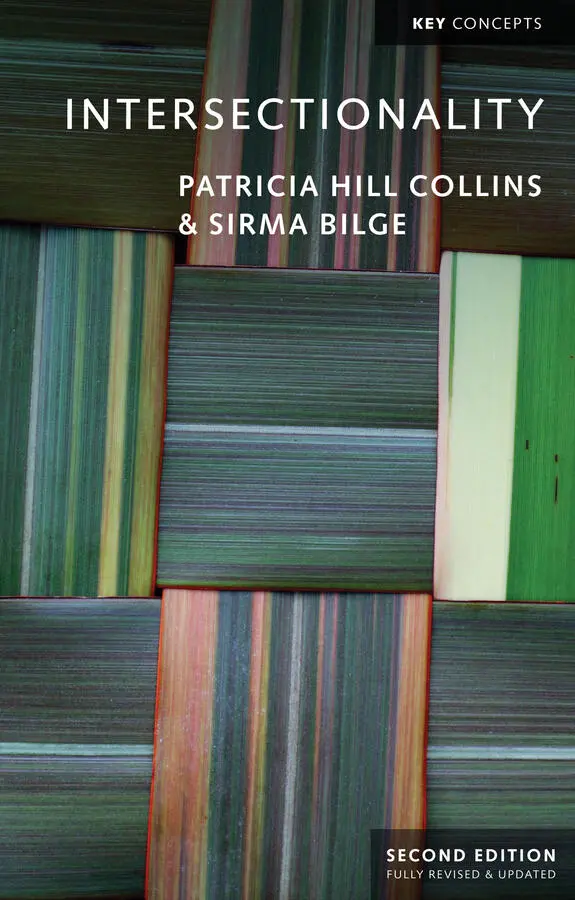
- Название:Intersectionality
- Автор:
- Жанр:
- Год:неизвестен
- ISBN:нет данных
- Рейтинг книги:5 / 5. Голосов: 1
-
Избранное:Добавить в избранное
- Отзывы:
-
Ваша оценка:
Intersectionality: краткое содержание, описание и аннотация
Предлагаем к чтению аннотацию, описание, краткое содержание или предисловие (зависит от того, что написал сам автор книги «Intersectionality»). Если вы не нашли необходимую информацию о книге — напишите в комментариях, мы постараемся отыскать её.
Intersectionality — читать онлайн ознакомительный отрывок
Ниже представлен текст книги, разбитый по страницам. Система сохранения места последней прочитанной страницы, позволяет с удобством читать онлайн бесплатно книгу «Intersectionality», без необходимости каждый раз заново искать на чём Вы остановились. Поставьте закладку, и сможете в любой момент перейти на страницу, на которой закончили чтение.
Интервал:
Закладка:
Fourth, these cases point to how relationality informs all aspects of intersectionality. Relationality embraces a both/and analytical framework that shifts focus from seeing categories as oppositional, for example, the differences between race and gender, to examining their interconnections. Relationality takes various forms within intersectionality and is found in terms such as “coalition,” “solidarity,” “dialog,” “conversation,” “interaction,” and “transaction.” But the terminology is less important than seeing how this shift in perspective toward relationality opens up new possibilities for intersectionality’s inquiry and praxis. For example, regarding inquiry, the case of global economic inequality illustrates how class-only arguments may be insufficient to explain global social inequality, and that intersectional analyses that examine the relationships among class, race, gender, and age might be more valuable. Similarly, regarding praxis, the Afro-Brazilian women’s movement illustrates how intersectionality emerged within coalition building for an intergenerational social movement.
Fifth, these cases highlight the complexity of doing critical intersectional analysis. Using intersectionality as an analytic tool is difficult, precisely because intersectionality itself is multifaceted. Because intersectionality aims to understand and analyze the complexity in the world, it requires intricate strategies to do so. Rather than proclaiming that complexity is important, we aimed to demonstrate through our case selection the multifaceted nature of intersectionality. Each of our cases is a highly abbreviated rendition of a far more complex intersectional argument. Starting with a well-known social institution (FIFA), or an important social problem (social inequality), or a seemingly invisible political phenomenon (black women’s movement) involves incorporating ever more complex levels of analysis. Intersections of race and gender can identify the need for class analysis, or viewing intersections of nation and sexuality can highlight the need for other categories of analysis. This level of complexity is not easy for anyone to handle. It complicates things and can be a source of frustration for scholars, practitioners, and activists alike. Yet complexity is not something that one achieves by using intersectionality as an analytic tool, but rather something that deepens intersectional analysis.
Finally, some commitment to social justice has historically informed much of intersectionality’s critical inquiry and praxis. We selected these cases to introduce intersectionality because they all illuminate how intersectionality’s use as a critical analytic tool is connected to a social justice ethos. What makes an intersectional project critical lies in its connection to social justice. For example, our analysis of global economic inequality illustrates how fostering social justice requires complex analyses of global economic inequality.
Yet because intersectionality’s ties to social justice may not be self-evident, the need to pursue a social justice agenda as an essential dimension of intersectionality remains contentious. Many people believe that social ideals, such as the belief in meritocracy, fairness, and the reality of democracy, have already been achieved. For them, there is no global crisis of social inequality because economic inequality is the outcome of fair competition and fully functioning democratic institutions. Social inequality can exist without it being socially unjust. Our cases challenge this view, suggesting that FIFA reproduces social inequality in ways that are neither fair nor just. Social justice is elusive in unequal societies where the rules may seem fair, yet differentially enforced through discriminatory practices, the case of Brazil’s racial democracy. Social justice is also elusive where the rules themselves may appear to be equally applied to everyone, yet still produce unequal and unfair outcomes: in social democracies and neoliberal nation-states, everyone may have the “right” to vote, but not everyone has equal access to do so, and not everyone’s vote counts the same.
Our goal in this book is to democratize the rich and growing literature of intersectionality – not to assume that only African American students will be interested in black history, or that LGBTQ youth will be the only ones interested in queer studies, or that intersectionality is for any one segment of the population. Rather, we invite our readers to use intersectionality as an analytic tool to examine a range of topics such as those discussed here. In this chapter, we have introduced selected main ideas within intersectionality by using intersectionality as an analytical tool. In Chapters 2and 3, we further examine intersectionality’s analytical framework by introducing the distinction between intersec-tionality as a form of inquiry and as praxis and by tracing the emergence of these ideas. In Chapters 4and 5, we return to the use of intersectionality as an analytical tool by showing its utility for analyzing global phenomena – specifically, human rights, reproductive rights, digital media, global social protest, and neoliberal state policies. In Chapters 6and 7, we take up identity politics and critical education as two important issues that have shaped intersectionality as discourse. Our concluding chapter revisits the challenges of using intersectionality as an analytic tool, as well as the varying forms that its core themes of social inequality, relationality, power, social context, complexity, and social justice can and might assume.
Notes
1 1. FIFA’s legal troubles aside, the business of the World Cup goes far beyond the games themselves. Rather, as the scope of people who were indicted indicates, the World Cup is situated at the convergence of increasingly important global industries: sports and entertainment, global telecommunications and tourism, and the globalized World Cup paraphernalia industry. For example, the FIFA-approved official ball of the 2014 World Cup, Adidas Brazuca, with a price tag of US$160, was manufactured in the Forward Sports factory at Sialkot (Pakistan) by Pakistani women (90 percent of the workforce) who each made barely US$100 per month. After selling 13 million official World Cup match balls in 2010, Adidas made hundreds of millions of dollars.
2 2. In one case, Polish fans threw bananas at a Nigerian football player. The fans aren’t the only problem – racial slurs among players are also an issue. For example, at the 2006 World Cup, France’s Zinedine Zidane, a three-time winner of FIFA’s world player of the year award, violated a rule of fair play by headbutting Italy’s Marco Materazzi in the chest. Zidane, the son of Algerian immigrants, reported he was goaded by Materazzi’s racist and sexist slurs against his mother and sister. Materazzi was kept in play while Zidane was ejected from what was to be his last ever World Cup match.
3 3. Despite the 2008 global financial crisis, by 2014 the richest 1 percent had increased its share of the world’s wealth – from 44 percent in 2009 to 48 percent in 2014. In the US, the wealthiest 1 percent captured 95 percent of post-financial crisis growth after 2009, while the remaining 90 percent became poorer. In 2013, the combined wealth of the world’s richest 85 people equaled the total wealth of the poorest half of the world’s population, which accounted for 3.5 billion people (Oxfam 2014). More recently, these trends have shown no evidence of abating. By 2018, the wealth of the world’s billionaires increased by $900 billion, an increase of $2.5 billion each day. In contrast, progress made in fighting extreme poverty, which is defined by the World Bank as an income of $1.90 per person per day, slowed down (Oxfam 2019).
Читать дальшеИнтервал:
Закладка:
Похожие книги на «Intersectionality»
Представляем Вашему вниманию похожие книги на «Intersectionality» списком для выбора. Мы отобрали схожую по названию и смыслу литературу в надежде предоставить читателям больше вариантов отыскать новые, интересные, ещё непрочитанные произведения.










Обсуждение, отзывы о книге «Intersectionality» и просто собственные мнения читателей. Оставьте ваши комментарии, напишите, что Вы думаете о произведении, его смысле или главных героях. Укажите что конкретно понравилось, а что нет, и почему Вы так считаете.