Eric Tyson - Investing For Dummies
Здесь есть возможность читать онлайн «Eric Tyson - Investing For Dummies» — ознакомительный отрывок электронной книги совершенно бесплатно, а после прочтения отрывка купить полную версию. В некоторых случаях можно слушать аудио, скачать через торрент в формате fb2 и присутствует краткое содержание. Жанр: unrecognised, на английском языке. Описание произведения, (предисловие) а так же отзывы посетителей доступны на портале библиотеки ЛибКат.
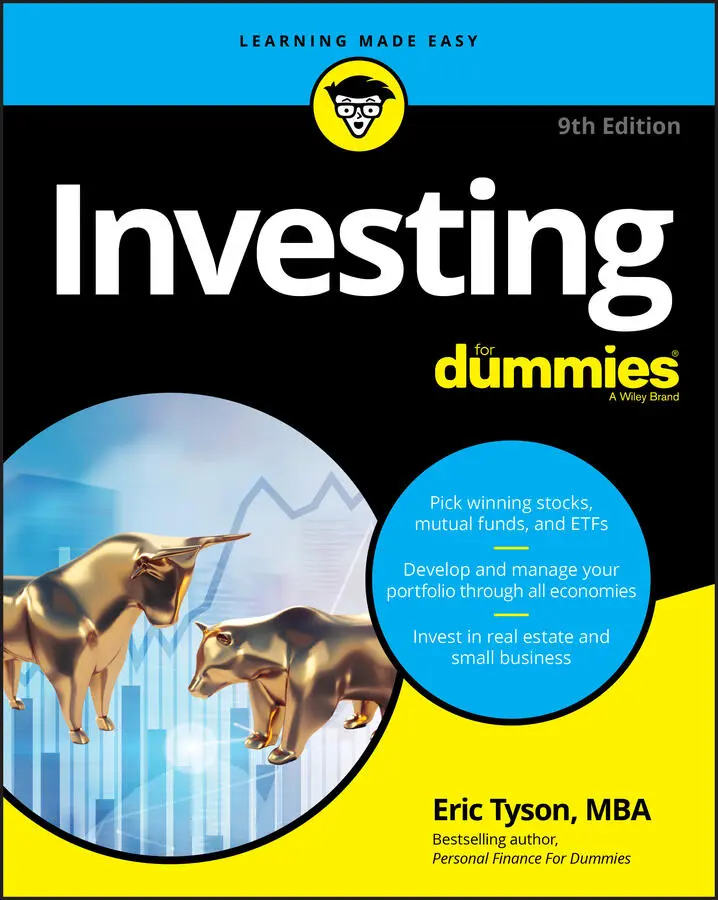
- Название:Investing For Dummies
- Автор:
- Жанр:
- Год:неизвестен
- ISBN:нет данных
- Рейтинг книги:3 / 5. Голосов: 1
-
Избранное:Добавить в избранное
- Отзывы:
-
Ваша оценка:
Investing For Dummies: краткое содержание, описание и аннотация
Предлагаем к чтению аннотацию, описание, краткое содержание или предисловие (зависит от того, что написал сам автор книги «Investing For Dummies»). Если вы не нашли необходимую информацию о книге — напишите в комментариях, мы постараемся отыскать её.
Investing for your future is wise and essential. Of course, you want to make solid investment choices and minimize mistakes. This updated, best-selling guide educates you on investing concepts and lingo so you can make the best decisions in all economies and markets. Understanding how to find and make smart investments is a skill that can be learned, and this book by money-pro Eric Tyson will help you by discovering how to weigh risk vs. return, offering tips on choosing stocks and funds, getting started in real estate and small business, and so much more.
Selecting investments wisely Increasing your wealth through stocks and funds Understanding tax laws and their impact on investing Choosing a brokerage firm Investing in a home and other real estate Discovering how politics and policy affect your money
Investing For Dummies — читать онлайн ознакомительный отрывок
Ниже представлен текст книги, разбитый по страницам. Система сохранения места последней прочитанной страницы, позволяет с удобством читать онлайн бесплатно книгу «Investing For Dummies», без необходимости каждый раз заново искать на чём Вы остановились. Поставьте закладку, и сможете в любой момент перейти на страницу, на которой закончили чтение.
Интервал:
Закладка:
You want to know how to earn healthy returns on your investments without getting clobbered, right? Who doesn’t? Although you generally must accept greater risk to have the potential for earning higher returns (see Chapter 2), in this chapter, I tell you about some high-return, low-risk investments. You have a right to be skeptical about such investments, but don’t stop reading this chapter yet. Here, I point out some of the easy-to-tap opportunities for managing your money that you may have overlooked.
Establishing an Emergency Reserve
You never know what life will bring, so having a readily accessible reserve of cash to meet unexpected expenses makes good financial sense. If you have a sibling who works at a well-paying and secure job or a financially secure and understanding parent, you can use one of them as your emergency reserve. (Although you should ask them how they feel about that before you count on receiving funding from them!) If you don’t have a wealthy family member, the ball’s in your court to establish a reserve.
 Make sure you have quick access to at least three months’ to as much as six months’ worth of living expenses. Keep this emergency money in a savings account (see Chapter 7) or a money market fund (see Chapter 8). You may also be able to borrow against your employer-based retirement account or against your home equity should you find yourself in a bind, but these options are much less desirable.
 If you don’t have a financial safety net, you may be forced into selling an investment that you’ve worked hard for. And selling some investments, such as real estate, costs big money (because of transaction costs, taxes, and so on).
Consider the case of Warren, who owned his home and owned and rented out an investment property in the Pacific Northwest. He felt, and appeared to be financially successful. But then Warren lost his job, accumulated sizable medical expenses, and had to sell his investment property to come up with cash for living expenses. Warren didn’t have enough equity in his home to borrow. He didn’t have other sources — a wealthy relative, for example — to borrow from, either, so he was stuck selling his investment property. Warren wasn’t able to purchase another investment property and missed out on the large appreciation the property earned over the subsequent two decades. Between the costs of selling and taxes, getting rid of the investment property cost Warren about 15 percent of its sales price. Ouch!
SHOULD YOU INVEST EMERGENCY MONEY IN STOCKS?
As interest rates drifted lower during the 1990s, keeping emergency money in money market accounts became less and less rewarding. When interest rates were higher, fewer people questioned the wisdom of an emergency reserve. However, in the late 1990s, which had low money market interest rates and stock market returns of 20 percent per year, more investors balked at the idea of keeping a low-interest stash of cash.
I began seeing articles that suggested you simply keep your emergency reserve in stocks. After all, you can easily sell stocks (especially those of larger companies) any day the financial markets are open. Why not treat yourself to the 20 percent annual returns that stock market investors enjoyed during the 1990s instead of earning a paltry few percent?
At first, that logic sounds great. But as I discuss in Chapter 2, stocks historically have returned about 9 percent per year. In some years — in fact, about one-third of the time — stocks decline in value, sometimes substantially.
Stocks can drop and have dropped 20, 30, or 50 percent or more over relatively short periods of time. Consider the major drops in stock prices in the early 2000s, then again in the 2008 financial crisis, and most recently in early 2020 thanks to the COVID-19 pandemic. Suppose that such a drop coincides with an emergency — such as the loss of your job, major medical bills, and so on. Your situation may force you to sell at a loss, perhaps a substantial one.
Here’s another reason not to keep emergency money in stocks: If your stocks appreciate and you need to sell some of them for emergency cash, you get stuck paying taxes on your gains. And those gains on stocks held less than one year are taxed at the relatively high ordinary income tax rates.
I suggest that you invest your emergency money in stocks (ideally through well-diversified mutual or exchange-traded funds) only if you have a relative or some other resource to tap for money in an emergency. Having a backup resource for money minimizes your need to sell your stock holdings on short notice. As I discuss in Chapter 5, stocks are intended to be a longer-term investment, not an investment that you expect (or need) to sell in the near future.
Evaluating Your Debts
Yes, paying down debts is boring, but it makes your investment decisions less difficult. Rather than spending so much of your time investigating specific investments, paying off your debts (if you have them and your cash coming in exceeds the cash going out) may be your best high-return, low-risk investment. Consider the interest rate you pay and your investing alternatives to determine which debts you should pay off.
Conquering consumer debt
Borrowing via credit cards, auto loans, and the like is typically an expensive way to borrow. (Note that car dealers could afford to give you a better price on a car rather than providing you with a no- or low-cost loan.) Banks and other lenders charge higher interest rates for consumer debt than for debt for investments, such as real estate and business. The reason: Consumer loans are the riskiest type of loan for a lender.
Many folks have credit card or other consumer debt, such as an auto loan, that costs 8, 10, 12, or perhaps as much as 18-plus percent per year in interest (some credit cards whack you with interest rates exceeding 20 percent if you make a late payment). Reducing and eventually eliminating this debt with your savings is like putting your money in an investment with a guaranteed tax-free return equal to the rate that you pay on your debt.
For example, if you have outstanding credit card debt at 15 percent interest, paying off that debt is the same as putting your money to work in an investment with a guaranteed 15 percent tax-free annual return. Because the interest on consumer debt isn’t tax-deductible, you need to earn more than 15 percent by investing your money elsewhere in order to net 15 percent after paying taxes. Earning such high investing returns is highly unlikely, and in order to earn those returns, you’d be forced to take great risk.
Consumer debt is hazardous to your long-term financial health (not to mention damaging to your credit score and future ability to borrow for a home or other wise investments) because it encourages you to borrow against your future earnings. I often hear people say things like “I can’t afford to buy most new cars for cash — look at how expensive they are!” That’s true, new cars are expensive, so you need to set your sights lower and buy a good used car that you can afford. You can then invest the money that you’d otherwise be spending on monthly auto loan payments.
 Using consumer debt may make sense if you’re financing a business. If you don’t have home equity, personal loans (through a credit card or auto loan) may actually be your lowest-cost source of small-business financing. (See Chapter 14for details.)
Интервал:
Закладка:
Похожие книги на «Investing For Dummies»
Представляем Вашему вниманию похожие книги на «Investing For Dummies» списком для выбора. Мы отобрали схожую по названию и смыслу литературу в надежде предоставить читателям больше вариантов отыскать новые, интересные, ещё непрочитанные произведения.
Обсуждение, отзывы о книге «Investing For Dummies» и просто собственные мнения читателей. Оставьте ваши комментарии, напишите, что Вы думаете о произведении, его смысле или главных героях. Укажите что конкретно понравилось, а что нет, и почему Вы так считаете.