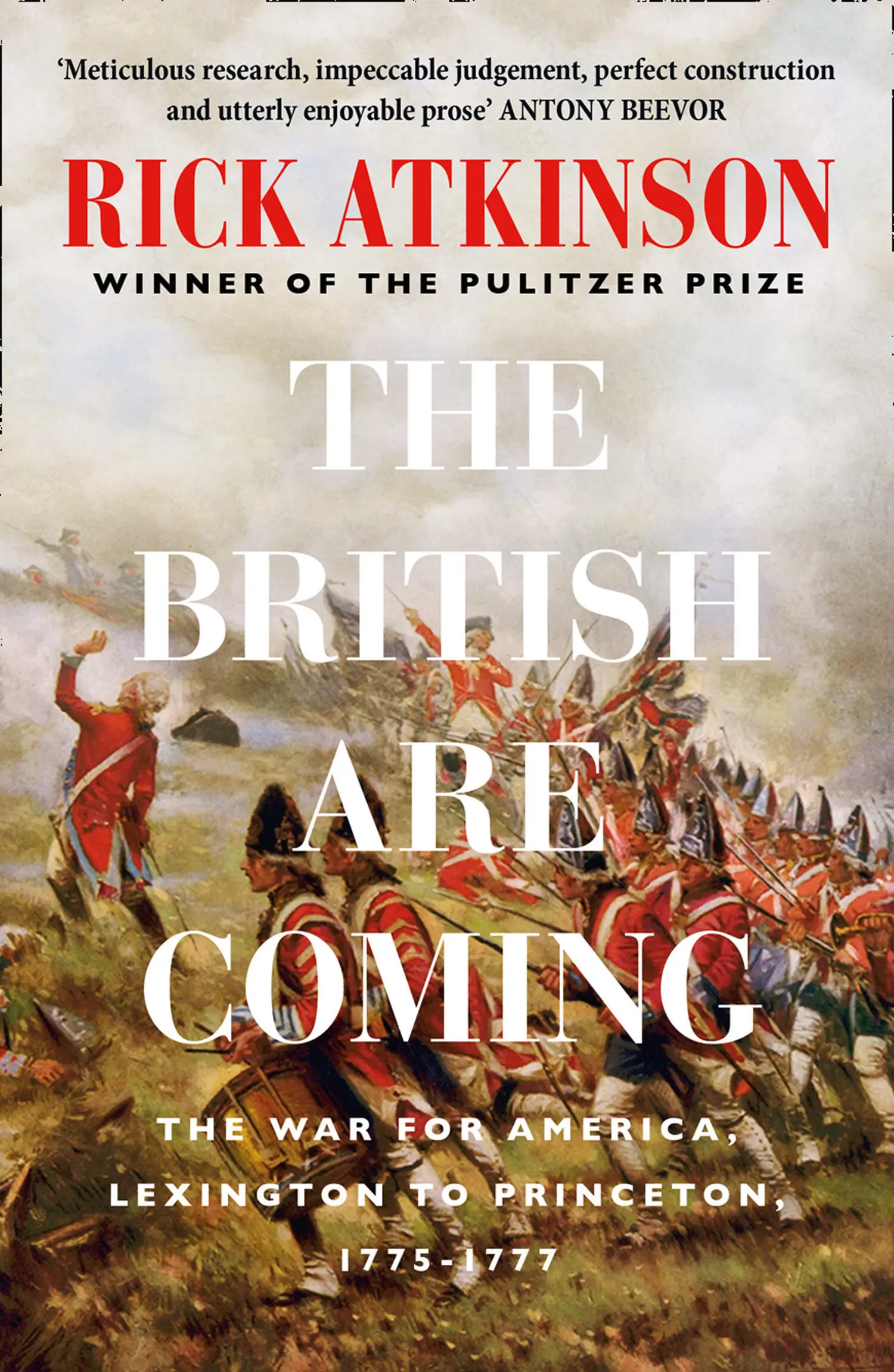
Rick Atkinson - The British Are Coming
Здесь есть возможность читать онлайн «Rick Atkinson - The British Are Coming» — ознакомительный отрывок электронной книги совершенно бесплатно, а после прочтения отрывка купить полную версию. В некоторых случаях можно слушать аудио, скачать через торрент в формате fb2 и присутствует краткое содержание. Жанр: unrecognised, на английском языке. Описание произведения, (предисловие) а так же отзывы посетителей доступны на портале библиотеки ЛибКат.
- Название:The British Are Coming
- Автор:
- Жанр:
- Год:неизвестен
- ISBN:нет данных
- Рейтинг книги:3 / 5. Голосов: 1
-
Избранное:Добавить в избранное
- Отзывы:
-
Ваша оценка:
The British Are Coming: краткое содержание, описание и аннотация
Предлагаем к чтению аннотацию, описание, краткое содержание или предисловие (зависит от того, что написал сам автор книги «The British Are Coming»). Если вы не нашли необходимую информацию о книге — напишите в комментариях, мы постараемся отыскать её.
The British Are Coming — читать онлайн ознакомительный отрывок
Ниже представлен текст книги, разбитый по страницам. Система сохранения места последней прочитанной страницы, позволяет с удобством читать онлайн бесплатно книгу «The British Are Coming», без необходимости каждый раз заново искать на чём Вы остановились. Поставьте закладку, и сможете в любой момент перейти на страницу, на которой закончили чтение.
Интервал:
Закладка:
Gage concluded his order without sentiment: “You will open your business and return with the troops as soon as possible.”
And now, as one loyalist wrote, “The war began to redden.… The iron was quite hot enough to be hammered.”
2.
Men Came Down from the Clouds
LEXINGTON AND CONCORD, APRIL 18–19, 1775
Shadows scuttled beneath the elm and linden trees along Boston Common. Hoarse whispers carried on the night air, along with the creak of leather and the clatter of a stone kicked down a lane. It would later be reported that a barking dog was bayoneted to enforce the silence. Not until the moon rose at ten p.m. on Tuesday, April 18, three nights past full but still radiant, did shape and color emerge from the hurrying gray figures to reveal hundreds of men in blood-red coats congregating on the beach near the town magazine, close to where Privates Duckett and Ferguson had been shot for desertion. Moonglow glinted off metal buttons and silvered the tall bearskin caps of the grenadiers. The soldiers reeked of damp wool and sweat, mingled with the tang of the brick dust and pipe clay used to scour brass and leather. Their hair had been greased, powdered, and clubbed into queues held with leather straps. The moon also gave tint to the facings on their uniform coats—purple or green, buff or royal blue, depending on the regiment from which each man had been plucked for the march to Concord.
The navy had collected only twenty longboats, and two lifts would be needed to shuttle all eight hundred men to marshy Lechmere Point, a mile distant across Back Bay. Sailors bent to their ash oars against the tide, and the standing soldiers swayed with every stroke. Each man’s kit included the eleven-pound Brown Bess, three dozen rounds of ammunition in a cartridge box, and a haversack to carry bread and salt pork. Beneath the heavy coats and crossbelts they wore wool waistcoats, white linen shirts, breeches buckled at the knee, and canvas or linen gaiters to keep pebbles from their low-topped brogans. Most wore black leather caps or felt hats with the brim stitched up to give a forepeak and two corners. Gorgets hung by neck cords at the officers’ throats—small silver or gilt crescents worn as an emblem of rank, a last remnant of medieval armor.
Loading was haphazard, and as the soldiers clambered from the boats to wade through the reeds on the far shore, sergeants hissed and clucked to reassemble the ten discomposed companies of light infantry and eleven of grenadiers. “We were wet up to the knees,” Lieutenant Barker later reported. Midnight had passed by the time the second lift arrived, and further delays followed as navy provisions in the boats were handed out—supplies that, Barker added, “most of the men threw away.” Fording a shallow inlet on the edge of Cambridge further wetted each shivering man to his waistcoat, but at last they reached the wide road leading west, unpaved except for napped stones and gravel shoveled into mud holes.
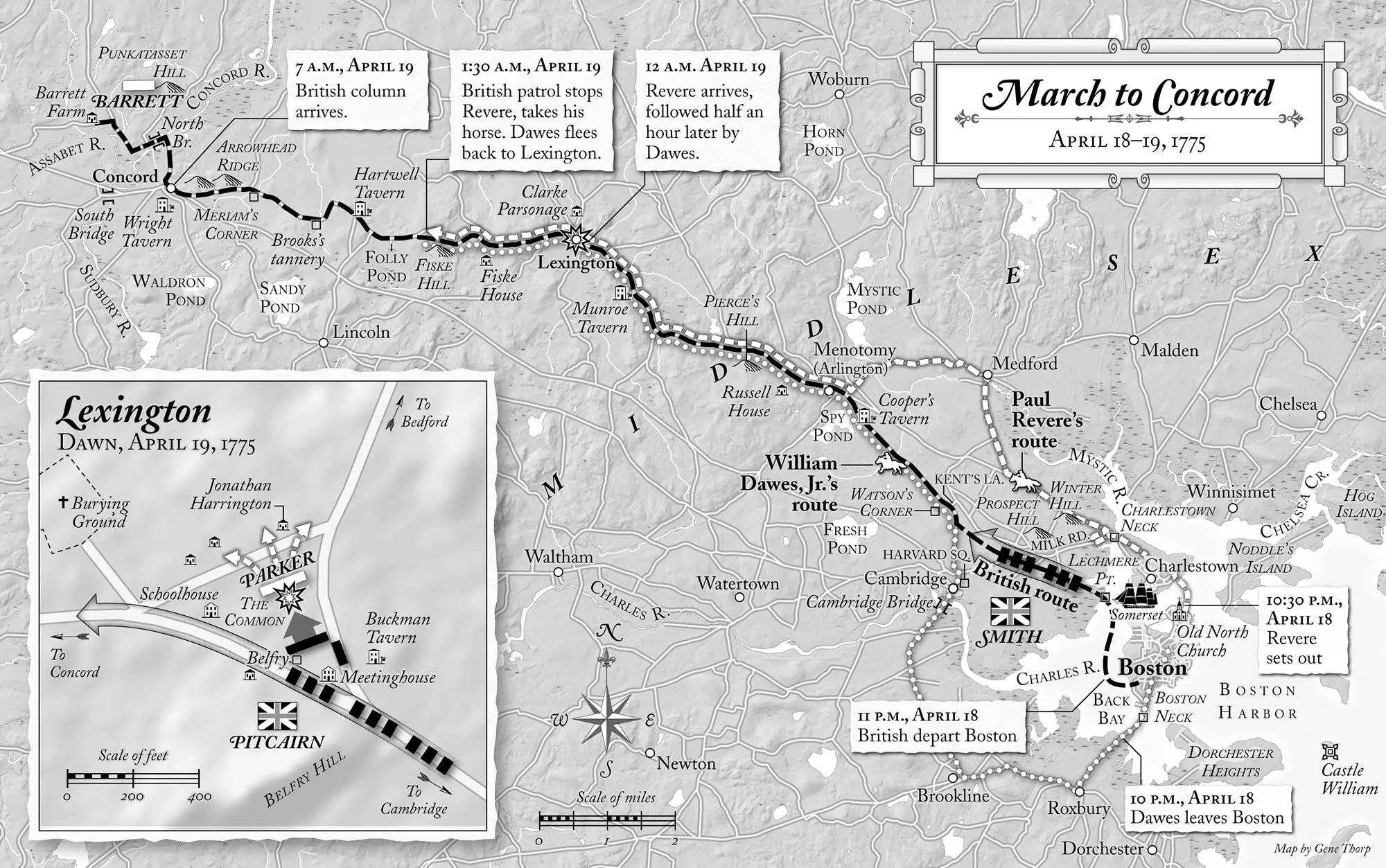
Few knew their destination. Two a.m. had come and gone as they put on speed. With their wet shoes squelching at more than a hundred steps per minute, their pace approached four miles an hour. Past apple and plum orchards they tramped, past smokehouses and cider mills and oblique driftways that led into cow pastures. The heavy footfall rattled pewter dishes on dressers and in cupboards, and an eight-year-old boy, awake when he should have been sleeping, later recalled a wondrous sight on the road outside his window: a long bobbing column of red, “like a flowing river,” sweeping northwest beneath the gibbous moon.
A brigade of armed men tiptoeing through Boston in the middle of the night had not gone unnoticed. “The town,” a British fusilier acknowledged, “was a good deal agitated.” Joseph Warren may have watched the mustering troops himself; he lived in a rented house on Hanover Street, barely a mile from the foot of the Common, and several companies had made for the boats from his North End neighborhood. Regardless, he was soon well informed. Two weeks earlier, the provincial congress had agreed that an enemy force greater than five hundred men leaving town with baggage and artillery ought to be considered a threat to the province and met by an assembled “army of observation … to act solely on the defensive so long as it can be justified.” This British force, even without heavy guns, was threatening enough for Dr. Warren. Before the first boats pulled off the Boston beach, he had summoned two couriers to carry the alarm to Samuel Adams and John Hancock, holed up in a Lexington parsonage, and to alert the wider countryside.
The first herald was a beefy, slab-jawed tanner in a slouched hat. William Dawes, Jr., barely thirty, still lived in Ann Street, where he had been raised by Puritan stock so strict that children were forbidden to look outside the window on Sundays and the instructive School of Good Manners advised, “Let thy recreations be lawful, brief, and seldom.” Dawes had overcome such constrictions to become an adept smuggler, a patriot messenger, a militia adjutant, and an intelligence agent; while surveilling British officers, he supposedly sometimes posed as a vegetable peddler, sometimes as a miller, sometimes as a drunk. At Warren’s instruction, he would now ride through the Boston Neck gate on a “slow-jogging horse,” then loop northwest through Cambridge, rousing households on the way to Lexington.
The second herald had already proved his value as a trusted courier in nearly a dozen rides to New York, Philadelphia, New Hampshire, and, twice so far this month, Lexington and Concord. Paul Revere had often been mentioned in various newspapers over the past year because of the dispatches he carried hither and yon from Boston; he had, as the historian David Hackett Fischer would write, “a genius for being at the center of great events.” Now forty, with the brown eyes of his French Huguenot forebears, a broad, ruddy face, and the sinewy arms of a metalworker, he had run his own business as a silver- and goldsmith for more than twenty years—making teapots, mending spoons, inventing alloys, and setting false teeth, including two for Dr. Warren. He had become a skilled copperplate engraver, a concocter of allegory and caricature, who also made plates for playing cards, broadside illustrations, and paper money. For all his legendary bravura, Revere’s life was stained with tragedy: he would father sixteen children, his “little lambs,” and most would die before their time.
This was his time. After a brief consultation with Warren, he hurried to his nearby house in Clark’s Square, snatched up his riding boots and a long surtout, then picked his way through the twisting North End alleys to the waterfront. Two confederates waited with a dinghy. Softly they rowed from the wharf, against the young flood and under that old moon, with a temperate breeze stirring out of the southwest. Ahead loomed the Somerset , a seventy-gun warship anchored as a sentinel in the ferryway between Boston and Charlestown, in water so shallow she could barely swing at anchor. Some of Somerset ’s crewmen were either manning the longboats at Lechmere Point or working her pumps; an inspection this week had showed the man-of-war to be in desperately poor repair—seams rotten, butt ends open, and long overdue for caulking and sheathing in Halifax. Whether distracted or sightless, the watch failed to spot the small boat that scooted past her stern and on to the Charlestown shore.
In 1775, America had more than three thousand churches, representing eighteen denominations, but none was more important on this April night than Christ Church in Boston’s Salem Street. Known as Old North, the church featured eight great bells cast in England, a magnificent quartet of hand-carved wooden angels perched above the nave, and a towering steeple, long used as a landmark by navigators entering the harbor and featured in a Boston panorama engraved by Revere the previous year. As carefully planned earlier in the week, another confederate—Revere identified him only as “a friend”—climbed 154 stairs and then a rickety ladder to a window in the steeple’s north face, lugging two lanterns of tinned steel with glass panels, pewter finials, and metal rings for hanging or carrying. For plainspun Boston, the lanterns—or at least the one that has survived—were fancy artifacts: fourteen inches high, six inches wide and deep, with two hundred perforations in the top, arranged to throw exquisite shadows shaped as circles, diamonds, and Maltese crosses. Flint and steel soon lighted the candles, and twin gleams could be seen across the harbor. As Revere intended, rebel leaders beyond the Charles now knew that British troops were on the move via Back Bay—two if by sea—rather than taking the more circuitous, one-if-by-land route through Roxbury.
Читать дальшеИнтервал:
Закладка:
Похожие книги на «The British Are Coming»
Представляем Вашему вниманию похожие книги на «The British Are Coming» списком для выбора. Мы отобрали схожую по названию и смыслу литературу в надежде предоставить читателям больше вариантов отыскать новые, интересные, ещё непрочитанные произведения.










Обсуждение, отзывы о книге «The British Are Coming» и просто собственные мнения читателей. Оставьте ваши комментарии, напишите, что Вы думаете о произведении, его смысле или главных героях. Укажите что конкретно понравилось, а что нет, и почему Вы так считаете.