Thomas B. Costain - The Silver Chalice
Здесь есть возможность читать онлайн «Thomas B. Costain - The Silver Chalice» — ознакомительный отрывок электронной книги совершенно бесплатно, а после прочтения отрывка купить полную версию. В некоторых случаях можно слушать аудио, скачать через торрент в формате fb2 и присутствует краткое содержание. Жанр: unrecognised, на английском языке. Описание произведения, (предисловие) а так же отзывы посетителей доступны на портале библиотеки ЛибКат.
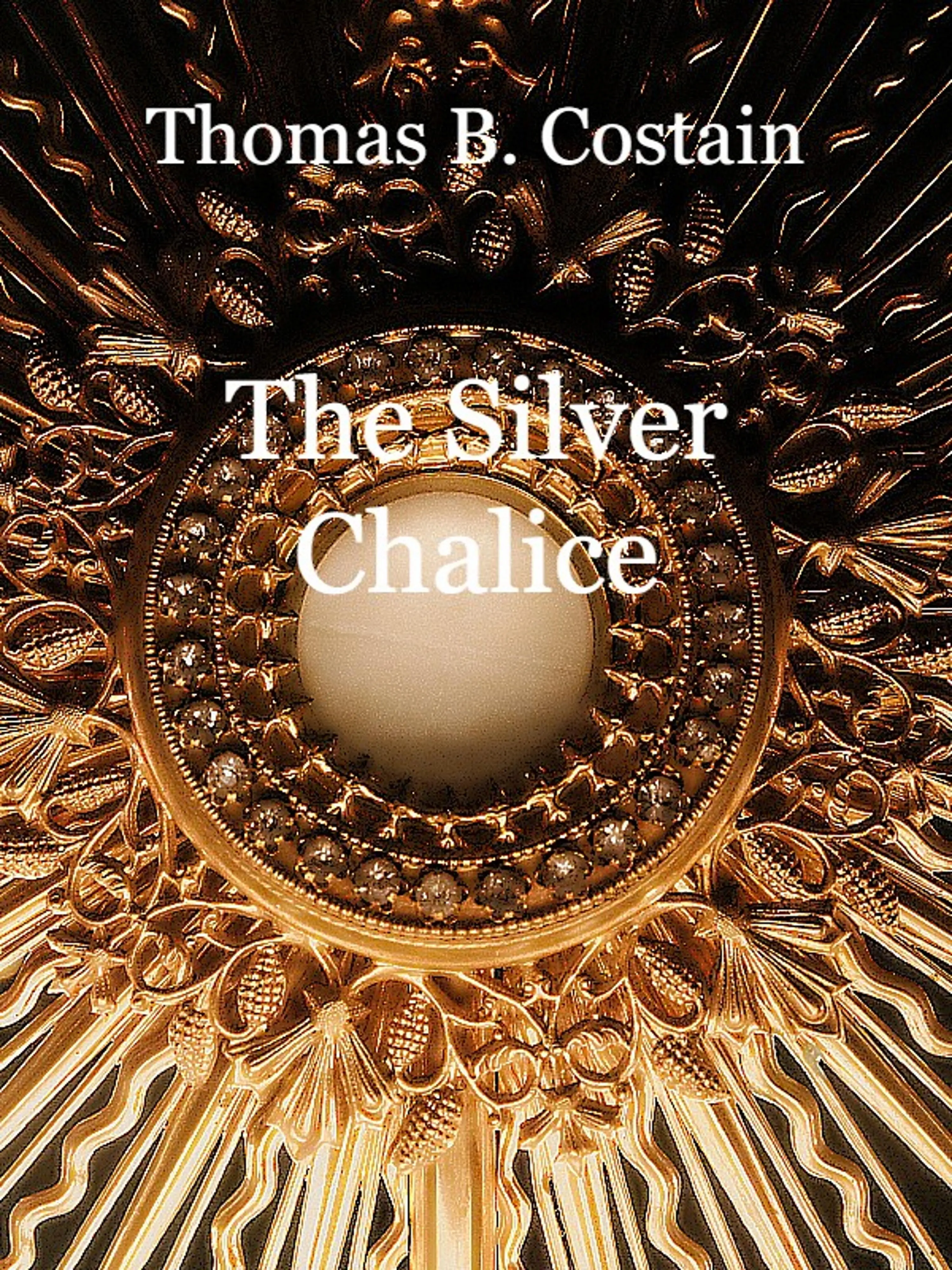
- Название:The Silver Chalice
- Автор:
- Жанр:
- Год:неизвестен
- ISBN:нет данных
- Рейтинг книги:5 / 5. Голосов: 1
-
Избранное:Добавить в избранное
- Отзывы:
-
Ваша оценка:
The Silver Chalice: краткое содержание, описание и аннотация
Предлагаем к чтению аннотацию, описание, краткое содержание или предисловие (зависит от того, что написал сам автор книги «The Silver Chalice»). Если вы не нашли необходимую информацию о книге — напишите в комментариях, мы постараемся отыскать её.
The Silver Chalice — читать онлайн ознакомительный отрывок
Ниже представлен текст книги, разбитый по страницам. Система сохранения места последней прочитанной страницы, позволяет с удобством читать онлайн бесплатно книгу «The Silver Chalice», без необходимости каждый раз заново искать на чём Вы остановились. Поставьте закладку, и сможете в любой момент перейти на страницу, на которой закончили чтение.
Интервал:
Закладка:
“One might even think you a quiet little family group, the two of you sitting there with your heads so close together, and Old Gaggle still under the influence of a big supper.” He had crossed the room and was standing above them. “You have been discussing, no doubt, the little piece of work this young genius is doing for the master.”
“No,” answered Deborra. “It has not been mentioned.”
“Aiy! Relaxing from his labors. I expected this. They are great relaxers, these Greeks; and always, it seems, in the company of beautiful women.”
“The bust is finished and ready for casting,” declared Basil angrily.
“Now that is excellent news.” Adam turned to look at Deborra. “Can you detach your mind sufficiently from what this undernourished Apollo has been saying to you to hear what I have been doing? I have been escorting someone of importance to Jerusalem.”
“I know,” said Deborra. “It is Paul.”
“Paul, and none else. The great teacher of the Gentiles. The ardent Jew who is striving so hard to wreck the Law of Moses. He was as fierce of eye and of temper as ever. But somewhat less talkative.
“I brought him from Caesarea. He had gone there to see Philip, and something had happened to take the edge of loquacity from his tongue.” Adam threw back his head and laughed. “I was even allowed to do some talking myself, which is a strange thing when Paul is around. Naturally he did not listen to anything I said.”
Although he had laughed as loudly as ever, it was clear that he did not feel any sense of amusement. His eyes kept jumping from one to the other, trying to find the key to the relationship that had developed between them. They were full of anger and disappointment. When they rested on Basil the depth of feeling in them became more intense and they seemed to say, “You have been up to tricks, my young pagan!”
“Did you bring him here?” asked Deborra.
Adam ben Asher snorted loudly. “I would as soon bring a pack of hungry lions into this house as Paul,” he declared. “It seems he had plans of his own. He disappeared almost as soon as we came through the gate. A humble-looking fellow fell into step beside the camel the great Paul was riding and they began to talk in whispers. Before I knew what had happened, he had slipped down from the back of the camel and had vanished without a word. All the rest of them disappeared at the same time. It’s well that they did. Within a few minutes they were swarming around us, the underlings from the Temple, and asking questions about him. There was a great deal of curiosity as to the whereabouts of Master Paul. If he had stayed with me, they would have had him trussed and ready for a hearing before the governor.”
Adam seemed to become conscious for the first time then that the absence of Joseph called for comment. He asked anxiously, “Is my good Master Joseph seriously ill that he could not come to supper?”
“No,” answered Deborra. “He is not ill at all. He is in bed, but he enjoyed a good supper by himself.”
Adam gave his thigh a slap and burst into a loud roar of laughter. “That means we have company tonight from the Temple. I should know by this time that our good old man is always indisposed when the great ones come to sup with Aaron. They have not laid an eye on him in ten years. Aiy, he is still the wisest fox of them all.” A still louder laugh attested his pleasure in the successful maneuvering of his employer. “Then I may see him this evening? I have many bits of information for his ear.”
“He will want to see you, of course.”
The servant Abraham had returned and was collecting the dishes from the table. He was in a disturbed state of mind; his hands fumbled at their task and he even allowed a cup half full of wine to fall. Deborra gave him an anxious glance and saw that his face was white.
“Are you ill?” she asked.
The servant straightened up and began to collect the remains of the supper with more care. “No, mistress, I am not ill.” Then he replaced the jug of mulsum on the table and asked in an angry voice: “Is it right that a Samaritan should be admitted to this house? One of the cursed Cutheans? Is it right that the master’s son should tell me to place a chair for him at the table? One would think he was a great man and not mud under our feet!”
Adam walked over to the table. “A Samaritan? Abraham, who is it?”
Abraham answered in a reluctant voice, as though unwilling to reveal the full infamy of the situation. “Simon the Magician. He was not here for supper. He came later, and they said he was to be taken in to them. They are all down there now, talking and whispering with their heads close together.”
“And the High Priest himself is there?”
The servant nodded his head. “He is sitting there in his jeweled ippudah, the closest of all to this Cuthean.” His voice sank to a husky note of fear. “All the fiends and the wicked spirits came into the house with him. I could feel them in the air.”
“I think I know what those old men of iron down there are plotting with Simon the Magician,” muttered Adam. “I hope Moses hears them. He will not approve!”
CHAPTER VI
1
Seated at one of his windows, Basil waited the next morning for the summons from Joseph of Arimathea. From here he could look across the bridge that spanned the Cheesemakers’ Valley and ran straight as an arrow flight to the Temple. The bridge was a magnificent structure, as great in its way as the Temple itself; a span of white stone nearly four hundred feet long and wide enough to allow the passage of five chariots driving abreast. He had crossed it many times in his morning rambles and was finding that he fell naturally into the custom of keeping his eyes on the grandeur of marble and gold massed above and allowing his feet to take care of themselves. One aspect had kept him in a somewhat unhappy frame of mind, however: the squalor of the valley two hundred feet below. There was no reason, he realized, for him to carry any such burden of worry: the people of Jerusalem, even the humble workers themselves who lived in that hot and malodorous depression, seemed to give no thought to the contrast between the magnificence of the heights and the poverty of the depths. Or did they reserve their discontent for the meetings in the cellars of Fish Street that Benjie the Asker frequented?
As he watched the bridge this morning, Basil became aware of three men in particular. They had, quite apparently, visited the Temple and were now crossing back to the city. They walked abreast, and the one in the center was shorter than his two companions, a slight figure with bowed legs showing beneath his knee-length tunic. He was monopolizing the conversation, for even at that distance Basil could see the emphatic nod of his head, the frequent lift of his hand for emphasis. His fellow walkers paced along beside him in absorbed silence, their attention given to every word he uttered.
Basil’s attention, nevertheless, was given mostly to the member of the trio who walked on the right. There was a familiarity about this figure that did not lead to an identification until some peculiarity about the man’s gait solved the problem. It was Luke, a jaded and somewhat disheveled Luke, weary from his travels and walking with the suggestion of a limp. Basil got to his feet and leaned out of the window in order to see better. He was realizing how much he had missed this kindliest of men since they had parted at Aleppo.
A man crossing the bridge in the opposite direction stopped as the three passed him. He remained motionless for a few moments, his eyes fixed intently on their backs. Then he turned and began to follow. A few moments later another pedestrian did the same. Before the watcher in the window was fully aware of what was happening there were half a dozen people tramping in the wake of the small man with the bowed legs; and before the head of the procession had reached the end of the bridge there were at least twoscore. It was now possible to distinguish voices, and Basil could hear repeated one word time and again, “Paul—Paul—Paul.”
Читать дальшеИнтервал:
Закладка:
Похожие книги на «The Silver Chalice»
Представляем Вашему вниманию похожие книги на «The Silver Chalice» списком для выбора. Мы отобрали схожую по названию и смыслу литературу в надежде предоставить читателям больше вариантов отыскать новые, интересные, ещё непрочитанные произведения.







Обсуждение, отзывы о книге «The Silver Chalice» и просто собственные мнения читателей. Оставьте ваши комментарии, напишите, что Вы думаете о произведении, его смысле или главных героях. Укажите что конкретно понравилось, а что нет, и почему Вы так считаете.