Bioethics
Здесь есть возможность читать онлайн «Bioethics» — ознакомительный отрывок электронной книги совершенно бесплатно, а после прочтения отрывка купить полную версию. В некоторых случаях можно слушать аудио, скачать через торрент в формате fb2 и присутствует краткое содержание. Жанр: unrecognised, на английском языке. Описание произведения, (предисловие) а так же отзывы посетителей доступны на портале библиотеки ЛибКат.
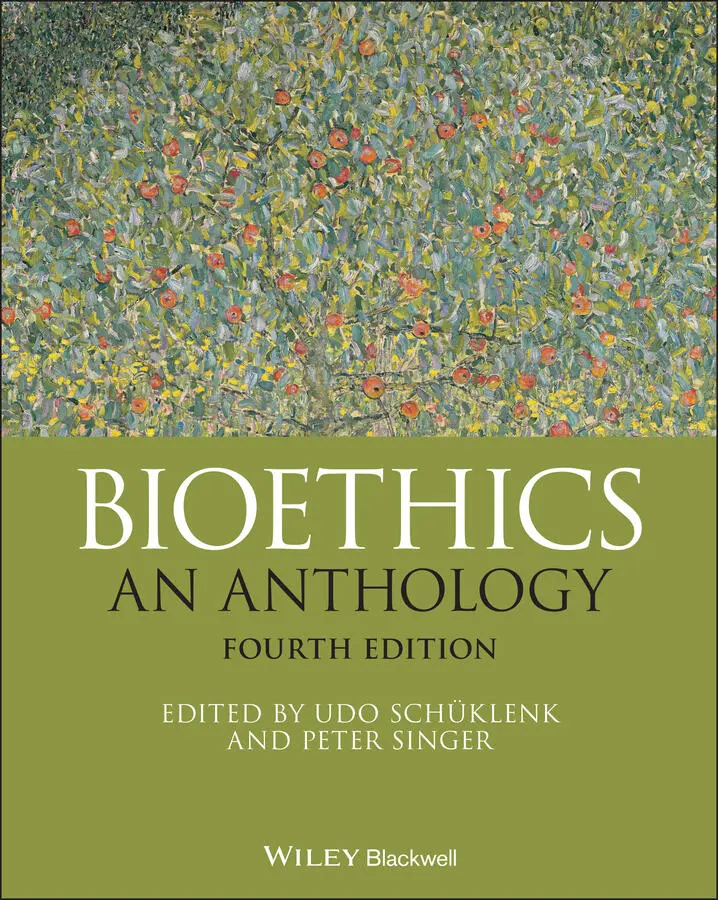
- Название:Bioethics
- Автор:
- Жанр:
- Год:неизвестен
- ISBN:нет данных
- Рейтинг книги:4 / 5. Голосов: 1
-
Избранное:Добавить в избранное
- Отзывы:
-
Ваша оценка:
Bioethics: краткое содержание, описание и аннотация
Предлагаем к чтению аннотацию, описание, краткое содержание или предисловие (зависит от того, что написал сам автор книги «Bioethics»). Если вы не нашли необходимую информацию о книге — напишите в комментариях, мы постараемся отыскать её.
For more than two decades,
has been widely regarded as the definitive single-volume compendium of seminal readings on both traditional and cutting-edge ethical issues in biology and medicine. Acclaimed for its scope and depth of coverage, this landmark work brings together compelling writings by internationally-renowned bioethicist to help readers develop a thorough understanding of the central ideas, critical issues, and current debate in the field.
Now fully revised and updated, the fourth edition contains a wealth of new content on ethical questions and controversies related to the COVID-19 pandemic, advances in CRISPR gene editing technology, physician-assisted death, public health and vaccinations, transgender children, medical aid in dying, the morality of ending the lives of newborns, and much more. Throughout the new edition, carefully selected essays explore a wide range of topics and offer diverse perspectives that underscore the interdisciplinary nature of bioethical study. Edited by two of the field’s most respected scholars, Covers an unparalleled range of thematically-organized topics in a single volume Discusses recent high-profile cases, debates, and ethical issues Features three brand-new sections: Conscientious Objection, Academic Freedom and Research, and Disability Contains new essays on topics such as brain death, life and death decisions for the critically ill, experiments on humans and animals, neuroethics, and the use of drugs to ease the pain of unrequited love Includes a detailed index that allows the reader to easily find terms and topics of interest
remains a must-have resource for all students, lecturers, and researchers studying the ethical implications of the health-related life sciences, and an invaluable reference for doctors, nurses, and other professionals working in health care and the biomedical sciences.
Bioethics — читать онлайн ознакомительный отрывок
Ниже представлен текст книги, разбитый по страницам. Система сохранения места последней прочитанной страницы, позволяет с удобством читать онлайн бесплатно книгу «Bioethics», без необходимости каждый раз заново искать на чём Вы остановились. Поставьте закладку, и сможете в любой момент перейти на страницу, на которой закончили чтение.
Интервал:
Закладка:
I am inclined to agree, however, that the prospects for “drawing a line” in the development of the fetus look dim. I am inclined to think also that we shall probably have to agree that the fetus has already become a human person well before birth. Indeed, it comes as a surprise when one first learns how early in its life it begins to acquire human characteristics. By the tenth week, for example, it already has a face, arms and legs, fingers and toes; it has internal organs, and brain activity is detectable. 2 On the other hand, I think that the premise is false, that the fetus is not a person from the moment of conception. A newly fertilized ovum, a newly implanted clump of cells, is no more a person than an acorn is an oak tree. But I shall not discuss any of this. For it seems to me to be of great interest to ask what happens if, for the sake of argument, we allow the premise. How, precisely, are we supposed to get from there to the conclusion that abortion is morally impermissible? Opponents of abortion commonly spend most of their time establishing that the fetus is a person, and hardly any time explaining the step from there to the impermissibility of abortion. Perhaps they think the step too simple and obvious to require much comment. Or perhaps instead they are simply being economical in argument. Many of those who defend abortion rely on the premise that the fetus is not a person, but only a bit of tissue that will become a person at birth; and why pay out more arguments than you have to? Whatever the explanation, I suggest that the step they take is neither easy nor obvious, that it calls for closer examination than it is commonly given, and that when we do give it this closer examination we shall feel inclined to reject it.
I propose, then, that we grant that the fetus is a person from the moment of conception. How does the argument go from here? Something like this, I take it. Every person has a right to life. So the fetus has a right to life. No doubt the mother has a right to decide what shall happen in and to her body; everyone would grant that. But surely a person’s right to life is stronger and more stringent than the mother’s right to decide what happens in and to her body, and so outweighs it. So the fetus may not be killed; an abortion may not be performed.
It sounds plausible. But now let me ask you to imagine this. You wake up in the morning and find yourself back to back in bed with an unconscious violinist. A famous unconscious violinist. He has been found to have a fatal kidney ailment, and the Society of Music Lovers has canvassed all the available medical records and found that you alone have the right blood type to help. They have therefore kidnapped you, and last night the violinist’s circulatory system was plugged into yours, so that your kidneys can be used to extract poisons from his blood as well as your own. The director of the hospital now tells you, “Look, we’re sorry the Society of Music Lovers did this to you – we would never have permitted it if we had known. But still, they did it, and the violinist now is plugged into you. To unplug you would be to kill him. But never mind, it’s only for nine months. By then he will have recovered from his ailment, and can safely be unplugged from you.” Is it morally incumbent on you to accede to this situation? No doubt it would be very nice of you if you did, a great kindness. But do you have to accede to it? What if it were not nine months, but nine years? Or longer still? What if the director of the hospital says, “Tough luck, I agree, but you’ve now got to stay in bed, with the violinist plugged into you, for the rest of your life. Because remember this. All persons have a right to life, and violinists are persons. Granted you have a right to decide what happens in and to your body, but a person’s right to life outweighs your right to decide what happens in and to your body. So you cannot ever be unplugged from him.” I imagine you would regard this as outrageous, which suggests that something really is wrong with that plausible‐sounding argument I mentioned a moment ago.
In this case, of course, you were kidnapped; you didn’t volunteer for the operation that plugged the violinist into your kidneys. Can those who oppose abortion on the ground I mentioned make an exception for a pregnancy due to rape? Certainly. They can say that persons have a right to life only if they didn’t come into existence because of rape; or they can say that all persons have a right to life, but that some have less of a right to life than others, in particular, that those who came into existence because of rape have less. But these statements have a rather unpleasant sound. Surely the question of whether you have a right to life at all, or how much of it you have, shouldn’t turn on the question of whether or not you are the product of a rape. And in fact the people who oppose abortion on the ground I mentioned do not make this distinction, and hence do not make an exception in the case of rape.
Nor do they make an exception for a case in which the mother has to spend the nine months of her pregnancy in bed. They would agree that would be a great pity, and hard on the mother; but all the same, all persons have a right to life, the fetus is a person, and so on. I suspect, in fact, that they would not make an exception for a case in which, miraculously enough, the pregnancy went on for nine years, or even the rest of the mother’s life.
Some won’t even make an exception for a case in which continuation of the pregnancy is likely to shorten the mother’s life; they regard abortion as impermissible even to save the mother’s life. Such cases are nowadays very rare, and many opponents of abortion do not accept this extreme view. All the same, it is a good place to begin: a number of points of interest come out in respect to it.
1 Let us call the view that abortion is impermissible even to save the mother’s life “the extreme view.” I want to suggest first that it does not issue from the argument I mentioned earlier without the addition of some fairly powerful premises. Suppose a woman has become pregnant, and now learns that she has a cardiac condition such that she will die if she carries the baby to term. What may be done for her? The fetus, being a person, has a right to life, but as the mother is a person too, so has she a right to life. Presumably they have an equal right to life. How is it supposed to come out that an abortion may not be performed? If mother and child have an equal right to life, shouldn’t we perhaps flip a coin? Or should we add to the mother’s right to life her right to decide what happens in and to her body, which everybody seems to be ready to grant – the sum of her rights now outweighing the fetus’ right to life?
The most familiar argument here is the following. We are told that performing the abortion would be directly killing 3 the child, whereas doing nothing would not be killing the mother, but only letting her die. Moreover, in killing the child, one would be killing an innocent person, for the child has committed no crime, and is not aiming at his mother’s death. And then there are a variety of ways in which this might be continued. (1) But as directly killing an innocent person is always and absolutely impermissible, an abortion may not be performed. Or, (2) as directly killing an innocent person is murder, and murder is always and absolutely impermissible, an abortion may not be performed. 4 Or, (3) as one’s duty to refrain from directly killing an innocent person is more stringent than one’s duty to keep a person from dying, an abortion may not be performed. Or, (4) if one’s only options are directly killing an innocent person or letting a person die, one must prefer letting the person die, and thus an abortion may not be performed. 5
Some people seem to have thought that these are not further premises which must be added if the conclusion is to be reached, but that they follow from the very fact that an innocent person has a right to life. 6 But this seems to me to be a mistake, and perhaps the simplest way to show this is to bring out that while we must certainly grant that innocent persons have a right to life, the theses in (1) through (4) are all false. Take (2), for example. If directly killing an innocent person is murder, and thus is impermissible, then the mother’s directly killing the innocent person inside her is murder, and thus is impermissible. But it cannot seriously be thought to be murder if the mother performs an abortion on herself to save her life. It cannot seriously be said that she must refrain, that she must sit passively by and wait for her death. Let us look again at the case of you and the violinist. There you are, in bed with the violinist, and the director of the hospital says to you, “It’s all most distressing, and I deeply sympathize, but you see this is putting an additional strain on your kidneys, and you’ll be dead within the month. But you have to stay where you are all the same. Because unplugging you would be directly killing an innocent violinist, and that’s murder, and that’s impermissible.” If anything in the world is true, it is that you do not commit murder, you do not do what is impermissible, if you reach around to your back and unplug yourself from that violinist to save your life.
Читать дальшеИнтервал:
Закладка:
Похожие книги на «Bioethics»
Представляем Вашему вниманию похожие книги на «Bioethics» списком для выбора. Мы отобрали схожую по названию и смыслу литературу в надежде предоставить читателям больше вариантов отыскать новые, интересные, ещё непрочитанные произведения.

Обсуждение, отзывы о книге «Bioethics» и просто собственные мнения читателей. Оставьте ваши комментарии, напишите, что Вы думаете о произведении, его смысле или главных героях. Укажите что конкретно понравилось, а что нет, и почему Вы так считаете.