Frank Pope - 72 Hours - The First-Hand Account of a Royal Navy Mission to Save the Crew of a Trapped Russian Submarine
Здесь есть возможность читать онлайн «Frank Pope - 72 Hours - The First-Hand Account of a Royal Navy Mission to Save the Crew of a Trapped Russian Submarine» весь текст электронной книги совершенно бесплатно (целиком полную версию без сокращений). В некоторых случаях можно слушать аудио, скачать через торрент в формате fb2 и присутствует краткое содержание. Город: London, Год выпуска: 2012, ISBN: 2012, Издательство: Orion, Жанр: Морские приключения, Прочая документальная литература, nonf_military, на английском языке. Описание произведения, (предисловие) а так же отзывы посетителей доступны на портале библиотеки ЛибКат.
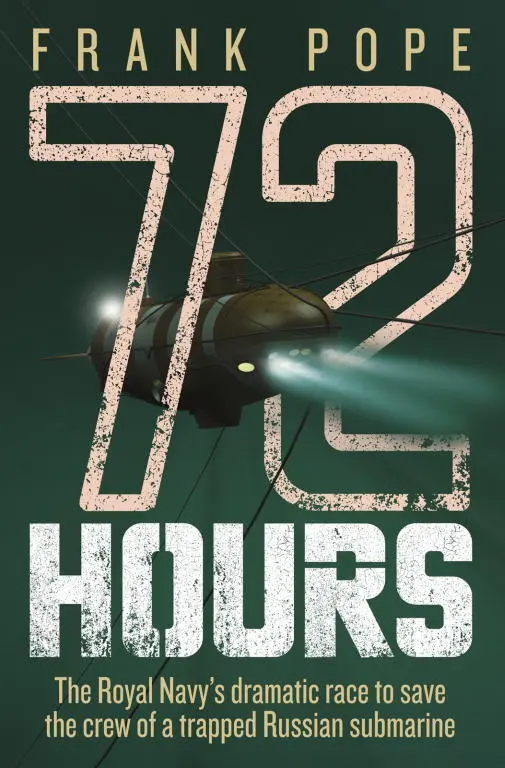
- Название:72 Hours: The First-Hand Account of a Royal Navy Mission to Save the Crew of a Trapped Russian Submarine
- Автор:
- Издательство:Orion
- Жанр:
- Год:2012
- Город:London
- ISBN:978-1-4091-4406-9
- Рейтинг книги:4 / 5. Голосов: 1
-
Избранное:Добавить в избранное
- Отзывы:
-
Ваша оценка:
72 Hours: The First-Hand Account of a Royal Navy Mission to Save the Crew of a Trapped Russian Submarine: краткое содержание, описание и аннотация
Предлагаем к чтению аннотацию, описание, краткое содержание или предисловие (зависит от того, что написал сам автор книги «72 Hours: The First-Hand Account of a Royal Navy Mission to Save the Crew of a Trapped Russian Submarine»). Если вы не нашли необходимую информацию о книге — напишите в комментариях, мы постараемся отыскать её.
5 August 2005. On a secret mission to an underwater military installation 30 miles off the coast of Kamchatka, Russian Navy submersible AS-28 ran into a web of cables and stuck fast. With 600 feet of freezing water above them, there was no escape for the seven crew. Trapped in a titanium tomb, all they could do was wait as their air supply slowly dwindled.
For more than 24 hours the Russian Navy tried to reach them. Finally – still haunted by the loss of the nuclear submarine Kursk five years before – they requested international assistance. On the other side of the world Commander Ian Riches, leader of the Royal Navy’s Submarine Rescue Service, got the call: there was a sub down.
With the expertise and specialist equipment available to him Riches knew his team had a chance to save the men, but Kamchatka was at the very limit of their range and time was running out. As the Royal Navy prepared to deploy to Russia’s Pacific coast aboard a giant Royal Air Force C-17 airlifter, rescue teams from the United States and Japan also scrambled to reach the area.
On board AS-28 the Russian crew shut down all non-essential systems, climbed into thick thermal suits to keep the bone-chilling damp at bay and waited, desperate to eke out the stale, thin air inside the pressure hull of their craft. But as the first of them began to drift in and out of consciousness, they knew the end was close. They started writing their farewells.
72 HOURS tells the extraordinary, edge-of-the-seat and real-life story of one of the most dramatic rescue missions of recent years. Review
About the Author cite —Daily Mail
72 Hours: The First-Hand Account of a Royal Navy Mission to Save the Crew of a Trapped Russian Submarine — читать онлайн бесплатно полную книгу (весь текст) целиком
Ниже представлен текст книги, разбитый по страницам. Система сохранения места последней прочитанной страницы, позволяет с удобством читать онлайн бесплатно книгу «72 Hours: The First-Hand Account of a Royal Navy Mission to Save the Crew of a Trapped Russian Submarine», без необходимости каждый раз заново искать на чём Вы остановились. Поставьте закладку, и сможете в любой момент перейти на страницу, на которой закончили чтение.
Интервал:
Закладка:
Friday, 5 August/Saturday, 6 August
SS + 39 h 15 mins
With the last of the crew now on board the C17, Squadron Leader Hewitt nodded to the rest of the cockpit crew of flight Ascot 6564. They immediately began to run through the start-up checklist. In the back, the RAF support squad were already settled in for the ride while the submarine rescue team were still getting used to the uncomfortable seats.
Hewitt had 29 people on board. A trip this long meant twin flight crews were essential. That gave him the advantage of having four pilots up front if they got into any hairy situations, each fully qualified and capable of taking control of the aircraft. Their presence made Hewitt feel a little more comfortable, given how many corners he’d had to cut to be in a position to begin the take-off this soon. Their flight plan still didn’t have a useable diversion; after all, there was barely enough fuel to make the destination. But making tough, tight decisions was what he was trained for, it was his bread and butter. As an ex-tanker pilot he was used to having fighter pilots harassing him in mid-air, wanting every last ounce of his reserves in order to continue with their missions. His personal risk aversion radar was on a different setting from commercial airline pilots; if he stayed on the ground any time there was a risk of not coming back, he’d never get airborne. Not that he was pretending the fuel wasn’t a problem. Fuel was something they were going to have to keep a very close eye on. But the lack of a diversion airfield was not going to keep his wheels on the ground.
Hewitt was strapped into the co-pilot’s seat as the C17 swung its broad nose around at the end of runway 31. So much for his regular sortie out into the jaws of Iraq or Afghanistan. He was about to fly into the unknown.
Sitting beside Hewitt was Flight Lieutenant John Macintyre – no relation of Andy, the loadmaster – who would be handling the takeoff. Macintyre ran through his last checks, including a last look at the windsock – a habit born of his training that he hadn’t let wear off, despite the fact that it took a howling 30-knot cross wind to worry the 260-ton plane. Macintyre held the enormous aircraft’s brakes while he slowly pushed each of the four throttles to maximum thrust. Fully loaded like this, they couldn’t afford to waste runway with a long take-off roll. Just as the aircraft began shuddering he released the brakes, and the C17 started to edge forwards.
When the aircraft neared rotation speed, Macintyre gently pulled back the yoke to lift the nose into the air. The designers had done a good job of leaving just enough feedback in the highly automated fly-by-wire; he could sense the aircraft’s reluctance to rise.
Roger Chapman, the Managing Director of James Fisher Rumic, was on the tarmac watching the aircraft accelerate down the runway. Despite being in and around the Globemaster for the whole afternoon, he was still taken aback by the size of the thing. He only wished he could be inside it. In a very real sense the whole of his professional life had been building up to this point – at least everything since his own submersible accident back in August 1973. A huge rescue effort had gathered on the surface back then, with a fleet of ships and aircraft converging on the featureless sea above them. For interminable hours, days, he and his co-pilot had tested the drips of water on their tongues, dreading the taste of salt that would mean not condensation but a leak. The splitting headache from the foul air was bad, but worse still was the damp cold.
He wanted to be there on the scene in Kamchatka to try to save the trapped Russians. There had been so many people involved in rescuing him that he felt a little strange not to be there to pass on the favour. But he had bowed to the aircraft’s weight issues, conceding that out there he might have been one manager too many.
All he could do was watch as the Globemaster shrank into the distance. It seemed to go on and on, and was a tiny speck in the distant twilight when at last it lifted into the sky.
As the C17 circled over the North Atlantic, working slowly upwards through the layers of low stratus cloud to gain enough altitude to cross the Scottish highlands on its way east, Commander Riches looked down the line of faces of the team. He’d met almost all of them before – some had been part of the squad on the recent NATO exercise in the Gulf of Taranto in June.
Gold, Nuttall, Sillet, Forrester and Hislop he knew, but he hadn’t met Nigel Pyne, another winchman and general fixer, or Marcus Cave, the naval architect that Rumic had insisted on sending. Gold had told him that both were as good as they get. At the end of the row of seats was David Burke, an ex-submarine officer who had been with Rumic less than a year. He wasn’t wearing a uniform, of course, but he was still the only other one on the Submarine Rescue Service side of the aircraft with military bearing.
The rest of them were obviously civilian. These guys formed one of the best submarine rescue crews in the world, but they wouldn’t have looked out of place in a dark barroom. Nuttall was a case in point – with his untamed hair and scruffy jeans, Riches would once have written him off. Now he knew better. Nuttall had a level of expertise that was hard to replicate anywhere, military included.
The canvas padding on the fold-down seats was already feeling thin. He dreaded having to sit in it for the next ten hours – there’d be little chance of sleeping in it. The din from the engines was unrelenting, the lights glaring. Just then a chill began to creep into the cabin. Before the aircraft had finished climbing, the RAF boys, most of whom were sitting across the fuselage from the team on the facing row of seats, began to dig into the rucksacks they’d carried on board. They pulled out warm clothes, sleeping bags, bed rolls, eye-covers, ear defenders and even portable DVD players, then began making themselves beds on the free pallets and on any other bit of spare deck. The rescue squad all looked at one another. All they had besides their rescue equipment was their passports, a change of clothes and their toothbrushes.
Up in the cockpit, the four pilots were still poring over the charts they’d managed to gather at Prestwick, trying to work out how to make it safely to Petropavlovsk. Their planned route followed a ‘great circle’, arcing over the northern tracts of Siberia more than 80 degrees north, coming within a few hundred kilometres of the North Pole. Although the shortest distance between any two points on the surface of the earth, following a great circle route involves constant adjustment of course because you are flying in a curve relative to the North Pole, the anchor of all navigational systems.
No matter how efficient the route, the pilots were still unable to track down a workable diversion if Petropavlovsk’s airfield was for some reason not operational. In the end Hewitt had to turn to his last resort: the Ascension Clause. Wideawake airfield, the joint UK-US base on the British-administered, mid-Atlantic island of Ascension, is so remote that it is impossible to fly there and have workable diversions. Once you’re past your point of no return you have no choice but to land there, whatever the problem. Using the Ascension clause was far from ideal, but if they were going to reach Petropavlovsk the rules regarding diversion had to be relaxed.
The crew had collected all the latest information about Petropavlovsk Elizovo airport before departure, and would keep asking for regular updates all the way up until their point of no return. The airfield was receiving commercial flights and the weather was good and forecast to remain so. The one consolation was that even if the conditions changed dramatically once the aircraft was fully committed, the airfield data sheet listed an Instrument Landing System that would be able to guide the aircraft down even if there was thick fog.
Читать дальшеИнтервал:
Закладка:
Похожие книги на «72 Hours: The First-Hand Account of a Royal Navy Mission to Save the Crew of a Trapped Russian Submarine»
Представляем Вашему вниманию похожие книги на «72 Hours: The First-Hand Account of a Royal Navy Mission to Save the Crew of a Trapped Russian Submarine» списком для выбора. Мы отобрали схожую по названию и смыслу литературу в надежде предоставить читателям больше вариантов отыскать новые, интересные, ещё непрочитанные произведения.










Обсуждение, отзывы о книге «72 Hours: The First-Hand Account of a Royal Navy Mission to Save the Crew of a Trapped Russian Submarine» и просто собственные мнения читателей. Оставьте ваши комментарии, напишите, что Вы думаете о произведении, его смысле или главных героях. Укажите что конкретно понравилось, а что нет, и почему Вы так считаете.