Frank Pope - 72 Hours - The First-Hand Account of a Royal Navy Mission to Save the Crew of a Trapped Russian Submarine
Здесь есть возможность читать онлайн «Frank Pope - 72 Hours - The First-Hand Account of a Royal Navy Mission to Save the Crew of a Trapped Russian Submarine» весь текст электронной книги совершенно бесплатно (целиком полную версию без сокращений). В некоторых случаях можно слушать аудио, скачать через торрент в формате fb2 и присутствует краткое содержание. Город: London, Год выпуска: 2012, ISBN: 2012, Издательство: Orion, Жанр: Морские приключения, Прочая документальная литература, nonf_military, на английском языке. Описание произведения, (предисловие) а так же отзывы посетителей доступны на портале библиотеки ЛибКат.
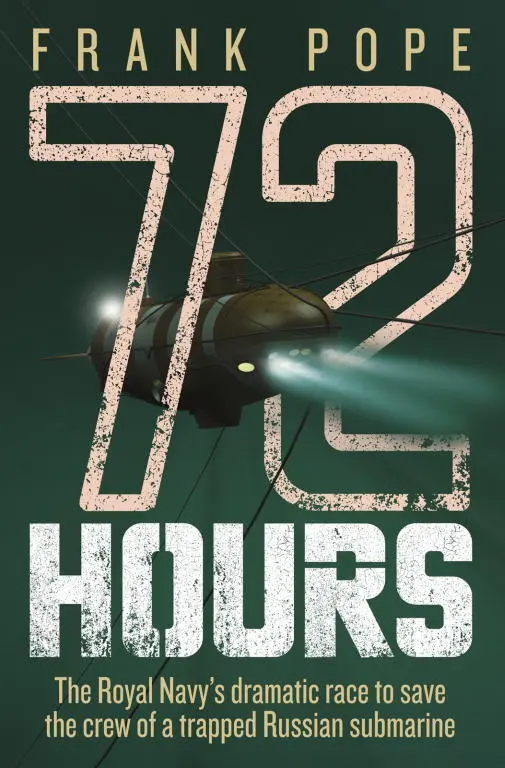
- Название:72 Hours: The First-Hand Account of a Royal Navy Mission to Save the Crew of a Trapped Russian Submarine
- Автор:
- Издательство:Orion
- Жанр:
- Год:2012
- Город:London
- ISBN:978-1-4091-4406-9
- Рейтинг книги:4 / 5. Голосов: 1
-
Избранное:Добавить в избранное
- Отзывы:
-
Ваша оценка:
72 Hours: The First-Hand Account of a Royal Navy Mission to Save the Crew of a Trapped Russian Submarine: краткое содержание, описание и аннотация
Предлагаем к чтению аннотацию, описание, краткое содержание или предисловие (зависит от того, что написал сам автор книги «72 Hours: The First-Hand Account of a Royal Navy Mission to Save the Crew of a Trapped Russian Submarine»). Если вы не нашли необходимую информацию о книге — напишите в комментариях, мы постараемся отыскать её.
5 August 2005. On a secret mission to an underwater military installation 30 miles off the coast of Kamchatka, Russian Navy submersible AS-28 ran into a web of cables and stuck fast. With 600 feet of freezing water above them, there was no escape for the seven crew. Trapped in a titanium tomb, all they could do was wait as their air supply slowly dwindled.
For more than 24 hours the Russian Navy tried to reach them. Finally – still haunted by the loss of the nuclear submarine Kursk five years before – they requested international assistance. On the other side of the world Commander Ian Riches, leader of the Royal Navy’s Submarine Rescue Service, got the call: there was a sub down.
With the expertise and specialist equipment available to him Riches knew his team had a chance to save the men, but Kamchatka was at the very limit of their range and time was running out. As the Royal Navy prepared to deploy to Russia’s Pacific coast aboard a giant Royal Air Force C-17 airlifter, rescue teams from the United States and Japan also scrambled to reach the area.
On board AS-28 the Russian crew shut down all non-essential systems, climbed into thick thermal suits to keep the bone-chilling damp at bay and waited, desperate to eke out the stale, thin air inside the pressure hull of their craft. But as the first of them began to drift in and out of consciousness, they knew the end was close. They started writing their farewells.
72 HOURS tells the extraordinary, edge-of-the-seat and real-life story of one of the most dramatic rescue missions of recent years. Review
About the Author cite —Daily Mail
72 Hours: The First-Hand Account of a Royal Navy Mission to Save the Crew of a Trapped Russian Submarine — читать онлайн бесплатно полную книгу (весь текст) целиком
Ниже представлен текст книги, разбитый по страницам. Система сохранения места последней прочитанной страницы, позволяет с удобством читать онлайн бесплатно книгу «72 Hours: The First-Hand Account of a Royal Navy Mission to Save the Crew of a Trapped Russian Submarine», без необходимости каждый раз заново искать на чём Вы остановились. Поставьте закладку, и сможете в любой момент перейти на страницу, на которой закончили чтение.
Интервал:
Закладка:
The Station Commander handed over a Flight Authorisation Form on a clipboard. ‘You sign it, I’ll sign it. We’ll sort out the details later,’ he said.
Hewitt blinked. This was most unusual. He began to protest, but the officer cut him short. ‘You need to get out to the aircraft, Keith. Right now. There’s a crew warming it up as we speak.’
Now Hewitt knew something big was up. Fighter aircraft might get scrambled, but not a huge, cargo-transporting C17. One of the fundamental rules of flying, drummed into any pilot from the very start of their training, was that you do your own pre-flight checks of the aircraft and flight planning. But this time the necessary two hours apparently couldn’t be spared. Whoever was warming up the aircraft probably didn’t have enough crew hours remaining to take on the mission, whatever it was.
His clearances signed, Hewitt headed out of the door and jogged over to the C17 that was standing on the apron, engines running. He clambered up the port side steps into the crew door, and took two practised paces up to the left on to the flight deck. As he’d been told, the other crew had already done the pre-flights and warmed up the aircraft. It was a strange feeling, to get into the pilot’s seat and have to take it for granted that everything had been done properly. His eye skimmed over the gauges, looking for any signs that it hadn’t.
Minutes later Hewitt’s co-pilot, Flight Lieutenant John Macintyre, turned up and together they were handed command of the aircraft. There was none of the usual verification of diplomatic clearances, checking of charts or consideration of the many other aspects crucial to a successful flight – such as information about the final destination. The station commander simply said ‘First stop Glasgow Prestwick. You just go. We’ll think about the rest later on.’
The rest of the crew had been on standby for the Special flight. They didn’t know much, but they did tell Hewitt more than he’d known up until then: they were on a submarine rescue mission.
Originally the C17 was to fly to Prestwick, pick up Scorpio and the rescue team, then tack back to Brize Norton to pick up a second aircrew. That would have allowed the aircraft to depart at around midnight. Then word had come back from Moscow that time was already becoming critically short, and if they were going to be of any help they’d need to arrive faster than that.
Friday, 5 August/Saturday, 6 August
SS + 33 h 45 mins
Two hundred feet above the Irish Sea, Squadron Leader Dan Gray was trying to keep his cool while flying his Nimrod maritime reconnaissance aircraft in a tight search pattern above the water. While his eyes flicked between altimeter, airspeed, heading and the sky ahead, the six analysts in the back were scouring the sea below for the enemy submarine. At that altitude there was no room for error, and Gray had to keep the aircraft on rails so as not to miss out any patches of sea where the boat might be hiding. They’d never find it, of course. They were on a training exercise.
Flying a search at this altitude wouldn’t ordinarily have caused Gray any discomfort but for the presence of the man standing behind him on the flight deck. The Standards and Evaluations team were on board, checking that everything his crew did was up to scratch and as per training. All through the aircraft, inspectors were shadowing each of the tasks being performed. So far things seemed to have gone fine. Before the submarine search they’d run through a couple of Anti-Surface Unit exercises, doing radar scans at a thousand feet to identify targets – in this case hapless fishing vessels – before dropping down to 200 feet for a close pass in which to take photographs. It wasn’t a move used in combat situations, but secure identifications were a likely request in the run-up to escalations, and were a vital part of their tactical quiver.
Back at the navigation panel, Flight Lieutenant Simon King was feeling on top of things too. The navigation was going according to plan, and that’s the way he wanted it to stay. Four hours into the flight, they were coming towards the end of the search phase. Soon they’d be turning for home.
Back in the main body of the aircraft, amid the banks of equipment used by the ‘wet operators’ – those who scan beneath the sea for enemy submarines – and the above-water radar and ESM modules, the Radio Officer turned to the telex machine that had started clattering. It might be 1970s technology, but for clarity nothing quite beat an order coming through in printed form. This one was from OPCON, the Operational Controller.
IMMEDIATE RETASK IF FUEL PERMITS. YOU ARE TO LAND AT BRISTOL TO PICK UP PAX FOR KINLOSS
The Radio Officer tore off the paper and immediately relayed the message through the hardwired audio link forward to the nav room and flight deck.
King swore to himself. This was the last thing they needed on a STEV flight. All his careful pre-flight planning would go out the window. With the inspector watching his every move in silence, King immediately started working with his co-navigator, Squadron Leader Martin Williams, to plot a route to Bristol, and up to Kinloss as the first stage in deciding whether they would have enough fuel to take the assignment. Making the trip itself would be fine, King could already see. The problem was the diversions. For every intended landing, he had to make sure the aircraft had enough fuel to divert to a different strip, just in case there was a problem with the first choice.
There were two airfields near Bristol, the International Airport at Lulsgate and the strip at Filton. Lulsgate was often shrouded in fog – it was so notorious that Second World War fighter pilots were sent there for low-visibility training. King made inquires, discovered that the passenger was coming from Abbey Wood, and decided to plan for the one that was closer by, Filton.
Neither of the navigators had landed at Filton before, so they pulled out the Terminal Approach Procedures manual and checked that the runway was long enough. It was – in fact, in April 1969 the second Concorde had taken its maiden flight from that very runway. British Aerospace still had factories there. Thanks to the residential houses nearby the approach was strictly controlled by Noise Abatement Procedures, but otherwise there didn’t appear to be any problems with landing there.
Williams began calculating distances, windspeeds and altitudes. King took detailed readings from the fuel tank gauges, then pulled down the thick Operating Data Manual and started running through the decision trees and many lines of calculation required to estimate the fuel burn for the trip.
It was no simple matter. Ascents and descents used different amounts of fuel depending on how heavy the aircraft was, which in turn was largely determined by how much fuel remained on board. The weight of the aircraft also affected how much braking was required to stop it on the runway. The hotter the brakes after landing, the longer they’d have to wait before take-off. Shutting down the engines during the wait was out of the question because of the time-consuming start-up processes, but keeping them idling also bit into the fuel calculations further down the line.
Some of the boys weren’t going to be happy about the changes to their Friday night plans, thought King, but he reasoned that OPCON didn’t issue a change of plan like this for no reason. The pressure was to get it right in front of the STEV team. If they screwed up, they could get bumped off Combat Ready status to Limited Combat Ready or even, if things went really awry, Non-Combat Ready.
Читать дальшеИнтервал:
Закладка:
Похожие книги на «72 Hours: The First-Hand Account of a Royal Navy Mission to Save the Crew of a Trapped Russian Submarine»
Представляем Вашему вниманию похожие книги на «72 Hours: The First-Hand Account of a Royal Navy Mission to Save the Crew of a Trapped Russian Submarine» списком для выбора. Мы отобрали схожую по названию и смыслу литературу в надежде предоставить читателям больше вариантов отыскать новые, интересные, ещё непрочитанные произведения.










Обсуждение, отзывы о книге «72 Hours: The First-Hand Account of a Royal Navy Mission to Save the Crew of a Trapped Russian Submarine» и просто собственные мнения читателей. Оставьте ваши комментарии, напишите, что Вы думаете о произведении, его смысле или главных героях. Укажите что конкретно понравилось, а что нет, и почему Вы так считаете.