Ben Kane - The Silver Eagle
Здесь есть возможность читать онлайн «Ben Kane - The Silver Eagle» весь текст электронной книги совершенно бесплатно (целиком полную версию без сокращений). В некоторых случаях можно слушать аудио, скачать через торрент в формате fb2 и присутствует краткое содержание. Жанр: Исторические приключения, на английском языке. Описание произведения, (предисловие) а так же отзывы посетителей доступны на портале библиотеки ЛибКат.
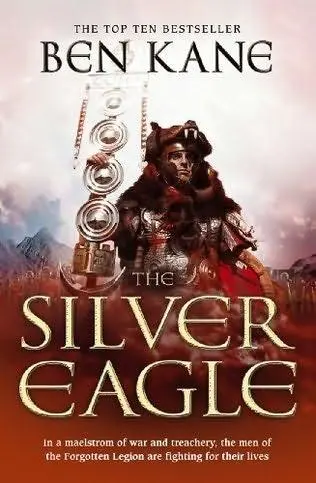
- Название:The Silver Eagle
- Автор:
- Жанр:
- Год:неизвестен
- ISBN:нет данных
- Рейтинг книги:3 / 5. Голосов: 1
-
Избранное:Добавить в избранное
- Отзывы:
-
Ваша оценка:
The Silver Eagle: краткое содержание, описание и аннотация
Предлагаем к чтению аннотацию, описание, краткое содержание или предисловие (зависит от того, что написал сам автор книги «The Silver Eagle»). Если вы не нашли необходимую информацию о книге — напишите в комментариях, мы постараемся отыскать её.
The Silver Eagle — читать онлайн бесплатно полную книгу (весь текст) целиком
Ниже представлен текст книги, разбитый по страницам. Система сохранения места последней прочитанной страницы, позволяет с удобством читать онлайн бесплатно книгу «The Silver Eagle», без необходимости каждый раз заново искать на чём Вы остановились. Поставьте закладку, и сможете в любой момент перейти на страницу, на которой закончили чтение.
Интервал:
Закладка:
Ten steps from Fabiola, a centurion collapsed. He kicked spasmodically and then lay still.
She stared at him in horror.
The officer had just taken off his horsehair-crested helmet to wipe the sweat from his brow. Now an egg-shaped depression visible through his short hair was leaking a mixture of blood and clear fluid. His skull had been smashed.
‘Shields up!’ roared Caesar.
Grabbing a discarded Brutus darted to Fabiola’s side and drew her to him. With it over her head, she was able to witness the Roman legions in action at first hand. Although the volleys of missiles had caused many casualties, the other soldiers did not panic. The gaps in the ranks closed swiftly, and the next stream of stones and javelins clattered down harmlessly on their shields. scutum ,
‘We can’t stay here like this,’ said Fabiola. ‘They’ll slaughter us.’
‘Wait.’ Brutus smiled. ‘Watch.’
‘Those with torches, hand them to the men behind. To the second cohort,’ ordered Caesar. ‘Quickly!’
His command was obeyed at once.
‘Front ranks,’ Caesar shouted. ‘Ready your pila ! Aim long!’
Hundreds of men drew their right arms back.
‘Loose!’
The Roman response rose up in a steep trajectory, flying high over the Egyptian legionaries. As Fabiola watched, the metal-tipped rain landed among the unarmoured slingers and skirmishers, striking them down in great swathes. Distracted by the screams of their comrades to the rear, the enemy troops’ front ranks visibly wavered. They were given no chance to recover.
‘First cohort, charge!’ Caesar’s order rang out crisp and clear. ‘Loose pila at will!’
His men had followed their general for years, through thick and thin. From Gaul to Germania, Britannia to Hispania and Greece, he had never failed them.
A swelling roar of anger left their throats and the front ranks swarmed forward at the Egyptians. Javelins were hurled as they ran, lodging in enemy scuta and injuring scores more soldiers.
Caesar was not finished. ‘Those in the second cohort, ready your torches.’
Still Fabiola did not understand, but a huge smile was spreading across Brutus’ face.
‘Aim at the ships! I want their sails to catch fire!’
Caesar’s men bellowed their approval.
‘Loose!’
Turning end over end in graceful, golden cartwheels of flame, dozens of torches flew through the darkness. It was one of the most beautiful things Fabiola had ever seen. And the most destructive. Loud screams rose from the ships and gilded barges as sailors were struck by the burning pieces of wood. There were muffled thumps as some torches landed on the vessels’ decks and hissing sounds as others fell into the water.
Just a few caught in the tightly furled sails. It was enough. Dried out by the sunshine and sea breezes, the heavy fabric was bone dry. Lit for some time, the pitch on the torches was red hot. It was a perfect mix.
Here and there, tell-tale yellow glowing patches appeared. They spread fast, reaching the masts within a matter of moments. Fabiola could not help but admire Caesar’s ingenuity.
Wails of dismay rose from the watching Egyptian soldiers. Their fleet was going to burn.
And then the legionaries hit them.
Reaching Alexandria had not proved difficult. After a long march in late-afternoon sunshine, the two friends had arrived at the southern outer walls. Gaining entry was similarly easy. Plenty of guards were on duty, bored-looking Egyptians in Roman-style mail and helmets, but they showed little interest in a pair of dusty travellers. Closing the Gate of the Sun at sundown was of more concern. Although keen to find out what was going on, Romulus and Tarquinius had not asked any questions of the sentries. It was not worth the potential problems they might encounter if their own armour and weapons were discovered. They would have to find out what they could from ordinary citizens.
But there had been little activity within the city. In fact, it was almost deserted. Even the Argeus, the main street which ran north to south, was virtually empty. A few people scuttled here and there between the obelisks, fountains and palm trees on its central parade, but the usual stalls selling food, drink, pottery and metalwork were abandoned, their wooden surfaces bare. Even the huge temples were vacant of worshippers.
It looked as if Tarquinius’ predictions were right: there had been fighting.
Their suspicions were raised further by the sight of Egyptian troops assembling outside what looked like a large barracks. Aware that they could be regarded as enemies, the pair ducked out of sight into an alleyway. More soldiers filled the next street as well. Using Hiero’s directions and the position of the sunlight, they worked their way through the rectangular grid of thoroughfares towards the centre. Romulus’ uneasiness grew steadily as the distance from the southern gate increased. But they could find no one to talk to. And Tarquinius was like a man driven: his expression eager, his pace fast.
By the time darkness fell, they had passed the tree-covered Paneium, a man-made hill dedicated to the god Pan, and the immense temple to Serapis, the god invented by the Ptolemies. Romulus was awestruck by Alexandria’s architecture and layout. Unlike Rome, which had only two streets wider than an ordinary ox-cart, this city had been built on a grand scale to an imaginative master plan. Rather than single impressive buildings or shrines dotted here and there, whole avenues of them were laid out. Everywhere there were grand squares, splashing fountains and well-designed gardens. Amazed by the Argeus, Romulus was bowled over by the Canopic Way, the main avenue which ran east to west straight across the city. At its intersection with the Argeus, he was able to appreciate its extraordinary length thanks to Alexandria’s flat terrain. The junction itself was dominated by a magnificent square filled with an obelisk and a huge fountain, which was decorated with marvellous statues of water creatures, real and mythical.
Romulus had been especially thrilled to see the outside of the Sema, the huge walled enclosure that contained the tombs of all the Ptolemy kings, as well as that of Alexander the Great. According to Tarquinius, his body was still on view inside, encased in an alabaster sarcophagus. He would have dearly loved to pay his respects to the greatest general who had ever lived, in whose footsteps he and Tarquinius had marched with the Forgotten Legion. But Romulus had to content himself with just seeing the site of Alexander’s final resting place. It helped him to feel that, in some way, his life had come full circle. Italy was not far away. What a pity Brennus was not with them too, Romulus thought sadly. But that had not been his fate.
Like all the other public buildings though, the Sema was shut, its tall wooden doors barred. As the sun set, its dying light turned the structure’s white marble an ominous blood-red colour.
At the same time, a bright yellow glow lit up the sky to the north.
Romulus stared in shock.
‘The lighthouse,’ said Tarquinius. ‘It can be seen thirty miles out to sea.’
There was nothing like that in the whole Republic, thought Romulus in amazement. The Egyptians were obviously a people of great ability. Everything he had seen here today proved that. And now, as it had done with so many other civilisations, Rome had come to conquer. Except, as Romulus was shortly to discover, things were not going to plan.
‘How far is the harbour?’
‘A few blocks.’ Tarquinius grinned boyishly. ‘The library is near too. Tens of thousands of books all in one place. I have to see it!’
Romulus was momentarily infected by his friend’s enthusiasm. But his fear soon returned as shouts and the clash of arms reached their ears. The noise was not far away, and it was coming from the direction that they were heading in. ‘Let’s go back,’ he urged. ‘We’ve seen enough.’
Читать дальшеИнтервал:
Закладка:
Похожие книги на «The Silver Eagle»
Представляем Вашему вниманию похожие книги на «The Silver Eagle» списком для выбора. Мы отобрали схожую по названию и смыслу литературу в надежде предоставить читателям больше вариантов отыскать новые, интересные, ещё непрочитанные произведения.

Обсуждение, отзывы о книге «The Silver Eagle» и просто собственные мнения читателей. Оставьте ваши комментарии, напишите, что Вы думаете о произведении, его смысле или главных героях. Укажите что конкретно понравилось, а что нет, и почему Вы так считаете.