Jonathan Watts - When a Billion Chinese Jump
Здесь есть возможность читать онлайн «Jonathan Watts - When a Billion Chinese Jump» весь текст электронной книги совершенно бесплатно (целиком полную версию без сокращений). В некоторых случаях можно слушать аудио, скачать через торрент в формате fb2 и присутствует краткое содержание. Город: New York, Год выпуска: 2010, ISBN: 2010, Издательство: Scribner, Жанр: sci_ecology, Публицистика, на английском языке. Описание произведения, (предисловие) а так же отзывы посетителей доступны на портале библиотеки ЛибКат.
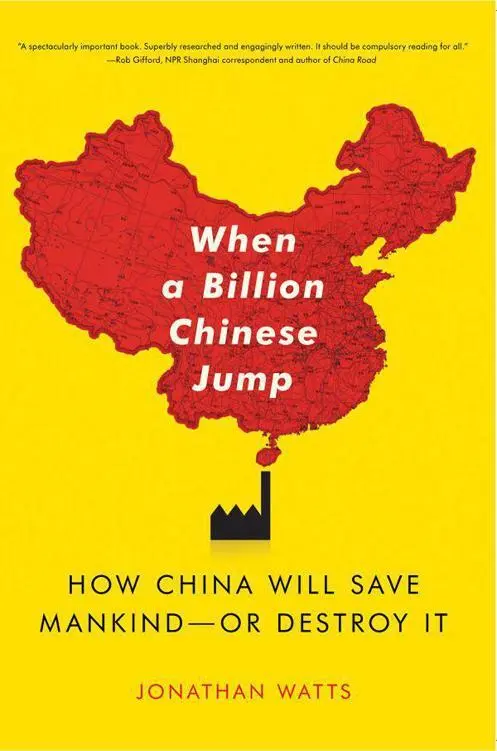
- Название:When a Billion Chinese Jump
- Автор:
- Издательство:Scribner
- Жанр:
- Год:2010
- Город:New York
- ISBN:978-1-4165-8076-8
- Рейтинг книги:3 / 5. Голосов: 1
-
Избранное:Добавить в избранное
- Отзывы:
-
Ваша оценка:
When a Billion Chinese Jump: краткое содержание, описание и аннотация
Предлагаем к чтению аннотацию, описание, краткое содержание или предисловие (зависит от того, что написал сам автор книги «When a Billion Chinese Jump»). Если вы не нашли необходимую информацию о книге — напишите в комментариях, мы постараемся отыскать её.
Starred Review
From Publishers Weekly
From Booklist Watts, an environmental correspondent for the Guardian, moved to Beijing in 2003 and found himself in the midst of an environmental crisis. Traveling through the vast land, Watts witnessed the toll that dams and railways take on the mountains of Tibet, and took part in an expedition to locate the last of a dwindling dolphin species known as the baiji, which was declared extinct after the search failed to turn up even a single one. He saw where Western waste—everything from computer hard drives to hotel welcome mats—piled up to be recycled in Guangdong and witnessed the suffering of people afflicted with cancer and AIDS in overcrowded Henan province. This stands in stark contrast to the luxuries of modernized cities, such as Shanghai, or even industrial villages like Huaxi, where citizens enjoy higher standards of living, in exchange for handing their paper wealth over to the authorities. Watts also meets forward-looking thinkers, such as Li Can, a professor working on solar power. Watts’ comprehensive, revealing study is eye-opening, not only for the way it illuminates how China’s population growth and rapid modernization affect the environment, but also for its exposure of the way Western waste contributes to the problem.
—Kristine Huntley
When a Billion Chinese Jump — читать онлайн бесплатно полную книгу (весь текст) целиком
Ниже представлен текст книги, разбитый по страницам. Система сохранения места последней прочитанной страницы, позволяет с удобством читать онлайн бесплатно книгу «When a Billion Chinese Jump», без необходимости каждый раз заново искать на чём Вы остановились. Поставьте закладку, и сможете в любой момент перейти на страницу, на которой закончили чтение.
Интервал:
Закладка:
On the road out of Guiyu I saw a banner proclaiming, “Protecting the Environment Is Enriching Life.” As was often the case in China, the ideal of the propaganda was the opposite of reality on the streets. It was aspirational. The country’s political system was well described as “government by slogan.” 20
Recycling could be less of a hazard with better governance, but Guangdong’s economic success has been achieved with speed and energy, not caution and regulation. That is part of its attraction to foreign capital. Since 1979, when the port of Shenzhen was chosen as one of the pioneer economic development zones, Guangdong has been at the forefront of China’s spectacular transformation. It was here that former paramount leader Deng Xiaoping launched his famous southern tour in 1992, when he urged the nation to follow Guangdong’s example. Reform, he said, should not “proceed slowly like women with bound feet, but blaze a trail and press forward boldly.”
The province has thrived on the shifting ideological border between old-style mainland communism and the capitalism of neighboring Hong Kong, its main conduit for trade and investment. Ethics have been contorted by the province’s itinerant, border culture. As well as building one of the most spectacular and dynamic economies in the modern world, Guangdong has pioneered a model of corrupt, land-grabbing, labor-abusing, environment-degrading development. For a journalist, it is a gold mine.
How manufacturing costs were kept low is one of the province’s dirtiest secrets. Manufacturers are often contractually obliged not to reveal which companies they make products for because the value of brands could be destroyed if consumers are informed about factory conditions. Weak governance helps companies cover up, but the people of Guangdong knew better than anyone the real worth of luxury-brand bags and footwear because they make many of the components.
Due to weak governance, the province has become a counterfeiting center as well as a manufacturing hub, sometimes turning out the knockoffs very close to the original. The city of Shantou on the northeast coast is notorious for copying products made in foreign-invested factories. 21The cultural fakery also applies to art. At Dafen, 3,000 counterfeit painters produce Rembrandts, Picassos, and Dalís at the rate of fifty masterpieces per day. You can haggle down a copy of Vincent Van Gogh’s Sunflowers to a mere 50 yuan.
Income disparities are more glaring here than most places in China. On one side is Hong Kong, which has the tenth-richest population on the planet. On the other is Guangxi, one of the poorest provinces in China with an average income twenty times lower. 22Lodged between these extremes, Guangdong is a hotbed of tension and crime. Corruption is rampant. 23“Black society” gangs, such as the Triads, are traditionally strong in this region, partly because of Canton’s tribal culture but also because of the proximity of the gambling dens of Macau and the opportunities of underworld business in Hong Kong. Many local governments and businesses employ thugs. One night in Shenzhen, a row over an inflated bar bill ended up with two friends and me being chased by a gang of more than a dozen heavies. They surrounded our taxi, smashed my glasses, and badly beat up one of my friends with sticks and belts. It could easily have been much worse.
Far more violent tensions were found at the shifting boundary between urban and rural Guangdong. Pressure often exploded to the surface, particularly when farmland was requisitioned for expanding cities and industrial estates. Like many correspondents, I had spent much of my time in China interviewing dispossessed farmers in Guangdong, which was on the front line of the land disputes. Governance, the law, and farmers’ interests were sacrificed in the name of economic expediency so land could be secured for more factories, showrooms, and dump sites. The illegality of the authorities’ actions was evident in their attempts to cover up what they were doing. In Xiangyang, I was detained by police, who admitted they had intercepted my phone calls to local protesters. In Taishi, two rural activists were put under house arrest to prevent them from speaking to me. 24To avoid getting another in trouble, I had to dash through an emergency exit and hide in a restaurant toilet for thirty minutes to avoid detection.
In Sanshan, residents were so desperate to appeal to the outside world about the confiscation of their land that they took the risk of sneaking out of their villages at midnight, being interviewed through the early hours, and then returning just before dawn. Some passed on messages and pictures through intermediaries. Others agreed to meet in parks where they could check whether any of us were being followed. Other interviews could only be conducted by phone—frequently switching prepaid SIM cards because the police might be listening in. This, in what was supposedly the most modern and open province in China.
Guangdong had other dirty secrets. It was a hub for the illegal trade in endangered species. Stallholders, restaurants, and chemists competed to offer the most unusual wildlife dishes and medicines from the traditional pharmacopoeia described in the previous chapter. Markets teemed with more exotic creatures than many zoos. The stalls sold snakes, scorpions, salamanders, and dozens of species of birds and turtles, some of which were endangered. Rare animals were once partially protected by their price. In the past, only the rich could afford such delicacies. But with the rise in wealth, many were being mass-consumed into extinction. 25
I had a soft spot for the pangolin, a cute scaly anteater that was much in demand for its tasty meat and because its scales were thought to regulate menstruation and to help mothers lactate. The creature had once been common in Guangdong, Yunnan, and Guangxi but was now extremely rare in China. To meet the growing demand, hunters moved to neighboring Cambodia, Vietnam, and Laos; then, when the pangolin populations of these nations were decimated, they pushed ever farther south down through Thailand and the Malay peninsula to Indonesia. The last healthy populations in the remote jungles of Java were also coming under threat. 26
The smuggling of these beasts was highlighted in May 2006, when a rickety wooden vessel lost engine power off Qingzhou Island off the coast of Guangdong. After the coast guard boarded the abandoned boat, they discovered 5,000 of the world’s rarest animals, many so dehydrated from the tropical sun that they were close to death. Crushed inside 200 cages on this 25-meter craft were 31 pangolins, 44 leatherback turtles, 2,720 monitor lizards, and 1,130 Brazilian turtles. They also found twenty-one bear paws wrapped in newspaper. 27The cargo would probably never have been discovered if it were not for the engine failure, and many more are undoubtedly smuggled in undetected.
Weak governance was at the core of the problem. Police investigations into illegal wildlife consumption were stepped up, but they made limited progress. 28In 2006, a waitress at one Guangdong restaurant did not think twice before confirming to my assistant, who was posing as a customer, that pangolin was indeed on the menu. Three years later, after countless other supposed crackdowns, we found another restaurant offering pangolin at 1,000 yuan (about $143) per kilogram. “You need to pay in advance and then we will find one for you,” said an employee. “We can cook it in a hot pot or braise it in soy sauce.”
As illegal restaurants and markets were closed down, others opened up elsewhere or were pushed underground. At 4 a.m., in a dark suburb of Taiping, about an hour’s drive from downtown Guangzhou, I found exotic-animal traders covertly doing business out of sight of the authorities and conservationists. The three long rows of sheds they occupied resembled a cramped and dirty zoo filled with wire cages: long and tall for the herons, flat and low for the civet cats. Ostriches had room to move their necks but not their bodies. Local conservationists told me there were similar markets throughout southern China.
Читать дальшеИнтервал:
Закладка:
Похожие книги на «When a Billion Chinese Jump»
Представляем Вашему вниманию похожие книги на «When a Billion Chinese Jump» списком для выбора. Мы отобрали схожую по названию и смыслу литературу в надежде предоставить читателям больше вариантов отыскать новые, интересные, ещё непрочитанные произведения.









Обсуждение, отзывы о книге «When a Billion Chinese Jump» и просто собственные мнения читателей. Оставьте ваши комментарии, напишите, что Вы думаете о произведении, его смысле или главных героях. Укажите что конкретно понравилось, а что нет, и почему Вы так считаете.