Vladimir Yakunin - The Treacherous Path - An Insider's Account of Modern Russia
Здесь есть возможность читать онлайн «Vladimir Yakunin - The Treacherous Path - An Insider's Account of Modern Russia» весь текст электронной книги совершенно бесплатно (целиком полную версию без сокращений). В некоторых случаях можно слушать аудио, скачать через торрент в формате fb2 и присутствует краткое содержание. Город: London, Год выпуска: 2018, ISBN: 2018, Издательство: Biteback Publishing, Жанр: Политика, Биографии и Мемуары, Публицистика, на английском языке. Описание произведения, (предисловие) а так же отзывы посетителей доступны на портале библиотеки ЛибКат.
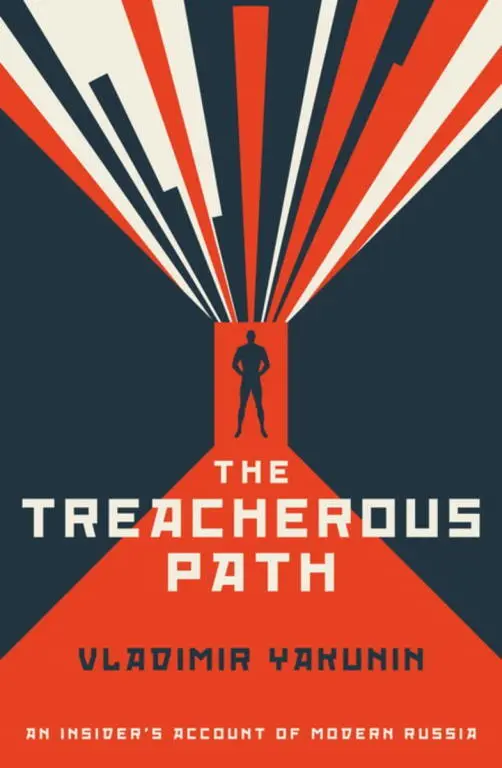
- Название:The Treacherous Path: An Insider's Account of Modern Russia
- Автор:
- Издательство:Biteback Publishing
- Жанр:
- Год:2018
- Город:London
- ISBN:978-1-78590-377-9
- Рейтинг книги:4 / 5. Голосов: 2
-
Избранное:Добавить в избранное
- Отзывы:
-
Ваша оценка:
The Treacherous Path: An Insider's Account of Modern Russia: краткое содержание, описание и аннотация
Предлагаем к чтению аннотацию, описание, краткое содержание или предисловие (зависит от того, что написал сам автор книги «The Treacherous Path: An Insider's Account of Modern Russia»). Если вы не нашли необходимую информацию о книге — напишите в комментариях, мы постараемся отыскать её.
The state that he had served for all his adult life had been dissolved, the values he knew abandoned. Millions of his compatriots suffered as their savings disappeared and their previously secure existences were threatened by an unholy combination of criminality, corruption and chaos. Others thrived amid the opportunities offered in the new polity, and a battle began over the direction the fledgling state should take.
While something resembling stability was won in the early 2000s, today Russia’s future remains unresolved; its governing class divided.
The Treacherous Path is Yakunin’s account of his own experiences on the front line of Russia’s implosion and eventual resurgence, and of a career – as an intelligence officer, a government minister and for ten years the CEO of Russia’s largest company – that has taken him from the furthest corners of this incomprehensibly vast and complex nation to the Kremlin’s corridors.
Tackling topics as diverse as terrorism, government intrigue and the reality of doing business in Russia, and offering unparalleled insights into the post-Soviet mindset, this is the first time that a figure with Yakunin’s background has talked so openly and frankly about his country. Reviews cite —Dominique de Villepin, Prime Minister of France 2005–2007 cite —Malcolm Rifkind, Foreign Secretary 1992–1997
The Treacherous Path: An Insider's Account of Modern Russia — читать онлайн бесплатно полную книгу (весь текст) целиком
Ниже представлен текст книги, разбитый по страницам. Система сохранения места последней прочитанной страницы, позволяет с удобством читать онлайн бесплатно книгу «The Treacherous Path: An Insider's Account of Modern Russia», без необходимости каждый раз заново искать на чём Вы остановились. Поставьте закладку, и сможете в любой момент перейти на страницу, на которой закончили чтение.
Интервал:
Закладка:
By the time I was born, traces of the pre-revolutionary attitudes to faith and nationhood had survived, but they were only fragmentary and diffident. The ambiguous position Russia enjoyed within the Soviet Union meant that many Russians had a somewhat confused national identity. For years, the terms ‘Russian’ and ‘Soviet’ had been elided. And the vigorous repression of traditional identities meant that generations grew up with an unclear notion of what it really meant to be Russian – much of our heritage, with the exception of those elements that the Bolsheviks had coopted for their own purposes, had been suppressed or allowed to decay.
My mother had to arrange for me to be baptised in secret, an event that was hidden even from my father. As a Communist Party member, he could not be implicated in this conspiracy; if it had been discovered that he knew anything then he was at risk of punishment. I would not even say my mother was particularly religious, but I think she understood the importance of tradition. We would visit churches when I was young, and we would pray, but our engagement was as much about maintaining a connection with our country’s customs and heritage as it was about religious observance.
But I did not, at least to begin with, understand the scale of our nation’s loss, for I had been born into a happy generation. We were the children of the Khrushchev thaw, a period of openness and calm that was in stark contrast to the violence and cynicism of High Stalinism. The country had been in almost permanent turmoil since 1917, but the Civil War, the rural nightmare of collectivisation and the savage and uncertain years of the purges and five-year-plans were memories now. A nation ravaged by one of the most brutal and destructive conflicts in history – that between 1941 and 1945 had lost more than 26 million citizens – had been able to send a man into space just sixteen years later.
Like everyone around me, I grew up convinced that socialism was inevitable and that, within my lifetime, it would reign throughout the world, bringing with it peace, equality and a better standard of living for everyone. There was a true sense of community and cohesion and we did not worry about the future. Like my peers, I felt, more than anything, free. We were encouraged to follow our dreams, and the country in which we lived provided us with the tools to achieve them.
From an early age, we were all participants in a comprehensive programme designed to introduce the entire population to the socialist principles that underpinned our society. At twelve, we joined the Pioneers and then, when we were into our teens, the Komsomol. We were taught how to be good citizens: to make friends, to help each other, to take special care to help the elderly, to respect our parents, to love our country, to try and contribute to the wellbeing of the communities in which we lived.
We were brought up on the examples of the heroes of the Patriotic War of 1812 and the Great Patriotic War of 1941–45, and learned about the achievements of socialists across the world. We were encouraged to feel proud of our education system, of our cosmonauts’ brave journeys into outer space, and also of the advances that had been made by our fellow progressives. When Fidel Castro visited the USSR in 1963, he was mobbed in the street by children who had escaped from their schools just so they could greet this hero; they were joined by their parents and friends – so many people that the police struggled to control the excitement.
Once we left school and started to work, we would discover that every factory, every shop, had some kind of representative from the regime’s local apparatus. Our lives, whether we always were conscious of it or not, were permeated by the values of socialism, and by the time we reached adulthood, the vast majority of us shared the same ideals, and were all committed to achieving the same targets.
Socialism was a system that had given us all a great deal and which we regarded as superior to the selfish, bloated and unequal capitalist regimes we learned about in our textbooks, even if it was not without its own faults. When you consider where my forebears had come from, then perhaps this confidence does not seem so misplaced. My father, who eventually would go on to be a highly respected pilot in the Soviet Frontier Guards – was born into a family of poor peasants in central Russia. It seemed to them like a miracle when he graduated from the military academy in Moscow. Sputnik was launched in 1957, when I was nine, but the most significant event for his parents that year was that they finally got electricity in their home – it is hard not to think of Lenin’s famous saying: ‘Communism is Soviet power plus the electrification of the entire country’. There was no golden age for my forebears to look back on to compare – generations had led lives scarred by poverty and exclusion.
I remember that a little later, when I was still a young boy, their household was afflicted by a tragedy: their cow passed away. It seems inconceivable now, but they depended on that animal; indeed, they were far from alone in relying on such a fragile thread for their survival. My father was forced to give his family his entire officer’s salary, together with loans from friends – 4,000 roubles, if I remember correctly; an enormous sum at the time – because he understood that they would die without it. At exactly the same time as large swathes of Russia were undergoing enormous urbanisation and industrialisation, and millions of previously impoverished citizens were offered new hope and dignity, they were part of a shadow population, left behind and forgotten by the modern world.
Though I was born only twenty-nine years after my father, the advantages I enjoyed compared to him meant that we might as well have been raised in different centuries. Those living in the first years of communism suffered terribly; they sacrificed their comfort so that we might enjoy a different kind of life. Despite the terrible losses suffered in the Great Patriotic War, by 1948 our nation had made many decades’ worth of progress in just one generation. Unlike our parents, my friends and I did not grow up stalked by hunger or frustrated by ignorance. We felt safe, well fed and secure in the knowledge that we would be receiving one of the best educations available anywhere in the world. Under the tsars, only a minority of the population had been able to read, whereas the Bolsheviks introduced compulsory universal education and built thousands of schools – I grew up in an almost completely literate society, where books were cheap and writers valued. Even in the 1930s, a time when many capitalist nations were struggling with the effects of a crippling global depression, there was close to full employment in the Soviet Union, and the same remained true when I came of age. By the time I was a teenager, it felt as if the only question that hung over us was: what would you like to be when you are older? A doctor? An engineer? A scientist?
It helped that few of us were afraid of sacrifice. We were aware of the concept of political necessity – that in order to achieve great aims, sometimes small things must be sacrificed along the way. We were prepared to put up with the occasional shortage, the incursions by the state into our private lives, the crumbling apartment blocks that stank of beer and stale smoke, because we were patriots confident that whatever we endured would be for the greater good and that the final triumph of socialism was in sight.
Later, I would come to learn about the Soviet Union’s dissidents, or ‘other-thinkers’ as they referred to themselves, whose relationship with the state and its ideology diverged sharply from the position I had taken, and who wanted their lives to unfurl in different ways to the rest of the population (although it is worth mentioning that, more often than not, their criticisms were of the way in which the USSR had veered away from the true path set out by Lenin all those years ago; it was rare that any argued for imitating the capitalistic systems of the West, which would not have occurred to people who knew nothing but a Communist regime). I knew of people who had been sent to camps, but at the time it remained a peripheral kind of knowledge, glimpsed as it were out of the corners of my eyes; it did not trespass on my loyalty.
Читать дальшеИнтервал:
Закладка:
Похожие книги на «The Treacherous Path: An Insider's Account of Modern Russia»
Представляем Вашему вниманию похожие книги на «The Treacherous Path: An Insider's Account of Modern Russia» списком для выбора. Мы отобрали схожую по названию и смыслу литературу в надежде предоставить читателям больше вариантов отыскать новые, интересные, ещё непрочитанные произведения.



Обсуждение, отзывы о книге «The Treacherous Path: An Insider's Account of Modern Russia» и просто собственные мнения читателей. Оставьте ваши комментарии, напишите, что Вы думаете о произведении, его смысле или главных героях. Укажите что конкретно понравилось, а что нет, и почему Вы так считаете.