Christopher Andrew - The Sword and the Shield
Здесь есть возможность читать онлайн «Christopher Andrew - The Sword and the Shield» весь текст электронной книги совершенно бесплатно (целиком полную версию без сокращений). В некоторых случаях можно слушать аудио, скачать через торрент в формате fb2 и присутствует краткое содержание. Город: New York, Год выпуска: 2001, ISBN: 2001, Издательство: Basic Books, Жанр: История, Политика, на английском языке. Описание произведения, (предисловие) а так же отзывы посетителей доступны на портале библиотеки ЛибКат.
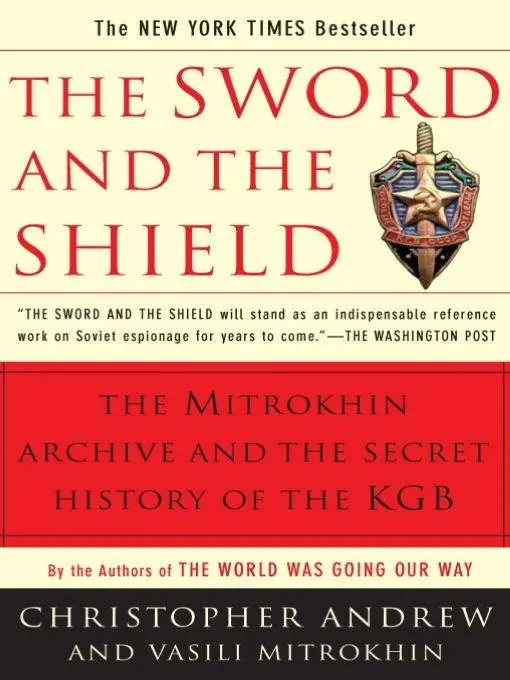
- Название:The Sword and the Shield
- Автор:
- Издательство:Basic Books
- Жанр:
- Год:2001
- Город:New York
- ISBN:978-0-465-01003-5
- Рейтинг книги:4 / 5. Голосов: 1
-
Избранное:Добавить в избранное
- Отзывы:
-
Ваша оценка:
The Sword and the Shield: краткое содержание, описание и аннотация
Предлагаем к чтению аннотацию, описание, краткое содержание или предисловие (зависит от того, что написал сам автор книги «The Sword and the Shield»). Если вы не нашли необходимую информацию о книге — напишите в комментариях, мы постараемся отыскать её.
Though there is top-secret material on almost every country in the world, the United States is at the top of the list. As well as containing many fascinating revelations, this is a major contribution to the secret history of the twentieth century.
Among the topics and revelations explored are:
• The KGB’s covert operations in the United States and throughout the West, some of which remain dangerous today.
• KGB files on Oswald and the JFK assassination that Boris Yeltsin almost certainly has no intention of showing President Clinton.
• The KGB’s attempts to discredit civil rights leader in the 1960s, including its infiltration of the inner circle of a key leader.
• The KGB’s use of radio intercept posts in New York and Washington, D.C., in the 1970s to intercept high-level U.S. government communications.
• The KGB’s attempts to steal technological secrets from major U.S. aerospace and technology corporations.
• KGB covert operations against former President Ronald Reagan, which began five years before he became president.
• KGB spies who successfully posed as U.S. citizens under a series of ingenious disguises, including several who attained access to the upper echelons of New York society.
The Sword and the Shield — читать онлайн бесплатно полную книгу (весь текст) целиком
Ниже представлен текст книги, разбитый по страницам. Система сохранения места последней прочитанной страницы, позволяет с удобством читать онлайн бесплатно книгу «The Sword and the Shield», без необходимости каждый раз заново искать на чём Вы остановились. Поставьте закладку, и сможете в любой момент перейти на страницу, на которой закончили чтение.
Интервал:
Закладка:
Bitnov was unaware that in February 1962, only seven months after his own arrival in Canada, another illegal, codenamed DOUGLAS, had landed with his wife and four-year-old son at Montreal airport. DOUGLAS was Dalibar Valoushek, a 33-year-old Czech border guard recruited by the KGB with the assistance of its Czechoslovak counterpart, the StB. 9He took the identity of a Sudeten German, Rudolf Albert Herrmann, who had died in the Soviet Union during the Second World War. According to Valoushek’s legend, Herrmann had survived the war and made his home in East Germany, then taken refuge in the West to escape the Communist regime. His wife, Inga (codenamed GERDA), a Sudeten German whose family had moved to the GDR, took the identity of Ingalore Noerke, a “dead double” who had been killed during the wartime bombing of Stettin. At the end of 1957 the Valousheks fled to the West, loudly proclaiming their hatred of the East German regime. They spent the next four years strengthening their legends as anti-Communist refugees while Valoushek learned how to run a small business. 10
Once in Canada, Valoushek proved a much better businessman than Bitnov—though not quite as successful as published accounts of his career (which do not give his real identity) have suggested. Soon after his arrival in Canada he bought Harold’s Famous Delicatessen in downtown Toronto, which he and Inga, as “Rudi” and “Inga Herrmann” made a popular rendezvous for staff from the nearby studios of the Canadian Broadcasting Company. After two years Valoushek sold the delicatessen, got a job as a CBC sound engineer and took courses in film-making. His first major assignment was on a film advertising campaign for the Liberal Party. By the mid-1960s he had a reputation as a popular and successful film-maker. At the 1967 Liberal convention, which elected Pierre Trudeau as party leader, Trudeau leaned off the stage and playfully popped grapes into “Rudi Herrmann’s” mouth. 11Though Valoushek’s business appeared prosperous, however, his KGB file reveals that the Centre had to provide 10,000 dollars to cover trading losses. 12
In 1967 Valoushek became the controller of the KGB’s most important Canadian agent, Hugh Hambleton (RADOV). 13After losing his job at NATO on security grounds in 1961 (though without any charges being brought against him), Hambleton had spent the next three years taking a PhD at the London School of Economics, returning to Canada in 1967 to become a professor in the economics department at Laval University in Quebec. Once back in Quebec, Hambleton’s contact with the KGB dwindled. He met an officer from the legal residency three times in Ottawa, on each occasion talking to him in a car parked near the main post office. Hambleton, however, disliked his new controller, who tried unsuccessfully to persuade him to apply for a job in External Affairs. After an interval during which Hambleton failed to turn up for meetings in Ottawa, Valoushek was sent to Quebec to renew contact with him. During a congenial dinner at the Cháteau Frontenac overlooking the Saint Lawrence river, the two men established a mutual rapport and Hambleton agreed to resume his career as a Soviet agent. 14Over the next few years, he traveled to a great variety of destinations, combining research on academic projects with work for the KGB. He remained in touch with Valoushek until 1975, meeting him in Trinidad and Haiti, as well as Canada and the United States. But Hambleton’s travels were so far flung that it required a considerable number of KGB officers to maintain contact with him. 15
In 1968, a year after becoming Canadian citizens, Valoushek and his family were transferred to the United States to found a new illegal residency in the New York area. His first KGB contact was IVANOVA, a young Russian woman who, having formerly worked as an agent of the KGB Second Chief Directorate inside the Soviet Union, had been allowed (perhaps even encouraged) to marry an American visitor and had moved to the United States. IVANOVA gave Valoushek 15,000 dollars to establish himself and had several further secret meetings with him to pass on instructions from the Centre and letters from his Czech relatives. 16With the funds provided by IVANOVA, Valoushek made a 12,000 dollar downpayment on a secluded house fifteen miles north of New York, in Hartsdale, 17joined the New York Press Club and began work as a freelance cameraman and commercial photographer. His first major assignment from the KGB was to penetrate the Hudson Institute, a leading New York think tank. The Centre had been excited by a report from Hambleton giving information on the Institute’s members and believed it to be a major potential source of intelligence on American global strategy and defense policy. 18
IN MAY 1962, three months after Valoushek’s arrival, BOGUN, another Soviet illegal, had landed in Canada. The Centre intended that, after establishing himself in Canada, BOGUN, like DOUGLAS, should transfer to the territory of the Main Adversary. BOGUN was Gennadi Petrovich Blyablin, a 38-year-old Muscovite who had taken the identity of Peter Carl Fisher, born in Sofia in 1929 of a German father and Bulgarian mother. Like Valoushek, he perfected his German legend by living in East Germany, then moved to the West in 1959, posing as a refugee. The Centre allowed him three years to settle, legalize his status and find work in West Germany before sending him to Canada. On March 9, 1961 Blyablin married his KGBAPPROVED partner, LENA, in Hanover. In December they obtained their West German passports before setting off for Canada five months later. 19
While Valoushek found cover as a film-maker, Blyablin established himself as a freelance press photographer—a profession which provided numerous opportunities and pretexts for traveling around Canada and further afield. In February 1965, following the Centre’s instructions, Blyablin and his wife moved to the United States on immigrant visas. His main task over the next three years was photographing and providing intelligence on major military, scientific and industrial targets around the United States. 20
In 1968, however, Blyablin attracted the attention of the FBI during his investigation of major targets in the United States and had to be hurriedly recalled, together with his wife, to Moscow. 21It was later discovered that some of his correspondence with the Centre, routed via agent SKIF, had been intercepted. SKIF was Karo Huseinjyan, an ethnic Armenian born in Cyprus in 1919 was Karo Huseinjyan, an ethnic Armenian born in Cyprus in 1919 who owned a jewelry shop in Beirut and provided a forwarding service for a number of illegals. A Centre investigation disclosed that letters from Blyablin, dated April 7 and July 27, 1968, sent via Huseinjyan, had been steamed open. 22
A year before Blyablin’s sudden recall, RYBAKOV, another Soviet illegal, had arrived in the United States. RYBAKOV was Anatoli Ivanovich Rudenko, whose early career was strikingly similar to Blyablin’s. Like Blyablin, Rudenko was a Muscovite born in 1924 who had assumed a bogus German identity, spent several years in East Germany working on his legend and then moved to the West. Rudenko was given the identity documents of Heinz Walter August Feder, born in Kalisch on November 6, 1927. 23While in East Germany he had trained as a piano tuner and repairer. After crossing to West Germany in April 1961, posing as a refugee from Communism, he found a job with the world-famous piano manufacturers Steinway in Hamburg. Though Rudenko was told that his ultimate destination was the United States, in 1964 he was sent to work with a musical instrument company in London, probably in order to accustom him to an English-speaking environment. 24
Rudenko’s period in London almost ended in disaster. Once, while returning from Brussels, where he had received his maintenance allowance from a KGB operations officer, he was stopped at Heathrow and 500 pounds were found on him which he had failed to declare. Rudenko was fortunate to find a sympathetic customs officer. The money, he pleaded, was his life savings, the product of many sacrifices over the years. He was allowed to keep the 500 pounds and no action was taken against him.
Читать дальшеИнтервал:
Закладка:
Похожие книги на «The Sword and the Shield»
Представляем Вашему вниманию похожие книги на «The Sword and the Shield» списком для выбора. Мы отобрали схожую по названию и смыслу литературу в надежде предоставить читателям больше вариантов отыскать новые, интересные, ещё непрочитанные произведения.








Обсуждение, отзывы о книге «The Sword and the Shield» и просто собственные мнения читателей. Оставьте ваши комментарии, напишите, что Вы думаете о произведении, его смысле или главных героях. Укажите что конкретно понравилось, а что нет, и почему Вы так считаете.