Christopher Andrew - The Sword and the Shield
Здесь есть возможность читать онлайн «Christopher Andrew - The Sword and the Shield» весь текст электронной книги совершенно бесплатно (целиком полную версию без сокращений). В некоторых случаях можно слушать аудио, скачать через торрент в формате fb2 и присутствует краткое содержание. Город: New York, Год выпуска: 2001, ISBN: 2001, Издательство: Basic Books, Жанр: История, Политика, на английском языке. Описание произведения, (предисловие) а так же отзывы посетителей доступны на портале библиотеки ЛибКат.
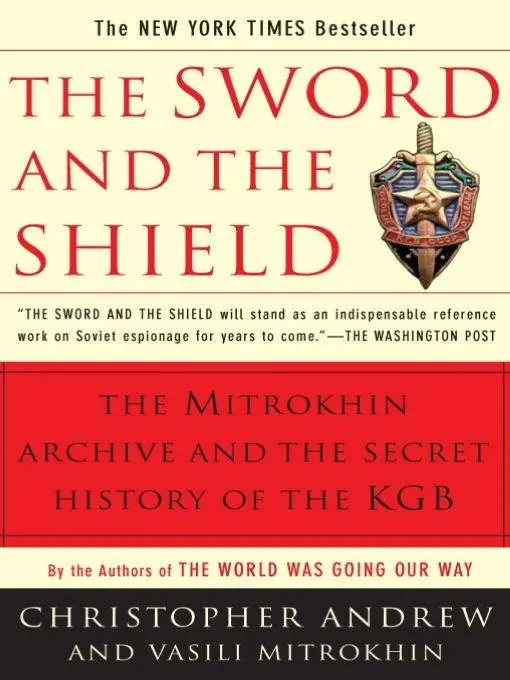
- Название:The Sword and the Shield
- Автор:
- Издательство:Basic Books
- Жанр:
- Год:2001
- Город:New York
- ISBN:978-0-465-01003-5
- Рейтинг книги:4 / 5. Голосов: 1
-
Избранное:Добавить в избранное
- Отзывы:
-
Ваша оценка:
The Sword and the Shield: краткое содержание, описание и аннотация
Предлагаем к чтению аннотацию, описание, краткое содержание или предисловие (зависит от того, что написал сам автор книги «The Sword and the Shield»). Если вы не нашли необходимую информацию о книге — напишите в комментариях, мы постараемся отыскать её.
Though there is top-secret material on almost every country in the world, the United States is at the top of the list. As well as containing many fascinating revelations, this is a major contribution to the secret history of the twentieth century.
Among the topics and revelations explored are:
• The KGB’s covert operations in the United States and throughout the West, some of which remain dangerous today.
• KGB files on Oswald and the JFK assassination that Boris Yeltsin almost certainly has no intention of showing President Clinton.
• The KGB’s attempts to discredit civil rights leader in the 1960s, including its infiltration of the inner circle of a key leader.
• The KGB’s use of radio intercept posts in New York and Washington, D.C., in the 1970s to intercept high-level U.S. government communications.
• The KGB’s attempts to steal technological secrets from major U.S. aerospace and technology corporations.
• KGB covert operations against former President Ronald Reagan, which began five years before he became president.
• KGB spies who successfully posed as U.S. citizens under a series of ingenious disguises, including several who attained access to the upper echelons of New York society.
The Sword and the Shield — читать онлайн бесплатно полную книгу (весь текст) целиком
Ниже представлен текст книги, разбитый по страницам. Система сохранения места последней прочитанной страницы, позволяет с удобством читать онлайн бесплатно книгу «The Sword and the Shield», без необходимости каждый раз заново искать на чём Вы остановились. Поставьте закладку, и сможете в любой момент перейти на страницу, на которой закончили чтение.
Интервал:
Закладка:
The fact is that not a single Party leader was anti-Soviet—not before the war, not during, not after… Stalin and the Soviet Union were our corner-stone and point of spiritual origin… 3
There were already signs by the end of the war, however, that Tito (codenamed OREL (“Eagle”) by the Centre) would be less sycophantic to Moscow than most other leaders of the emerging Soviet Bloc. Unlike other Bloc members, the Yugoslav partisans had defeated the Germans and Italians chiefly through their own efforts rather than the sacrifices of the Red Army. Tito declared ominously soon after VE Day, “We will not be dependent on anyone ever again.” Burtakov reported to the Centre:
Side by side with his positive qualities—popularity, good looks, an expressive face, spirit and willpower—OREL also has the following negative traits: lust for power, lack of modesty, arrogance and insincerity. He considers himself to be the absolute authority, prefers unquestioning obedience, dislikes an exchange of views and criticism of his orders; he is irritable, hot-tempered and curt; he loves to strike poses.
Burtakov also believed Tito was less than frank about his dealings with Britain, “although outwardly he makes a show of his supposed hostility towards the Allies, especially the British.” 4
Tito and Ranković, in turn, took a dim view of Burtakov, who became notorious for his habit of looting jewelry, crystal, china and rugs from Yugoslav mansions (a practice he was to repeat when posted to Romania and Czechoslovakia). 5At the end of 1945 Burtakov was replaced as chief adviser to the Bureau of People’s Protection (OZNA) by Arseni Vasilyevich Tishkov, known to the Yugoslavs as Timofeyev. 6
The post-war MGB had residencies in Belgrade, Zagreb, Ljubljana and Skopje, as well as four sub-residencies elsewhere in Yugoslavia, 7whose imperious behavior caused increasing resentment at Soviet intrusion into Yugoslav affairs. An inspection by the Centre reported that MGB advisers “interfered roughshod in the internal affairs of the Bureau of People’s Protection, and applied pressure in order to obtain information.” Information refused by OZNA’s leaders was surreptitiously obtained from its junior officers. 8What caused most resentment in Belgrade, however, was MGB recruitment of Yugoslav agents. Tito was unaware that two of his own ministers—Andriya Hebrang, minister of industry, and Streten Žujović, finance minister—were among them. He was, however, outraged at a Soviet attempt in 1945 to seduce and recruit Dusica Petrović, the female officer in charge of Yugoslav ciphers. When informed of the case by Ranković, Tito exploded: “A spy network is something we will not tolerate! We’ve got to let them know right away.” 9Tishkov, however, continued to demand from Tito and Ranković offices for himself and the Soviet “advisers” inside OZNA headquarters, with the right to be informed of all agent files and operations. 10
Of all Tito’s early signs of independence, the one which caused most alarm in Moscow was probably his plan for a Balkan federation—interpreted by Stalin as a potential challenge to Soviet hegemony. In March 1948 the Soviet Union recalled its advisers and angrily denounced the Yugoslav Party as riddled with both ideological heresy and British spies. On June 28 Cominform (the post-war successor to Comintern) expelled the Yugoslavs and appealed to “healthy elements” in the Party to overthrow the leadership. Tito’s flattering secret codename OREL (“Eagle”) was hurriedly downgraded to STERVYATNIK (“Carrion Crow”). 11Stalin, however, initially overestimated the ease with which “Carrion Crow” could be overthrown. “I shall shake my little finger,” he boasted to Khrushchev, “and there will be no more Tito.” When that failed, “he shook everything else he could shake;” but without success. Tito’s hold over the Party, army and state machinery remained secure.
In the summer of 1948 the MGB and UDBA (OZNA’s successor) began a vicious intelligence war. Hebrang and Žujović, the two Soviet moles in Tito’s cabinet, were arrested. Other Soviet agents were discovered in Tito’s bodyguard, of whom the most senior was Major-General Momo Jurović (codenamed VAL). According to Djilas, the UDBA discovered an MGB plot to wipe out the Yugoslav Politburo with automatic rifles while they were relaxing in the billiards room at Tito’s villa. The UDBA’s use of terror against Cominforn “traitors” rivaled in horror, if not in scale, that of the NKVD against Soviet “enemies of the people” a decade before. Djilas mournfully told Ranković, “Now we are treating Stalin’s followers just as he treated his enemies!” 12The MGB and its allied intelligence services simultaneously engaged in a purge of mostly imaginary Titoist conspirators throughout the Soviet Bloc. Their most celebrated victims were the Hungarian interior minister, László Rajk, and seven alleged accomplices who confessed at a carefully rehearsed show trial in Budapest to taking part in a vast non-existent plot hatched by Tito and the CIA. 13
The final, and most ingenious, of the MGB plans to assassinate Tito involved one of the most remarkable of all Soviet illegals, Iosif Grigulevich (at this time codenamed MAKS or DAKS), who had taken a leading part in the first, narrowly unsuccessful, attempt on Trotsky’s life in Mexico City in May 1940, had run a Latin American sabotage network during the Second World War, and in 1951—posing as Teodoro Castro—had become Costa Rican chargé d’affaires (later Minister Plenipotentiary) in Rome. 14Since Costa Rica had no diplomatic mission in Belgrade, Grigulevich was also able to obtain the post of non-resident envoy to Yugoslavia. The MGB reported to Stalin in February 1953:
While fulfilling his diplomatic duties in the second half of the year 1952, [MAKS] twice visited Yugoslavia, where he was well received. He had access to the social group close to Tito’s staff and was given the promise of a personal audience with Tito. The post held by MAKS at the present time makes it possible to use his capabilities for active measures against Tito. 15
Grigulevich volunteered for the role of assassin. At a secret meeting with senior MGB officers in Vienna early in February 1953 he suggested four possible ways to eliminate “Carrion Crow:”
1. To administer a lethal dose of pneumonic plague from a silent spray concealed in his clothing during a personal audience with Tito. (Grigulevich would be inoculated with an antidote beforehand.)
2. To obtain an invitation to the reception for Tito to be given during his forthcoming visit to London by the Yugoslav ambassador, with whom Grigulevich was on friendly terms. Grigulevich would shoot Tito with a silenced pistol, then spray tear gas at the reception to cause panic and assist his escape.
3. To use the previous method at a diplomatic reception in Belgrade.
4. To present Tito with jewelry in a booby-trapped box which would release a lethal poison gas as soon as it was opened.
Grigulevich was asked to submit more detailed proposals to the Centre, Meanwhile, the MGB assured Stalin that there was no doubt that “MAKS, because of his personal qualities and experience in intelligence work, is capable of accomplishing a mission of this kind.” 16
The use of an accredited Central American diplomat as Tito’s assassin was intended to conceal as effectively as possible the hand of the MGB. Using his Costa Rican alias, Grigulevich composed a farewell letter addressed to his Mexican wife to be made public and used to reinforce his Latin American cover if he were captured or killed during the assassination attempt. 17On March 1, 1953 the MGB reported to Stalin that MAK’s attempt to “rub out” Tito had, unfortunately, not yet taken place. This disappointing report, which Stalin read at about midnight, may well have been the last document he saw before he suffered a fatal stroke in the early hours of March 2. 18
Читать дальшеИнтервал:
Закладка:
Похожие книги на «The Sword and the Shield»
Представляем Вашему вниманию похожие книги на «The Sword and the Shield» списком для выбора. Мы отобрали схожую по названию и смыслу литературу в надежде предоставить читателям больше вариантов отыскать новые, интересные, ещё непрочитанные произведения.





Обсуждение, отзывы о книге «The Sword and the Shield» и просто собственные мнения читателей. Оставьте ваши комментарии, напишите, что Вы думаете о произведении, его смысле или главных героях. Укажите что конкретно понравилось, а что нет, и почему Вы так считаете.