Уильям Коллинз - Лучшие романы Уилки Коллинза / The Best of Wilkie Collins
Здесь есть возможность читать онлайн «Уильям Коллинз - Лучшие романы Уилки Коллинза / The Best of Wilkie Collins» — ознакомительный отрывок электронной книги совершенно бесплатно, а после прочтения отрывка купить полную версию. В некоторых случаях можно слушать аудио, скачать через торрент в формате fb2 и присутствует краткое содержание. Город: Москва, Год выпуска: 2014, ISBN: 2014, Издательство: Array Литагент «Эксмо», Жанр: foreign_language, Юмористическая проза, на английском языке. Описание произведения, (предисловие) а так же отзывы посетителей доступны на портале библиотеки ЛибКат.
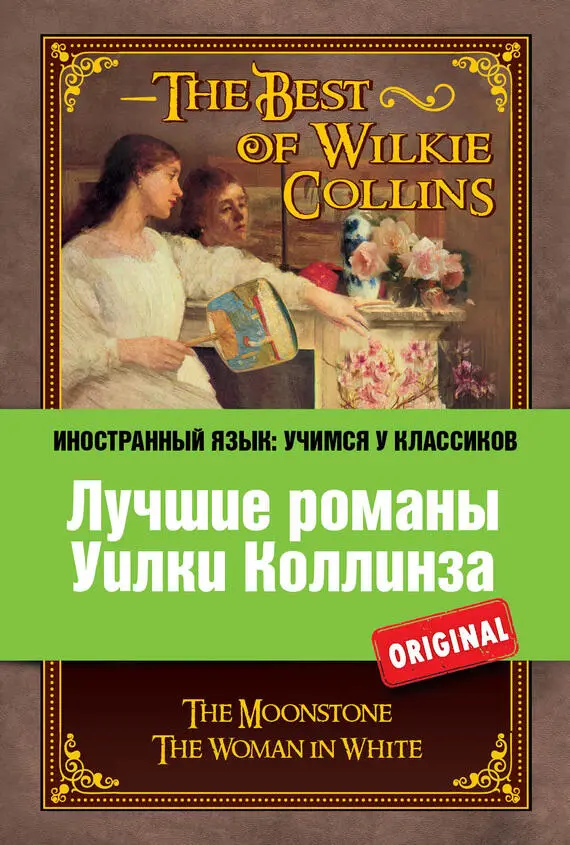
- Название:Лучшие романы Уилки Коллинза / The Best of Wilkie Collins
- Автор:
- Издательство:Array Литагент «Эксмо»
- Жанр:
- Год:2014
- Город:Москва
- ISBN:978-5-699-70380-7
- Рейтинг книги:3 / 5. Голосов: 1
-
Избранное:Добавить в избранное
- Отзывы:
-
Ваша оценка:
Лучшие романы Уилки Коллинза / The Best of Wilkie Collins: краткое содержание, описание и аннотация
Предлагаем к чтению аннотацию, описание, краткое содержание или предисловие (зависит от того, что написал сам автор книги «Лучшие романы Уилки Коллинза / The Best of Wilkie Collins»). Если вы не нашли необходимую информацию о книге — напишите в комментариях, мы постараемся отыскать её.
Серия «Иностранный язык: учимся у классиков» адресована широкому кругу читателей, хорошо владеющих английским языком и стремящихся к его совершенствованию.
Лучшие романы Уилки Коллинза / The Best of Wilkie Collins — читать онлайн ознакомительный отрывок
Ниже представлен текст книги, разбитый по страницам. Система сохранения места последней прочитанной страницы, позволяет с удобством читать онлайн бесплатно книгу «Лучшие романы Уилки Коллинза / The Best of Wilkie Collins», без необходимости каждый раз заново искать на чём Вы остановились. Поставьте закладку, и сможете в любой момент перейти на страницу, на которой закончили чтение.
Интервал:
Закладка:
The next inquiries related to the fire.
The servant and I, and the boy who had heard the light struck in the vestry, were the first witnesses called. The boy gave his evidence clearly enough, but the servant’s mind had not yet recovered the shock inflicted on it – he was plainly incapable of assisting the objects of the inquiry, and he was desired to stand down.
To my own relief, my examination was not a long one. I had not known the deceased – I had never seen him – I was not aware of his presence at Old Welmingham – and I had not been in the vestry at the finding of the body. All I could prove was that I had stopped at the clerk’s cottage to ask my way – that I had heard from him of the loss of the keys – that I had accompanied him to the church to render what help I could – that I had seen the fire – that I had heard some person unknown, inside the vestry, trying vainly to unlock the door – and that I had done what I could, from motives of humanity, to save the man. Other witnesses, who had been acquainted with the deceased, were asked if they could explain the mystery of his presumed abstraction of the keys, and his presence in the burning room. But the coroner seemed to take it for granted, naturally enough, that I, as a total stranger in the neighbourhood, and a total stranger to Sir Percival Glyde, could not be in a position to offer any evidence on these two points.
The course that I was myself bound to take, when my formal examination had closed, seemed clear to me. I did not feel called on to volunteer any statement of my own private convictions; in the first place, because my doing so could serve no practical purpose, now that all proof in support of any surmises of mine was burnt with the burnt register; in the second place, because I could not have intelligibly stated my opinion – my unsupported opinion – without disclosing the whole story of the conspiracy, and producing beyond a doubt the same unsatisfactory effect an the minds of the coroner and the jury, which I had already produced on the mind of Mr. Kyrle.
In these pages, however, and after the time that has now elapsed, no such cautions and restraints as are here described need fetter the free expression of my opinion. I will state briefly, before my pen occupies itself with other events, how my own convictions lead me to account for the abstraction of the keys, for the outbreak of the fire, and for the death of the man.
The news of my being free on bail drove Sir Percival, as I believe, to his last resources. The attempted attack on the road was one of those resources, and the suppression of all practical proof of his crime, by destroying the page of the register on which the forgery had been committed, was the other, and the surest of the two. If I could produce no extract from the original book to compare with the certified copy at Knowlesbury, I could produce no positive evidence, and could threaten him with no fatal exposure. All that was necessary to the attainment of his end was, that he should get into the vestry unperceived, that he should tear out the page in the register, and that he should leave the vestry again as privately as he had entered it.
On this supposition, it is easy to understand why he waited until nightfall before he made the attempt, and why he took advantage of the clerk’s absence to possess himself of the keys. Necessity would oblige him to strike a light to find his way to the right register, and common caution would suggest his locking the door on the inside in case of intrusion on the part of any inquisitive stranger, or on my part, if I happened to be in the neighbourhood at the time.
I cannot believe that it was any part of his intention to make the destruction of the register appear to be the result of accident, by purposely setting the vestry on fire. The bare chance that prompt assistance might arrive, and that the books might, by the remotest possibility, be saved, would have been enough, on a moment’s consideration, to dismiss any idea of this sort from his mind. Remembering the quantity of combustible objects in the vestry – the straw, the papers, the packing-cases, the dry wood, the old worm-eaten presses – all the probabilities, in my estimation, point to the fire as the result of an accident with his matches or his light.
His first impulse, under these circumstances, was doubtless to try to extinguish the flames, and failing in that, his second impulse (ignorant as he was of the state of the lock) had been to attempt to escape by the door which had given him entrance. When I had called to him, the flames must have reached across the door leading into the church, on either side of which the presses extended, and close to which the other combustible objects were placed. In all probability, the smoke and flame (confined as they were to the room) had been too much for him when he tried to escape by the inner door. He must have dropped in his death-swoon – he must have sunk in the place where he was found – just as I got on the roof to break the skylight window. Even if we had been able, afterwards, to get into the church, and to burst open the door from that side, the delay must have been fatal. He would have been past saving, long past saving, by that time. We should only have given the flames free ingress into the church – the church, which was now preserved, but which, in that event, would have shared the fate of the vestry. There is no doubt in my mind, there can be no doubt in the mind of any one, that he was a dead man before ever we got to the empty cottage, and worked with might and main to tear down the beam.
This is the nearest approach that any theory of mine can make towards accounting for a result which was visible matter of fact. As I have described them, so events passed to us outside. As I have related it, so his body was found.
The inquest was adjourned over one day – no explanation that the eye of the law could recognise having been discovered thus far to account for the mysterious circumstances of the case.
It was arranged that more witnesses should be summoned, and that the London solicitor of the deceased should be invited to attend. A medical man was also charged with the duty of reporting on the mental condition of the servant, which appeared at present to debar him from giving any evidence of the least importance. He could only declare, in a dazed way, that he had been ordered, on the night of the fire, to wait in the lane, and that he knew nothing else, except that the deceased was certainly his master.
My own impression was, that he had been first used (without any guilty knowledge on his own part) to ascertain the fact of the clerk’s absence from home on the previous day, and that he had been afterwards ordered to wait near the church (but out of sight of the vestry) to assist his master, in the event of my escaping the attack on the road, and of a collision occurring between Sir Percival and myself. It is necessary to add, that the man’s own testimony was never obtained to confirm this view. The medical report of him declared that what little mental faculty he possessed was seriously shaken; nothing satisfactory was extracted from him at the adjourned inquest, and for aught I know to the contrary, he may never have recovered to this day.
I returned to the hotel at Welmingham so jaded in body and mind, so weakened and depressed by all that I had gone through, as to be quite unfit to endure the local gossip about the inquest, and to answer the trivial questions that the talkers addressed to me in the coffee-room. I withdrew from my scanty dinner to my cheap garret-chamber to secure myself a little quiet, and to think undisturbed of Laura and Marian.
If I had been a richer man I would have gone back to London, and would have comforted myself with a sight of the two dear faces again that night. But I was bound to appear, if called on, at the adjourned inquest, and doubly bound to answer my bail before the magistrate at Knowlesbury. Our slender resources had suffered already, and the doubtful future – more doubtful than ever now – made me dread decreasing our means unnecessarily by allowing myself an indulgence even at the small cost of a double railway journey in the carriages of the second class.
Читать дальшеИнтервал:
Закладка:
Похожие книги на «Лучшие романы Уилки Коллинза / The Best of Wilkie Collins»
Представляем Вашему вниманию похожие книги на «Лучшие романы Уилки Коллинза / The Best of Wilkie Collins» списком для выбора. Мы отобрали схожую по названию и смыслу литературу в надежде предоставить читателям больше вариантов отыскать новые, интересные, ещё непрочитанные произведения.





Обсуждение, отзывы о книге «Лучшие романы Уилки Коллинза / The Best of Wilkie Collins» и просто собственные мнения читателей. Оставьте ваши комментарии, напишите, что Вы думаете о произведении, его смысле или главных героях. Укажите что конкретно понравилось, а что нет, и почему Вы так считаете.