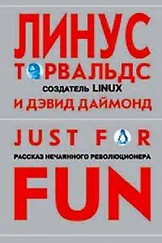
Linus Torvalds - Just for Fun
Здесь есть возможность читать онлайн «Linus Torvalds - Just for Fun» весь текст электронной книги совершенно бесплатно (целиком полную версию без сокращений). В некоторых случаях можно слушать аудио, скачать через торрент в формате fb2 и присутствует краткое содержание. Город: NewYork, Год выпуска: 2001, ISBN: 2001, Издательство: HarperCollins Publishers, lnc., Жанр: Программирование, на английском языке. Описание произведения, (предисловие) а так же отзывы посетителей доступны на портале библиотеки ЛибКат.

- Название:Just for Fun
- Автор:
- Издательство:HarperCollins Publishers, lnc.
- Жанр:
- Год:2001
- Город:NewYork
- ISBN:0-06-662072-4
- Рейтинг книги:4 / 5. Голосов: 2
-
Избранное:Добавить в избранное
- Отзывы:
-
Ваша оценка:
Just for Fun: краткое содержание, описание и аннотация
Предлагаем к чтению аннотацию, описание, краткое содержание или предисловие (зависит от того, что написал сам автор книги «Just for Fun»). Если вы не нашли необходимую информацию о книге — напишите в комментариях, мы постараемся отыскать её.
Just for Fun — читать онлайн бесплатно полную книгу (весь текст) целиком
Ниже представлен текст книги, разбитый по страницам. Система сохранения места последней прочитанной страницы, позволяет с удобством читать онлайн бесплатно книгу «Just for Fun», без необходимости каждый раз заново искать на чём Вы остановились. Поставьте закладку, и сможете в любой момент перейти на страницу, на которой закончили чтение.
Интервал:
Закладка:
The situation was playing out in information-technology departments throughout the world, although most of it took place in the United States. It was rarely a decision based on the non-cost of Linux, because the software itself actually represents a small part of such an investment. The service and support are much more costly. What tended to sway the suits were the simple technical arguments: Linux was stronger than the competition, which consisted of Windows NT and the various flavors of Unix. And, importantly, people just hate having to do things the way Microsoft or anybody else says they have to do them. You can do things with Linux that you can't do with the competition. The original people who used Linux did so because they could get access to sources in ways they couldn't with commercial software.
From that perspective, things hadn't changed much since I had released Version 0.01 from my bedroom. Linux was more flexible than other systems out there. You got to be your own boss. And, at least in the case of Web servers, it didn't contain the "bloat" -- the many unnecessary features -- that make up competing operating systems.
Another thing Linux had in its favor: Despite its growing popularity as an operating system for Web servers, it really didn't occupy a niche. This is important as a way of understanding Linux's success.
Mainframe computers were a niche. Unix in general was a series of niches -- the U.S. Department of Defense super-computer niche, the banking niche. The folks selling operating systems for mainframes and other big systems made money because they were charging a lot for their operating systems. Then Microsoft came along and charged ninety bucks. Microsoft didn't go after the banking niche or any other niche, but suddenly it was everywhere. It was like getting invaded by locusts. It's hard to get rid of that kind of invasion. (Not that locusts are bad. I like all animals.)
It's a lot better to be everywhere and take over every niche, and that's what Microsoft did. Think of a fluid organism that flows into any place it can find. If one niche is lost, it's not a big deal. The organism surrounds the world, flowing into anything that's interested.
The same thing is happening with Linux today. It flows into anything that's interested. Linux doesn't have just one niche. It's small and flexible and finds its way into many places. You find it in supercomputers, at important places like the U.S. Government's Fermilabs, or NASA. But that's kind of an outflowing of the server space. Which is an outflowing of the desktop space -- which is where I got started. And at the same time you'll find Linux in embedded devices, everything from antilock brakes to watches.
Watch it flow.
Meanwhile, there's a great advantage to grass roots. The best and the brightest of the next generation are using your product because you are the thing that makes that generation excited. In an earlier generation, it wasn't so much Microsoft and DOS but PCs that got people excited. If you were into PCs, you were into DOS. There wasn't much choice.
And that was a huge advantage for spreading Microsoft.
If you look at the brightest young kids around, they're not all doing Linux, but a lot of them are. Sure, one of the reasons that the open source philosophy and Linux both have major followings in universities is simple: the antiestablishment sentiment. (The same antiestablishment sentiment that made such a huge impact on my dad's life.) It's the Big, Evil Microsoft Corporation & Wicked, Greedy, Too-Fucking-Rich Bill Gates vs. the We're-In-It-for-the-Love-and-Free-Software-for-Everybody & the Self-Effacing (Seeming) Folk Hero Linus B. Torvalds thing. Those kids graduate and take jobs in corporations, where they bring with them their love for Linux.
So folks who've ventured into the depths of Microsoft tell me they've seen my face on dartboards. My only comment: How could anybody possibly miss my nose?
But I'm getting ahead of myself. IBM's big announcement in the spring of 1998 was followed by similar announcements by every major hardware vendor. By August, Forbes magazine had "discovered" our little world by putting a picture of me on the cover with the words, "Peace, Love, Software." As company after company made an (inevitable) commitment to Linux, you no longer had to peruse the advocacy newsgroups to read the tea leaves.
VI.
Linux had captured the planet's heart like some improbable Olympic gold medalist from an unrecognizable third-world nation.
I was the poster boy. In a press interview, Eric Raymond explained that part of my appeal (or whatever) was that I was "less visibly odd than a lot of other hackers." Okay. That's one hacker's opinion. Not everybody liked the situation. Richard Stallman campaigned to change the name Linux to gnu/Linux, using the logic that I had relied on the GNU gcc compiler and other free software tools and applications to get Linux off the ground. Others were growing increasingly irritated by the fact that Linux was finding a home in the corporate realm.
The press was playing up the dichotomy between the Idealists and the Pragmatists (not my terms!) among Linux's now hundreds of thousands of participants. Under that division, those who feared that Linux's ideals were incompatible with the goals of capitalism were dubbed the idealists. I led the pragmatists. But I saw such analysis as journalistic nonsense -- a simplistic attempt to fit everything neatly into a world of black vs. white. (I have the same problem with the way folks view the Linux phenomenon as a Linux vs. Microsoft war, when in fact it's something else entirely, something far more wide-reaching. It's a more organic way of spreading technology, knowledge, wealth, and having fun than the world of commerce has ever known.)
To me, it was a non-issue. Without commercial interests, how else would Linux flow into new markets? How else would it create opportunities for innovations? How else would it be able to reach the people who want an alternative -- a free alternative -- to the bad technology that's out there? What more realistic way for open source to take hold than through the sponsorship of corporations? And what better way of getting some of the less interesting work accomplished, boring stuff like maintenance and support, than doing it inside companies?
Open source is about letting everybody play. Why should business, which fuels so much of society's technological advancement, be excluded -- provided that they play by the rules? Open source can do nothing but improve the technology that companies create, and maybe make them less greedy.
And even if we wanted to stop the forces of commercialism, what could we do? I was not willing to suggest we hide, go underground, refuse to talk to commercial people.
Anticommercial sentiments have always been a part of the open source community, but it wasn't until Linux became a household word among low-tech households that there was a lot at stake. The newsgroups were aflame with the paranoid rantings of some of the vocal crazies. None of the Linux developers I interacted with were worried at all. But others raged on about how Red Hat or some other company would pervert the notions of open source, and about how some people were losing their idealism.
To some degree, it's probably true that some open source folks stood to get diverted from their idealism. But while certain people saw that as a losing proposition, I felt that it simply gave us more choice. Technical people who were worried about things like feeding their kids now had an option, for example. You can still be as idealistic as you've always been or you can choose to be part of the new commercial breed. You don't lose anything by having somebody else come in and give you a new option. Before, obviously you couldn't choose anything but being pure.
Читать дальшеИнтервал:
Закладка:
Похожие книги на «Just for Fun»
Представляем Вашему вниманию похожие книги на «Just for Fun» списком для выбора. Мы отобрали схожую по названию и смыслу литературу в надежде предоставить читателям больше вариантов отыскать новые, интересные, ещё непрочитанные произведения.











Обсуждение, отзывы о книге «Just for Fun» и просто собственные мнения читателей. Оставьте ваши комментарии, напишите, что Вы думаете о произведении, его смысле или главных героях. Укажите что конкретно понравилось, а что нет, и почему Вы так считаете.