Steve Tem - Ubo
Здесь есть возможность читать онлайн «Steve Tem - Ubo» весь текст электронной книги совершенно бесплатно (целиком полную версию без сокращений). В некоторых случаях можно слушать аудио, скачать через торрент в формате fb2 и присутствует краткое содержание. Город: Osney Mead, Год выпуска: 2017, ISBN: 2017, Издательство: Solaris, Жанр: Ужасы и Мистика, Фантастика и фэнтези, на английском языке. Описание произведения, (предисловие) а так же отзывы посетителей доступны на портале библиотеки ЛибКат.
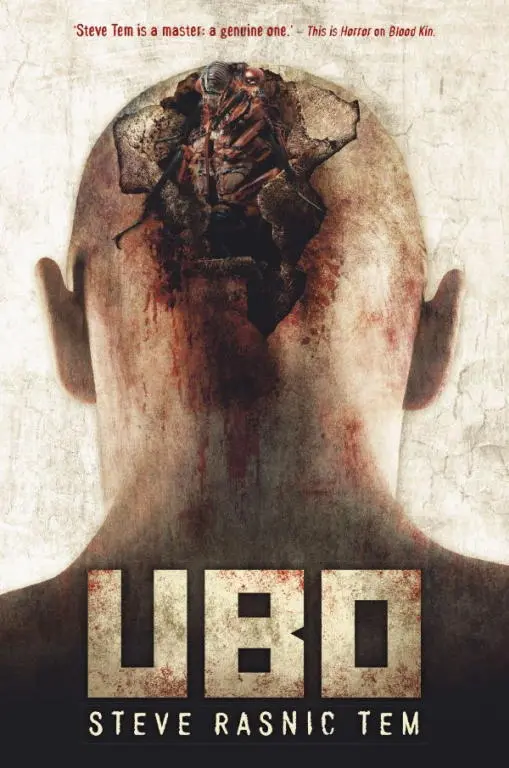
- Название:Ubo
- Автор:
- Издательство:Solaris
- Жанр:
- Год:2017
- Город:Osney Mead
- ISBN:978-1-84997-926-9
- Рейтинг книги:5 / 5. Голосов: 1
-
Избранное:Добавить в избранное
- Отзывы:
-
Ваша оценка:
Ubo: краткое содержание, описание и аннотация
Предлагаем к чтению аннотацию, описание, краткое содержание или предисловие (зависит от того, что написал сам автор книги «Ubo»). Если вы не нашли необходимую информацию о книге — напишите в комментариях, мы постараемся отыскать её.
Every resident has a similar memory of the journey: a dream of dry, chitinous wings crossing the moon, the gigantic insects dropping swiftly over the houses; the creatures, like a deck of baroquely ornamented cards, fanning themselves from one hidden world into the next.
And now each day they force Daniel to play a different figure from humanity’s violent history, from a frenzied Jack the Ripper to a stumbling and confused Stalin, to a self-proclaimed god executing survivors atop the ruins of the world. As skies burn and prisoners go mad, identities dissolve as the experiments evolve, and no one can foretell their mysterious end.
Ubo — читать онлайн бесплатно полную книгу (весь текст) целиком
Ниже представлен текст книги, разбитый по страницам. Система сохранения места последней прочитанной страницы, позволяет с удобством читать онлайн бесплатно книгу «Ubo», без необходимости каждый раз заново искать на чём Вы остановились. Поставьте закладку, и сможете в любой момент перейти на страницу, на которой закончили чтение.
Интервал:
Закладка:
Gandhi glanced at Falstaff’s sleeping mass. “Should we wake him?” But Lenin was almost to the dim outline of doorway. Daniel and Gandhi stumbled into each other, then hurried after him and into a series of increasingly damaged hallways, down neglected staircases, Daniel fought to keep his nerve. At least the spaces they travelled through were generally, if dimly, lit. The walls throughout the structure had been equipped with shallow baseboards that glowed in the dark, casting the surfaces with a pale blue. Some of the larger rooms had matching parallel ceiling borders in white. The resulting light showcased wall after wall of damage and corruption.
Navigation was inexact, based on whatever directional clues the werewolf’scries provided. They let Lenin take the lead. Daniel didn’t know that Lenin possessed any more understanding of the building than the rest of them, but at least he showed confidence. The werewolf continued to moan and whimper, scream and howl, the perceivable origins of these sounds complicated by the echoing emptiness in this part of the building.
For a time they shuffled their way across floors inches deep in wall and ceiling fragments that rattled and clacked against their shoes. “Who knew concrete would turn out to be a universal building material?” Gandhi said at one point, underlining a detail that had been nagging Daniel. For all their alienness, the roaches appeared to have problem-solved in a way not that different from human beings.
They descended several floors, but to Daniel’s ears they were no closer to the werewolf, who now alternated whining complaints with a rhythmic shrieking as if he were being stabbed. It increasingly troubled Daniel that they hadn’t seen a single roach, and he wondered if perhaps they were going where the roaches wanted them to go.
But then they saw one asleep in a far corner, surrounded by empty brown drink bottles. They walked slowly, watching where they put their feet, until they were past.
They came into a large area lined on one wall with broken windows. Encroaching vegetation had covered part of the floor and traced the walls. “Perhaps we should go back,” Lenin said softly.
“I want to finish this,” Daniel said, and no one disagreed.
The fractured window frames allowed moonlight to flood the space, providing a different view of the city than any he had had before. He was immediately drawn there, walking over a floor dotted with shrapnel pits and larger sections where the tile appeared to have been completely scraped to the subfloor. The wall beside and under the window frame looked unstable so he kept a couple of steps back. When he peered down through the frame he could see a great pile of debris several stories in height banking the base of the building. More ruins spilled out of a huge hole caved in the outer wall. Thick, woody vines had pushed their way into the hole and webbed the exterior, some tendrils snaking into the destroyed windows in front of him.
In the distance he could see a few standing structures within the rubble at the edge of the tumbledown city, and beyond that the red of fires and boiling black smoke. Faint traces of shouts or maybe screams floated in the air, but he might have imagined them.
“Someone’s done a mural,” Gandhi said behind him.
Daniel turned and moved toward the back wall, the mural revealing itself gradually in the unobstructed moonlight. Bullet holes speckled parts of it, and one portion nearest the door had been heavily damaged by fire. “It’s religious, I think,” he said, although he wasn’t sure why he thought so. “And it’s crude—I don’t think anyone professional did this.”
It was a city scape, ill-proportioned or from a severely distorted perspective. Central to the painting were the rooftops, seen from above, squares and rectangles distorted, with tiny human forms clinging desperately. It was a mix of paints and drawing media, markers, anything that might register on the wall, so some parts had faded to near invisibility while other portions were still quite vivid, as if an observer had precisely recalled only certain details and allowed the others to recede into a blur of forgetfulness.
“What are those larger beings?” Gandhi pointed at several figures, glowing and unrecognizable, floating above the rooftops.
“I believe they’re meant to be angels, the way they observe everything,” Lenin said.
Daniel thought they were meant to represent people, or what people someday hoped to be, but he might be wrong. They all might be wrong.
The buildings in the mural were bent, wobbly, snaky things, more like giant square hoses with windows than proper rigid architecture. Down at the base of these surreally twisted high rises lay—‘pandemonium’ was the word that came to mind. Dark figures danced in joy or agony, their bodies shiny and broken like those of insects, vehicles smashed and fires spreading as a frightful mania travelled through the streets.
“It’s an unhappy picture painted by an unhappy person,” Gandhi said.
The howl beneath their feet shook the floor. Gandhi stamped his foot. Even though the gesture made but a small sound, another howl returned. “Just one level down, I’d say.”
They moved on. Daniel lingered to touch the art piece. The lines and colors had been rubbed and gouged in, as if drawn with great passion, with a need for the mural to last. At the bottom of the images, just above the floor, was a border of larger figures in panicked poses, as if desperate to escape the destruction. They were humanoid for the most part, but the occasional stick figure had gears, pinions, pulleys—it was some sort of mechanical creature. All of them looked panicked, all of them persecuted in this strangely detailed Hell. Who would have drawn this, and when? Had there always been residents? This experiment, or study, whatever it was, might have been going on for decades. He looked through the window at the shambling sprawl beyond, and wondered if something out there had inspired this.
As he turned back, his shoes kicked up rubble on the floor. Something white and shiny, torn, lettered. “… Psych …”
“ This world is grown old. ”Shakespeare’s Falstaff had said that, but Daniel could imagine those words coming out of his large acquaintance’s mouth. It seemed an appropriate title for a painting such as this. Perhaps they had made a mistake in not awakening Falstaff and dragging him down here.
The howls gained force and volume again as the menmoved through the next level down. The werewolf must have heard their approach and wanted to make sure he could be located. But the howls didn’t feel like cries for help exactly, more like some mindless complaint. Finally, off a long and empty corridor, they found the door with the sound of intense scratching on the other side.
The small glass window in the solid door was broken out. A thin bar had been bolted over the opening. A low moan issued from the room. Daniel pressed forward. A pale face suddenly filled the opening, wide-eyed, multiply scratched, some of the scratches scabbed over, others fresh with blood.
“At last!” the face sobbed. “Human beings! I never thought…” His skinny hand came up and one fingernail clawed deeply into the flesh on the left side of his nose, tearing down with a fresh stream of blood.
“Stop that!” Daniel cried.
“I can’t help it! It itches unbearably! It’s growing inside my skin. It’s trying to tear its way through!”
“The hair?” Gandhi said. “The hair of the wolf?”
“My rage !” the face screamed. “There’s more of it every day! It wants to cover me!” And he disappeared.
Daniel walked slowly to the window. The stench was like a punch in the face. The man had moved to the center of the room, naked and gesturing frantically at the hundreds of scars, old and new, layering his body. “See, see how it’s trying to get out?” The man had a starved appearance, but it was hard to tell how emaciated he really was, given the confused mess of torn flesh and dried blood.
Читать дальшеИнтервал:
Закладка:
Похожие книги на «Ubo»
Представляем Вашему вниманию похожие книги на «Ubo» списком для выбора. Мы отобрали схожую по названию и смыслу литературу в надежде предоставить читателям больше вариантов отыскать новые, интересные, ещё непрочитанные произведения.









Обсуждение, отзывы о книге «Ubo» и просто собственные мнения читателей. Оставьте ваши комментарии, напишите, что Вы думаете о произведении, его смысле или главных героях. Укажите что конкретно понравилось, а что нет, и почему Вы так считаете.