Каарон Уоррен - The Year's Best Dark Fantasy and Horror 2018 Edition
Здесь есть возможность читать онлайн «Каарон Уоррен - The Year's Best Dark Fantasy and Horror 2018 Edition» весь текст электронной книги совершенно бесплатно (целиком полную версию без сокращений). В некоторых случаях можно слушать аудио, скачать через торрент в формате fb2 и присутствует краткое содержание. Город: Germantown, Год выпуска: 2018, ISBN: 2018, Издательство: Prime Books, Жанр: Ужасы и Мистика, Фэнтези, на английском языке. Описание произведения, (предисловие) а так же отзывы посетителей доступны на портале библиотеки ЛибКат.
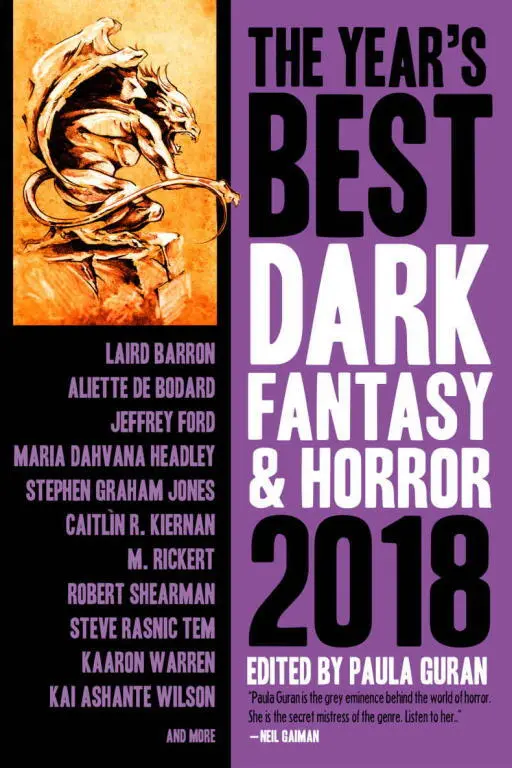
- Название:The Year's Best Dark Fantasy and Horror 2018 Edition
- Автор:
- Издательство:Prime Books
- Жанр:
- Год:2018
- Город:Germantown
- ISBN:978-1-60701-528-4
- Рейтинг книги:5 / 5. Голосов: 1
-
Избранное:Добавить в избранное
- Отзывы:
-
Ваша оценка:
The Year's Best Dark Fantasy and Horror 2018 Edition: краткое содержание, описание и аннотация
Предлагаем к чтению аннотацию, описание, краткое содержание или предисловие (зависит от того, что написал сам автор книги «The Year's Best Dark Fantasy and Horror 2018 Edition»). Если вы не нашли необходимую информацию о книге — напишите в комментариях, мы постараемся отыскать её.
The Year's Best Dark Fantasy and Horror 2018 Edition — читать онлайн бесплатно полную книгу (весь текст) целиком
Ниже представлен текст книги, разбитый по страницам. Система сохранения места последней прочитанной страницы, позволяет с удобством читать онлайн бесплатно книгу «The Year's Best Dark Fantasy and Horror 2018 Edition», без необходимости каждый раз заново искать на чём Вы остановились. Поставьте закладку, и сможете в любой момент перейти на страницу, на которой закончили чтение.
Интервал:
Закладка:
Luca was the same way. Most nights he didn’t come home until close to midnight. There was always more he felt he could be doing. For a while I’d felt really proud of him. And then when things got bad I’d just felt resentful, angry at him for spending so much time saving other people when what I really wanted was for him to save me.
In the gift shop I chose a postcard for him, a picture of the Flemish tapestry called The Hunt for the Unicorn . It showed five young men in aristocratic clothing with their spears and their dogs. If it weren’t for the title you wouldn’t have been able to tell what they were doing there. I wanted to choose one with the unicorn but all of them looked too violent or depressing. Something about the unicorn in captivity, collared, in a fence that can barely hold her, reminded me of Answering the King , and how the girl had been taken to prison after she shot the president. There had been a coda at the end of the novel, the little girl twenty years later, grown up, in solitary confinement. They had thought she had gone mad because she wouldn’t stop hurting herself.
But St. John showed the real reason. The girl had had another vision, one worse than what she’d stopped all those years ago. But this time there was nothing she could do about it.
I couldn’t get hold of Luca that night. He wasn’t answering his email and when I tried him at home—and then at work—the phone just rang and rang. It wasn’t that unusual. Sometimes there were emergencies, and Luca would become so totally absorbed in them he would forget everything else.
There were emergencies like that, I knew, one every few days it seemed. So eventually I left a message saying I loved him. I tried the TV but got nothing but static. Eventually I settled down to read. It was another story from Strangers and Friends but this one was about a haunted house called “Question the Foundations.” It was a twist on the trope: the houses weren’t haunted by people so much as the people by houses. In St. John’s world each person had a tiny space within them, an impression of the place where they had been born. And it remained there, like a scar, or a memory. And everyone else could see it too, who you were and where you came from. Except there was this young boy who didn’t have a place like that. He had nothing. He had come from nowhere. And because he had nothing he scared people.
I put the book down, confused and unsure of myself. The story bothered me but I didn’t know why. It was different from the others, softer, sadder. There was no real horror in the story. It had been about loneliness. How it felt to be hollow, an outsider. Rootless.
Maybe it was just those constellations of images, emptiness and violence. Luca had told me a story once about how his family used to keep chickens. He had lived in the middle of a wood. One day a fox break into the henhouse and tore open all the chickens. He’d found their bodies, or what was left of them, the next morning. Inside their bodies he had found strings of growing eggs, like pearls.
After he told me that I couldn’t sleep and it was the same feeling now. I didn’t have any regrets. Luca and I had talked, and he had left the decision to me. There had been no pressure, none from him anyway. But I’d been watching the news. And when the first bomb exploded in Paddington Station it had been like a warning sign. Not now. It wasn’t safe. Things would settle down soon, they had to. And then we could try again.
I put the book down and touched my stomach gently, tentatively. Beneath my fingers all I could feel was my own thick flesh.
Three times I passed the cafe before I finally had the courage to meet Lily Argo. I could see her—at least I thought it was her—sitting in the courtyard with her walker folded up beside her. She had long white hair and a red-and-gray printed dress with long sleeves. I knew her because of how tall she was, even a little stooped over. She still had at least six inches on me.
“Ms. Argo?” I asked her and she nodded politely while I pulled up a seat.
“So you’re the one who’s come asking about Barron St. John.”
“That’s right.” I tentatively launched into my pitch: an article on St. John’s early publication history, documenting her involvement in acquiring and editing his first title. She stopped me with a wave of her hand.
“Sure, honey,” she said with a wide, generous smile, “you don’t need to go on like that. I’m happy to talk about those days though I confess they seem a while ago now. You know I got that manuscript by accident, don’t you?”
I nodded and she seemed relieved.
“Good, so we’re not starting from scratch. What you want is the story, I take it, of how Bear—that’s what I always called him—and I got along in those early days? Where the horror came from?” I nodded again and took out my phone but she eyed it warily. “I’ll tell it as best I can and you can make of it whatever you will—but no recordings, okay? You can listen and you can write down what you get from it but you only get to hear it once.”
What was I supposed to say? Already I could feel a kind of strange buzz around her, the magnetic pull of her charisma. I had wanted her story and here she was, ready to give it to me.
“I was pretty young in those days,” she began, “when I first started working for Doubleday. I’d grown up in Ohio which I never liked very much in part because it didn’t seem like I was much use to my parents. I was a reader, even then, but they had wanted me to go to one of the nursing schools but I knew I’d never be happy with something like that, taking care of people all the time. So when I was seventeen I ran off to New York City.
“Publishing was still very much a gentleman’s sport back then and if you were a woman you were either someone’s secretary or you were publishing feminist pamphlets and burning your bra. I was the former.” She paused and took a delicate sip from her Coke. Her lipstick remained unsmudged though it left a trace of red on her straw. “Most of us at the time wanted to be writers. I suppose I did as much as anyone, and so we’d spend our days editing and we’d spend our nights writing. What was funny was that we knew all the people we were sending our drivel to, we’d met them at luncheons or for afterhours drinks. I was embarrassed. I was a good editor and because I was a good editor I knew I wasn’t a very good writer. I thought, how on earth will these men take me seriously if they see what I’m coming up with?
“So I did what most women did at the time, or anyone who wasn’t Daphne du Maurier anyway, and I made up a name. Mine was Victor Wolf, which today seems so damned fake I don’t know why no one thought anything of it. Or maybe they did but they just didn’t care. Anyway I may have been writing garbage but eventually the garbage got better and I started getting some of it published. It was what they called Kooks and Spooks stuff, I suppose, sort of crime fiction but with some other bits thrown in, monsters sometimes, and ghosts. Possession—or Russian spies using hypnosis to control young American teenagers, that sort of thing. There was a real taste for that sort of thing back then. By the early seventies the papers were going crazy, telling us the irrationalism of our reading was helping the Commies and we had to get back to old-fashioned American literature. But Rosemary’s Baby was an absolute hit, and then there was The Exorcist and people just wanted more of it.
“That was when Bear’s first manuscript came across my desk. The two of us call it an accident but it wasn’t that, not really. See, I was used to reading submissions for Donnie Rogers and when I finished Bear’s first one I knew there was magic in it, raw, maybe, but magic nonetheless. And I knew Donnie was slated for laparoscopic gallbladder surgery. He was going to be off for at least a week recovering. That was when I tried to pitch the manuscript.
Читать дальшеИнтервал:
Закладка:
Похожие книги на «The Year's Best Dark Fantasy and Horror 2018 Edition»
Представляем Вашему вниманию похожие книги на «The Year's Best Dark Fantasy and Horror 2018 Edition» списком для выбора. Мы отобрали схожую по названию и смыслу литературу в надежде предоставить читателям больше вариантов отыскать новые, интересные, ещё непрочитанные произведения.

Обсуждение, отзывы о книге «The Year's Best Dark Fantasy and Horror 2018 Edition» и просто собственные мнения читателей. Оставьте ваши комментарии, напишите, что Вы думаете о произведении, его смысле или главных героях. Укажите что конкретно понравилось, а что нет, и почему Вы так считаете.