William Forstchen - The Final Day
Здесь есть возможность читать онлайн «William Forstchen - The Final Day» весь текст электронной книги совершенно бесплатно (целиком полную версию без сокращений). В некоторых случаях можно слушать аудио, скачать через торрент в формате fb2 и присутствует краткое содержание. Город: New York, Год выпуска: 2017, ISBN: 2017, Издательство: Forge Books, Жанр: sf_postapocalyptic, Триллер, на английском языке. Описание произведения, (предисловие) а так же отзывы посетителей доступны на портале библиотеки ЛибКат.
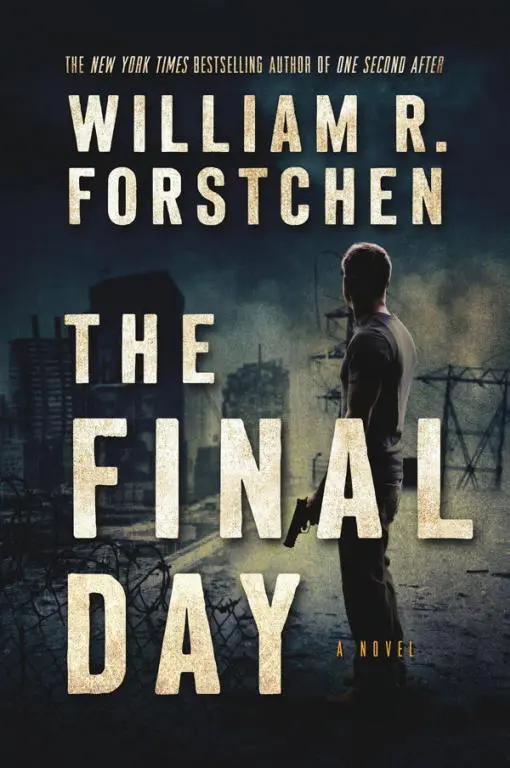
- Название:The Final Day
- Автор:
- Издательство:Forge Books
- Жанр:
- Год:2017
- Город:New York
- ISBN:978-0-7653-7673-2
- Рейтинг книги:5 / 5. Голосов: 1
-
Избранное:Добавить в избранное
- Отзывы:
-
Ваша оценка:
The Final Day: краткое содержание, описание и аннотация
Предлагаем к чтению аннотацию, описание, краткое содержание или предисловие (зависит от того, что написал сам автор книги «The Final Day»). Если вы не нашли необходимую информацию о книге — напишите в комментариях, мы постараемся отыскать её.
bestsellers,
and
,
immerses readers once more in the story of our nation’s struggle to rebuild itself after an electromagnetic pulse wipes out all electricity and plunges the country into darkness, starvation, and terror.
After defeating the designs of the alleged federal government, John Matherson and his community have returned their attention to restoring the technologies and social order that existed prior to the EMP (Electro-Magnetic Pulse) attack. Then the government announces that it’s ceding large portions of the country to China and Mexico. The Constitution is no longer in effect, and what’s left of the U.S. Army has been deployed to suppress rebellion in the remaining states.
The man sent to confront John is General Bob Scales, John’s old commanding officer and closest friend from prewar days. Will General Scales follow orders, or might he be the crucial turning point in the quest for an America that is again united? As the dubious Federal government increasingly curtails liberty and trades away sovereignty, it might just get exactly what it fears: revolution.
The Final Day — читать онлайн бесплатно полную книгу (весь текст) целиком
Ниже представлен текст книги, разбитый по страницам. Система сохранения места последней прочитанной страницы, позволяет с удобством читать онлайн бесплатно книгу «The Final Day», без необходимости каждый раз заново искать на чём Вы остановились. Поставьте закладку, и сможете в любой момент перейти на страницу, на которой закончили чтение.
Интервал:
Закладка:
The thoroughly frightened administrator was shoved forward. He cautiously advanced the last few dozen yards, turned in the middle of the road illuminated by several floodlights, and squeaked out a command for those waiting on the far side to give up.
What sounded like an argument started until Pelligrino shrieked out that they were outnumbered and everyone would die if they didn’t surrender immediately.
Seconds later, the first men and women of what John hoped was a final line of defense emerged, hands over their heads. Bob’s troopers, weapons pointed high but still aimed in their direction, shouted out for them to move up the road on the double.
Several dozen emerged, and as they were moved up the road, John could see the looks of fear.
It was the medic who was trying to follow Bentley and work on him who helped defuse the tension, walking in among them, offering reassurances, announcing that if any were hurt they should fall out and she would take care of them; otherwise, they should just keep moving up the road toward the exit. To John’s amazement, one of them was actually smoking a cigarette, the scent of it wafting around him as they passed him.
A cigarette? Here? Just what kind of place is this really?
“Any more?” Bob shouted. A trooper at the very front of the ground turned, looked back, and replied with a hand gesture that all were cleared, but John could see there was a look of confusion from the other troopers who were standing at the bend in the road.
“Let’s see if all of this was worth it,” Bob said softly, starting out again.
Whatever they were about to see, John could not get out of his mind that his friend Lee was dead. Whatever they were to find, was it worth Lee’s death?
And then he turned the corner of the road dug half a mile down into a mountain and came to a stop in silent amazement.
Theunderground cavern, if it could be called that, was illuminated nearly as bright as day and seemed to stretch off into infinity. The road, which had broadened out into four lanes as it went through the curve, emptied into a vast, open underground chamber, the road just continuing straight on until it was actually lost to view. There was a turnoff to the right, an illuminated sign overhead announcing all entering had to first report for decontamination and security clearance. Bob ignored it and up at the front with his troopers just pressed straight on, Bentley dragging Pelligrino along.
The ceiling overhead arced more than thirty feet high. The spread of the cavern from his left to right was at least several hundred yards or more.
The broad street was actually lined with barracks. World War II–era wooden barracks, row after row, each two stories high, and strangely, even topped with shingled roofs, interspersed with curved aluminum Quonset huts. At regular intervals, natural stone pillars rose from the floor to the ceiling to support the vast mountain overhead so that the interior almost looked like some strange, surreal, military cathedral.
All stood in amazement—except for Bob, who looked around, hands on his hips.
“Like I told you, John,” he said softly, “I was here once, more than twenty-five years ago as part of a drill. This was designed in the 1950s to be the fallback position for the Pentagon in the event of nuclear war.
“The barracks you see laid out down this road—it’s actually called Main Street—were left over from World War II. After the place was hollowed out, it was felt that the cheapest and easiest thing to do was just build these; we still had hundreds of them as surplus, prefabricated and sitting in a warehouse a couple of hours away. No weather here, no termites, they’ll stand a hundred years or more.
“Off to the right, there used to be a motor pool, even used to have a couple of old Sherman tanks down here, rigged up as earthmovers if we had to dig our way out if a nuke hit close by. There even used to be old-style electric golf carts for driving around inside. I think that was Ike’s idea.”
A hundred yards or more down Main Street, a small crowd had gathered.
“How many are here now?” Bob asked, looking back at Pelligrino.
“Who?”
“Civilians, damn it.”
Again a hesitation. “About fifteen hundred, maybe two thousand. Some leave at times, and others are brought in.” A brief pause, and with Bentley glaring at him, he finally added, “Sir.”
The man’s features had gone to nearly purple, his knees were shaking, and with a moan, he slowly sank to the ground. The medic ran up to him, knelt down, felt for his pulse, and then looked up at the general.
“Might be his heart, sir.”
“Given what I think is here,” Bob said softly, “I have to ask: What heart?” He then announced, “Shoulder all weapons. These are civilians here. Unless he dies on us, drag him along.”
He gazed down coldly at Pelligrino. “Which way to the command center?” he snapped, and the ailing man pointed straight down Main Street.
He set off with a purposeful stride, right up the middle of the main street, troopers—with weapons shouldered as ordered—flanking to either side. John trailed along behind him; his friends Reverend Black, Maury, Forrest, Kevin, and Grace, who had disobeyed John’s orders to stay behind and had caught up with the group and was still obviously in shock over Lee’s death, followed behind Bob.
They passed several of the wooden barracks, relics of what seemed another age. The paint was peeling from the wooden sides, but other than that, they seemed well tended. There were even nameplates tacked to doors.
John slowed as he passed a Quonset hut on his left. There was a single name tag tacked to the door. He recognized the name. The same as on the personal e-mails that Linda had snatched out of the ether and which had finally led them to this place. Surely it couldn’t be?
As he stared at the nameplate, similar to the types of nameplates set in front of an officer’s home on a military base, the door cracked open, an anxious young face looking out, a girl in her early teens at most, still gangly like a young colt.
He smiled at her, and a flicker of a smile creased her slender face as she nervously brushed back an errant wisp of reddish hair. John stopped, his friends staying with him.
“Are you here to arrest us or something?” she asked.
He shook his head and gestured toward the front porch as if requesting permission to approach. She hesitated, nodded, and opened the door wider.
He caught a glimpse of inside the barrack. Though the exterior was of World War II vintage, the interior looked something like a typical living room—a sofa, several chairs, and what appeared to be the back of an old-style television from thirty or more years ago.
“Don’t worry, young lady. There was a misunderstanding, but it’s been settled. You’re perfectly safe.”
He spared a quick glance back down Main Street. Bob had gone far ahead of him, surrounded by the troopers who had entered with him. John looked over his shoulder. His friends, however, had lingered behind, waiting for him out on the street.
Grace was still with him, and it was she who broke the tension.
“Hi. My name is Grace,” she announced in a warm, friendly voice, and she simply stepped past John, advanced up a step onto the porch, and extended her hand.
The nervous smile on the young girl’s face within the hut broadened slightly. She opened the door wider and took a step out, reached forward, and politely shook Grace’s hand.
“You sure everything is okay?” the girl asked. “We heard gunshots.”
“ We ?” John asked.
“I live here with my mother and two kid brothers. The emergency siren went off. Our teacher told us to go to the shelter, but I ran home to get Buster before going to the shelter area, because sometimes we’re in there for a day or two and I can’t sleep without Buster, and then I heard shooting.”
Читать дальшеИнтервал:
Закладка:
Похожие книги на «The Final Day»
Представляем Вашему вниманию похожие книги на «The Final Day» списком для выбора. Мы отобрали схожую по названию и смыслу литературу в надежде предоставить читателям больше вариантов отыскать новые, интересные, ещё непрочитанные произведения.
Обсуждение, отзывы о книге «The Final Day» и просто собственные мнения читателей. Оставьте ваши комментарии, напишите, что Вы думаете о произведении, его смысле или главных героях. Укажите что конкретно понравилось, а что нет, и почему Вы так считаете.