Peter Higgins - Truth and Fear
Здесь есть возможность читать онлайн «Peter Higgins - Truth and Fear» весь текст электронной книги совершенно бесплатно (целиком полную версию без сокращений). В некоторых случаях можно слушать аудио, скачать через торрент в формате fb2 и присутствует краткое содержание. Город: New York, Год выпуска: 2014, ISBN: 2014, Издательство: Orbit Books, Жанр: Фэнтези, Альтернативная история, на английском языке. Описание произведения, (предисловие) а так же отзывы посетителей доступны на портале библиотеки ЛибКат.
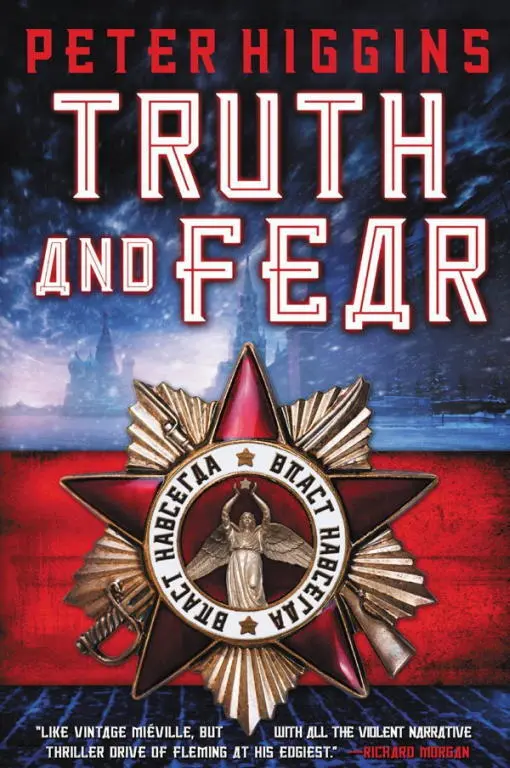
- Название:Truth and Fear
- Автор:
- Издательство:Orbit Books
- Жанр:
- Год:2014
- Город:New York
- ISBN:978-0-316-21973-0
- Рейтинг книги:5 / 5. Голосов: 1
-
Избранное:Добавить в избранное
- Отзывы:
-
Ваша оценка:
Truth and Fear: краткое содержание, описание и аннотация
Предлагаем к чтению аннотацию, описание, краткое содержание или предисловие (зависит от того, что написал сам автор книги «Truth and Fear»). Если вы не нашли необходимую информацию о книге — напишите в комментариях, мы постараемся отыскать её.
But Lom has other concerns. The police are after him, the mystery of the otherworldly Pollandore remains and the vast Angel is moving, turning all of nature against the city.
But will the horrors of war overtake all their plans?
Truth and Fear — читать онлайн бесплатно полную книгу (весь текст) целиком
Ниже представлен текст книги, разбитый по страницам. Система сохранения места последней прочитанной страницы, позволяет с удобством читать онлайн бесплатно книгу «Truth and Fear», без необходимости каждый раз заново искать на чём Вы остановились. Поставьте закладку, и сможете в любой момент перейти на страницу, на которой закончили чтение.
Интервал:
Закладка:
‘You opened his head with a knife.’
‘It was a chisel. A fine chisel.’
‘You hurt him. You tried to kill him, but it didn’t work: it made him better and stronger.’
‘He desires you, did you know that?’ Maroussia looked away. ‘Ah,’ said Chazia. ‘I see you do. And you desire him? You are lovers perhaps? Are you lovers? Tell me, darling, are you?’
‘I want to get off this train,’ said Maroussia.
Chazia ignored her.
‘There will be time for personal life,’ she said. ‘One day. We might even live to see it. But not yet, not now, and perhaps for you and me not ever. It cannot be indulged. Now there is work to do, and what is required is clear-sightedness, hardness and resolve in the doing of what is necessary. That will be our gift to the future. Our sacrifice.’ Chazia leaned forward and took Maroussia’s hand in hers. Stroked it. ‘Help me here, darling. Work with me. Help me to use the Pollandore. I don’t want to hurt you. I like you.’
‘I’m never going to help you. You know that.’
‘You will know me better, Maroussia darling, by and by.’
Later that same afternoon the train halted on the shore of an immense and nameless lake. Maroussia watched damson-coloured, damson-heavy cloud heads rise out of the distance and roll towards them, bruising more and more of the sky and darkening the surface of the water, erasing all reflection. Slowly the storm advanced, bringing the closing horizon with it as it came, until the train was enfolded in ominous dim purple-green light. Maroussia stood up in excitement and gripped the window bars. At last fat raindrops splatted on her window, singly at first, but faster and faster, harder and harder. Machine-gun bullets of rain. Water sluiced down the glass in a continuous rippling flood. There might have been arcs of lightning and shattering thunder crashes, or it might have been the glitter and roar of the rain.
Maroussia’s shouts of joy were lost in the noise.
And then a crack opened in the world, the rain and the storm split down the middle, and a different sun was shining through the carriage window: splashes of warmth and spaciousness and the quietness of an afternoon in early summer. The sourness in her mouth was gone, and her heart was big and calm with the possibility of happiness.
The Pollandore reached out and touched her face, and for the first time Maroussia felt how close it was, how near in time as well as distance. There had been bad things–bad things that happened and bad things she had done–but she and the Pollandore were travelling together now, and their paths were slowly converging, and the moment would come: the moment of meeting, when good things would be possible again. She could not have said exactly what the good things coming were, but that didn’t matter. It made no difference at all.
72
The Pollandore’s massive detonation of possibility and different sunlight sweeps outwards across the continent from its epicentre on Chazia’s train. It roars like an exploding shock wave through the certainty of things, gathering momentum as it goes, and the world of history unfolding stumbles, brought up suddenly smack against the truth of human dream and desire. In the trenches of the war and the bitterness of drab town streets the air is suddenly, briefly, rich with the smell of rain on broken earth; another voice is heard, not in the ears but in the blood, and for the brief unsustainable duration of the moment of the Pollandore’s passing, nothing, nothing anywhere dies at all.
The surge of change and otherness rolls across the continent and into the endless forest, where it passes from root to root and from leaf-head to leaf-head. It is leafburst. It is earth-rooted rain-sifting burning green thunder. It crashes against the steep high flanks of Archangel like an ocean storm against the cliffs of the shore.
And Archangel is appalled, because in his delight at his own movement he realises that he has made a terrible mistake.
He has forgotten to be afraid.
For a moment his painful grinding progress across the floor of the forest pauses, and for miles around him there is nothing but silence and a second of waiting.
He gathers. He centres. He focuses.
He remembers this thing.
How is it that he had forgotten? That never happens, but it has happened. This thing has been hiding from him! It has woven a forgetting around itself, but now it has made itself known.
This is a powerful and dangerous threat.
Archangel traces the path of the passing of the Pollandore moment back to its source. Examines. Analyzes. Knows what he must do.
73
Mirgorod, war city.
Elena Cornelius survived alone. Elena’s Mirgorod was zero city, thrown back a thousand years, order and meaning and all the small daily habits of use and illusion scorched and blasted away, the concepts themselves eradicated. Money wasn’t money any more when it had no value and there was nothing to buy. Food was what you found or stole. Clothing against the cold and the night lay around free for the taking on the unburied corpses of the dead. Homes weren’t security, shelter and belonging: they were broken buildings, burned and burst open to the elements, the intimate objects of interior domestic life scattered on the streets. Apartments were boxes to shut yourself in and wait for the bomb blasts, the fires, the starvation.
She kept moving, ate scraps scavenged from bombed buildings, drank water from rooftop pools and melted snow. She risked being shot for a looter, which she was, and she hid from the conscripters. She existed day by day in the timeless zero city, alien, unrooted, a sentience apart, belonging to nothing. Herself alone. She felt ancient. Places to hide and sleep were plentiful among the cellars and empty streets. When she slept, she dreamed of the rusalka in the potato-field river. She dreamed of her girls. Yeva and Galina. Mornings she woke early into fresh disorientation, the appalling daily shock: always she felt like she had survived a train crash in the night, a bridge that had crumbled beneath her, a house that had fallen down. Life had broken open, and everything was raw and clear. Every day she looked for her girls. Perhaps they had survived. Perhaps they were existing also somewhere, looking for her.
What follows after taking tea?
The resurrection of the dead.
There were no longer newspapers, but the MIRINFORM bulletin was posted on walls and telephone poles daily. ‘No sooner had Volyana fallen under our fire than the Archipelago soldiers jumped out of the windows with their underwear down and took to their heels. With cries of hurrah the battalion fell upon the slavers. Grenades, bayonets, rifle butts and flaming bottles came into play. The effect was tremendous.’ Increases in rations were reported. The city held stockpiles of grain and dried fish in reserve, ready to be distributed if the need arose. Courage, citizens. One more push, and victory will be ours. Nobody believed, but everybody gathered to read when a new edition was posted. It did not say that the cemeteries were full and there was no fuel for the mortuary trucks.
Elena walked out to the edge of the city until the way was barred by fighting. Three times she probed the outskirts in different directions, but always it was the same. Cleared firing zones. Shell holes filled with corpses and refuse. Charred skeletal buildings. The clatter of tank tracks and the rattle of gunfire. On her third attempt a sniper’s bullet skittered through the broken bricks at her feet like a steel lizard.
Elena knew she was tiring. The effort of keeping moving all day was almost beyond her. She should choose a place to be her permanent home, but she had to keep moving, walking twenty or thirty miles in a day. Looking for her girls.
Читать дальшеИнтервал:
Закладка:
Похожие книги на «Truth and Fear»
Представляем Вашему вниманию похожие книги на «Truth and Fear» списком для выбора. Мы отобрали схожую по названию и смыслу литературу в надежде предоставить читателям больше вариантов отыскать новые, интересные, ещё непрочитанные произведения.
![Кэмерон Доки - Правда и ее последствия[Truth and Consequences]](/books/79610/kemeron-doki-pravda-i-ee-posledstviya-truth-and-con-thumb.webp)





Обсуждение, отзывы о книге «Truth and Fear» и просто собственные мнения читателей. Оставьте ваши комментарии, напишите, что Вы думаете о произведении, его смысле или главных героях. Укажите что конкретно понравилось, а что нет, и почему Вы так считаете.