Christopher Nuttall - Ragnarok
Здесь есть возможность читать онлайн «Christopher Nuttall - Ragnarok» весь текст электронной книги совершенно бесплатно (целиком полную версию без сокращений). В некоторых случаях можно слушать аудио, скачать через торрент в формате fb2 и присутствует краткое содержание. Год выпуска: 2016, Жанр: Альтернативная история, prose_military, на английском языке. Описание произведения, (предисловие) а так же отзывы посетителей доступны на портале библиотеки ЛибКат.
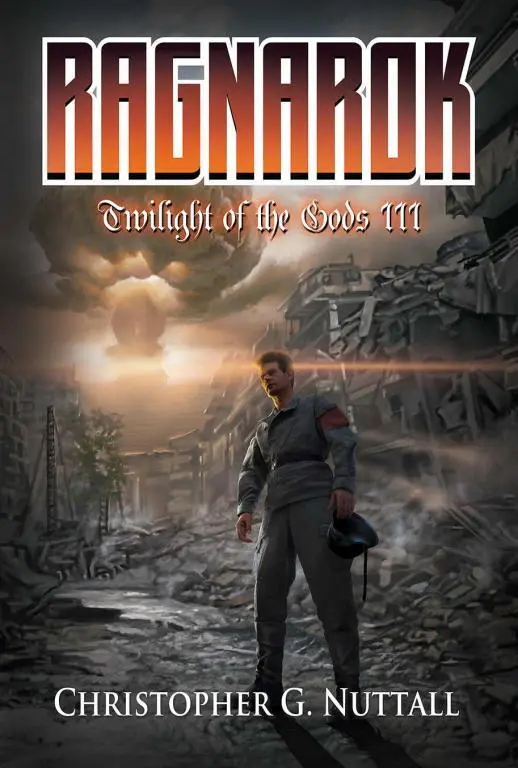
- Название:Ragnarok
- Автор:
- Жанр:
- Год:2016
- ISBN:нет данных
- Рейтинг книги:3 / 5. Голосов: 1
-
Избранное:Добавить в избранное
- Отзывы:
-
Ваша оценка:
Ragnarok: краткое содержание, описание и аннотация
Предлагаем к чтению аннотацию, описание, краткое содержание или предисловие (зависит от того, что написал сам автор книги «Ragnarok»). Если вы не нашли необходимую информацию о книге — напишите в комментариях, мы постараемся отыскать её.
The Provisional Government has scored a significant victory, driving the
back from Berlin and winning itself time to plot a counteroffensive. But Karl Holliston — the self-declared
of the Greater German
— isn’t about to give up so easily. As mighty armies prepare for the final campaign, winter sweeps down from the east and both side prepare their ultimate weapons, the fate of the world hangs in the balance…
…And if the
burns, the rest of the world may burn too.
Ragnarok — читать онлайн бесплатно полную книгу (весь текст) целиком
Ниже представлен текст книги, разбитый по страницам. Система сохранения места последней прочитанной страницы, позволяет с удобством читать онлайн бесплатно книгу «Ragnarok», без необходимости каждый раз заново искать на чём Вы остановились. Поставьте закладку, и сможете в любой момент перейти на страницу, на которой закончили чтение.
Интервал:
Закладка:
And the world outside Europe was very different.
She shook her head, bitterly, as a cold gust of wind swept in from the sea. Some of her political enemies were already sharpening their knives, whispering — quietly — that the Iron Lady was starting to rust. She’d been a great war leader, they acknowledged, but now the Cold War was over. It was time for someone else to take the helm and steer Britain into a Golden Age of peace, prosperity and freedom.
And unlimited rice pudding too , she thought dryly.
But it wasn’t time to leave, not yet. The chaos in Europe had yet to subside, while the chaos in Africa and the Middle East was growing steadily worse. Britain needed a strong hand at the helm as she navigated her way through suddenly-choppy seas and she, Margaret Thatcher, was that strong hand. None of her enemies had been tested, not like her. They had never sailed the ship of state, even in calm waters.
“Change is never easy,” she said. The Reich , for all of its horror, had been a predictable menace. Whatever rose from the ashes of history would be very different. “But we have to be ready.”
“This is not the end,” Anderson agreed. “ History never ends.”
Afterword
After the uprising of the 17th of June,
The Secretary of the Writers’ Union,
Had leaflets distributed in the Stalinallee,
Stating that the people,
Had forfeited the confidence of the government,
And could win it back only,
By redoubled efforts. Would it not be easier,
In that case for the government,
To dissolve the people,
And elect another?
In his stand-alone novel, In The Presence of Mine Enemies , Harry Turtledove postulated that the Third Reich would eventually face a Soviet-style crisis: economic collapse, a crisis of legitimacy and, eventually, a decline into near-irrelevance. This would, as it did in the Original TimeLine (OTL), spur a demand for political reform, a re-examination of the founding principles of the Third Reich and the abandonment of its principles. There would neither be a Third World War nor a civil war.
I was not so optimistic.
We were amazingly lucky that Gorbachev’s attempts to reform the Soviet Union did not lead to a civil war. Hard-liners within the Communist Party and the KGB could not have welcomed the changes, even if they understood that something had to change. The levels of stored hatred they’d built up ever since the Communist Party took a firm grip on power could easily have led to a bloody slaughter. Indeed, they did try to mount a coup — only to lose when it became clear just how little support they really had. And it was their coup attempt that led to the inevitable breakup of the USSR.
Gorbachev simply did not — could not — control the pace of change. The first signs of weakness led to other challenges to Moscow’s authority. Indeed, there was a strong feeling in many places — Poland, in particular — that the time had come to stand up or lose everything. Each successive problem led to more as Gorbachev veered between appeasement and repression, each failure weakening his own position. Once the ice began to melt, the changes were utterly unpredictable. There was no way to slow the pace of change.
The Third Reich , assuming it survived, might not cope anything like as well. It would have faced many of the same problems, yet it might have reached for very different solutions. And yet, no matter what happened to the protesters, they would be unable to hide from the underlying problems pervading the Reich . The coup plotters in Moscow, even if they had succeeded in turning the clock back by shooting everyone who assembled to stop them, would still have had to deal with a collapsing economy. It had simply fallen too far to be stopped.
But a different decision, at a different time, might have changed the course of history.
The problem facing repressive regimes — Hitler’s Germany, Stalin’s Russia (and the USSR after Stalin), Mao’s China, Saddam’s Iraq, Gaddafi’s Libya, Kim’s North Korea, etc — is that they tend to be very bad at coping with change. Power is organised in a pyramid structure, with the dictator and his cronies at the very top and everyone else in successive levels working their way down towards the common people at the bottom. It can be very hard for the dictator to truly understand what is going on at the bottom, even if he doesn’t have to deal with his subordinates constantly lying to him.
It doesn’t take long for the rot to set in. Each of the dictator’s cronies will try to gather as much power to himself as he can, relying on a patronage network to both protect him from the other cronies and set the stage for eventually usurping the dictator. Even if there are pre-dictatorship power structures — the military, for example — they will eventually be corrupted and folded into the dictatorship. The dictator will become corrupted by the unlimited power at his disposal, while his cronies will eventually become outright criminals.
If the state is based on ideology — Nazi Germany and the USSR, in particular — and it has avoided the trap of being led by a single family, it may be possible to mask this reality for decades. But the blunt truth is that the tools used to impose the ideology eventually create the dictatorship, if it wasn’t already present. In order to impose communism on Russia, Lenin created a system — spearheaded by the NKVD — that allowed Stalin to take control and gather all the levers of power into his hands.
[This should not have surprised anyone. Attempts to impose ideologies — anything from Communism to Radical Islam — will always meet opposition. The proponents will then have to decide if they want to abandon their plans or start forcing people to comply. Inevitably, they always choose the latter — and open the doors to a Stalin.]
Such a state’s leadership, therefore, may be split between true believers and the more cynical (and sometimes criminal) opportunists. The true believers will react to any threat to their power with horror — like the fanatics they are, they see the needs of the state as twinned with their own needs. They will ignore any inconvenient realities — such as a looming economic collapse — secure in the belief that their good intentions will see them through. Anything is justified in the name of their ideology. The opportunists, on the other hand, may be more interested in their personal power bases, but also more inclined to understand that a state that doesn’t bend — when the winds shift — may simply break.
This is not to say that these people — both groups and everything in-between — are not genuine patriots. They may believe that they truly do have the best interests of their country at heart (this was certainly true of the plotters in Moscow) and they may have good reason to fear for the future if the reformers (or rebels or whatever you want to call them) are allowed to run free. But these people always see the interests of the country, as I noted above, and their own interests as being identical. They are rarely able or willing to separate themselves from their country.
Their opposition, on the other hand, may be hopelessly disorganised. Rampaging mobs do not tend to lead to good — or any — governance. Dictators rarely leave any other power structures intact to allow their opponents a chance to build up overt support. Even if the opposition does manage to build up a common front, it may run into problems deciding what will happen after the dictatorship is defeated, allowing the dictator a chance to play divide and rule with his opponents.
Читать дальшеИнтервал:
Закладка:
Похожие книги на «Ragnarok»
Представляем Вашему вниманию похожие книги на «Ragnarok» списком для выбора. Мы отобрали схожую по названию и смыслу литературу в надежде предоставить читателям больше вариантов отыскать новые, интересные, ещё непрочитанные произведения.
Обсуждение, отзывы о книге «Ragnarok» и просто собственные мнения читателей. Оставьте ваши комментарии, напишите, что Вы думаете о произведении, его смысле или главных героях. Укажите что конкретно понравилось, а что нет, и почему Вы так считаете.