Terry Pratchett - The Long War
Здесь есть возможность читать онлайн «Terry Pratchett - The Long War» весь текст электронной книги совершенно бесплатно (целиком полную версию без сокращений). В некоторых случаях можно слушать аудио, скачать через торрент в формате fb2 и присутствует краткое содержание. Год выпуска: 2013, ISBN: 2013, Издательство: Harper, Жанр: Фантастика и фэнтези, на английском языке. Описание произведения, (предисловие) а так же отзывы посетителей доступны на портале библиотеки ЛибКат.
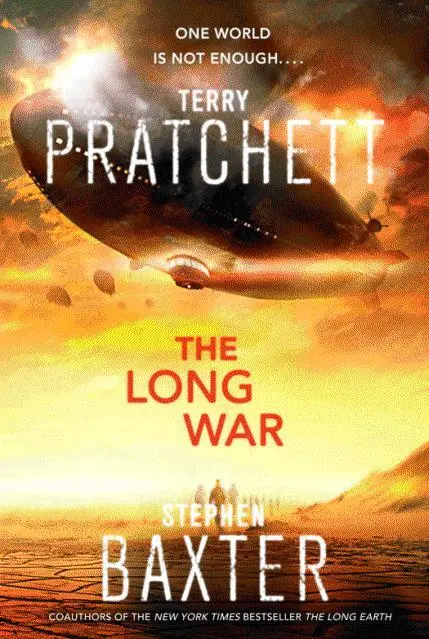
- Название:The Long War
- Автор:
- Издательство:Harper
- Жанр:
- Год:2013
- ISBN:978-0-06-206777-7
- Рейтинг книги:4 / 5. Голосов: 1
-
Избранное:Добавить в избранное
- Отзывы:
-
Ваша оценка:
The Long War: краткое содержание, описание и аннотация
Предлагаем к чтению аннотацию, описание, краткое содержание или предисловие (зависит от того, что написал сам автор книги «The Long War»). Если вы не нашли необходимую информацию о книге — напишите в комментариях, мы постараемся отыскать её.
The Long War — читать онлайн бесплатно полную книгу (весь текст) целиком
Ниже представлен текст книги, разбитый по страницам. Система сохранения места последней прочитанной страницы, позволяет с удобством читать онлайн бесплатно книгу «The Long War», без необходимости каждый раз заново искать на чём Вы остановились. Поставьте закладку, и сможете в любой момент перейти на страницу, на которой закончили чтение.
Интервал:
Закладка:
The career towards which she was heading was entirely a matter of stripping away delusion, she sometimes thought. What was the nature of the universe into which she had been born? Why did it exist at all? If it had a purpose, what was it? These seemed to her the only questions worth exploring. And the only valid technique evolved by humans for exploring such questions was the scientific method, a robust and self-correcting search for the truth. Yet it had become obvious to her since about the age of twelve that science as it had progressed so far—physics, chemistry, biology, all the rest—had only inched towards grappling with the true questions, the fundamentals. Those questions had only been addressed by theologians and philosophers, it seemed to her. Unfortunately, their answers were a mush of doubt, self-delusion and flummery that had probably done more harm than good. And yet that was all there was.
For now she had devoted herself, nominally at least, to theology and philosophy, as well as to explorations of the natural sciences, such as on this expedition. She had even received grants to help support this mission to the stepwise East from the Vatican, the Mormons, from Muslim orders, and various philosophical foundations. Dealing with such bodies, she had quickly learned when not to share her view that organized religion was a kind of mass delusion.
She had to work with what was available. She sometimes imagined she was like the scholars of the European Middle Ages who had worked their way through the ranks of the Church because there was no other organized scholarship around. Or, perhaps, as if she had been dropped even further into the past—as if she were trying to use stone blades and lumps of ochre to build a radio telescope. Still, she persevered, for there was no choice.
Despite her unsatisfactory education, Roberta Golding saw the world clearly. And she saw people clearly, more clearly than they could see themselves. Humanity, she once said in an answer in a philosophy exam taken when she was eleven years old, was nothing but the thin residue left when you subtracted the baffled chimp. Responses like that made her a promising scholar, and in Happy Landings, where there were many bright children like her, she had never had any trouble getting picked for the netball team. But here her lack of response, her habit of speaking in brief lectures, her corrections of simple errors, didn’t make the crew warm to her. Not even the forgiving Yue-Sai.
The airships settled over a suitable location, and in a methodical fashion sent up sounding-rockets and weather balloons to gain a broader picture of this world. Then Yue-Sai took Roberta down to the elevator deck, they checked over their equipment one last time, and descended to the surface of Earth East 2,201,749.
They were standing at the fringe of a forest, close to a sprawling river estuary. From the cover of the trees Roberta was able to look out over the open plain of the estuary and the wetlands that fringed it, to a sharp ocean horizon. She was distracted by huge flying creatures that swept low over the ocean water, a flock of them, each with filmy wings outspread—the largest flyers Roberta had ever seen. Something like pterosaurs? Something like bats? Something evolved from a different root altogether? Silhouetted in the sparkling light off the sea they swooped lower, graceful necks dipping, and huge fish, or fish-like creatures, were plucked from the water and gulped down into long beaks.
This was a warm, watery world, a world of high sea levels, of shallow oceans that washed far into the hearts of the continents. A world that could support such fantastic visions. And a world, Roberta understood from her studies, with dangers of its own, unknown on drier Earths like the Datum: not least exotic climatic catastrophes, such as the hypercane already brewing out on the local copy of the Pacific Ocean…
Shadows shifted across the forest.
Yue-Sai waved her hand. Roberta made sure the speaker feed from the monitor on her shoulder was off, and stood stock still and silent in the cover of the trees.
Immense forms moved through the forest, heading for the estuary and the fresh water. Roberta glimpsed compact, muscular bodies, on all fours but with massively powerful hind legs—they were something like kangaroos, she thought, but beefed-up—and with their ears flaring into tremendous coloured crests, stiffened with cartilage. There were several of these animals, the adults taller at the shoulder than Roberta, calves running alongside, and one infant being carried in a pouch at its mother’s belly.
Silent as a cat, Yue-Sai slid through the forest, tracking the herd.
Roberta followed as best she could. She wasn’t as quiet as Yue-Sai, but the whirring lenses of the shoulder monitor pack were noisier than her footsteps, and she took some pride in that.
They came to the edge of the forest, by a braid of fresh water. Across the estuary’s damp plain huge flocks of birds, or bird-like creatures, strutted, squabbled and fed. With marsh flowers in abundance it was a mass of colour, under a deep blue sky. Roberta thought she saw the characteristic ridged backs of crocodilians sliding through the deeper water.
And, by the water’s edge, the creatures of the forest came to drink.
The most obvious, the most spectacular, were those big bulky roos with their colourful sail-like ear-crests. The creatures were so huge and heavy, they moved so slowly and patiently, they looked as if they were carved from living rock. And they were so massive that those great hind legs must surely be evolved for kicking, not for jumping like a Datum kangaroo. But their ear-crests were oddly fragile-looking, almost translucent in the light of the sun, evidently just skin and tissue stretched over frames of cartilage. The crests were alight with brightly coloured patterns that shifted and dissolved as Roberta watched.
Yue-Sai murmured, “Are you getting this, Captain Chen, Mr. Montecute?”
“Yes, Lieutenant,” replied the Captain in their ears. “Try to keep these crests in view. Why so complex a display? I’ll have our scholars try passing them through pattern analyser suites…”
Yue-Sai touched Roberta’s shoulder and pointed again, further along the river bank.
More beasts drinking. These were like big flightless featherless birds, Roberta thought, walking almost daintily, balanced on two big back limbs but with two small grasping arms in front. Their heads were long, almost snake-like, but with wide duck-like beaks. When they dipped to the water, sucking noisily, long muscular tails waved behind them.
Roberta asked, “Birds, or dinosaurs?”
Yue-Sai shrugged. “They’re all the same big family. Don’t expect anything, Roberta. Don’t be surprised by anything…”
Roberta understood the principle. The histories of the parallel worlds of the Long Earth had been shaped by similar processes, but differed in the detail. You had to imagine you were travelling across a kind of probability tree, where you found worlds on which some long-past event had turned out differently, thus reshaping life’s subsequent history and providing novel raw material for natural selection to mold…
“For example,” Yue-Sai said, “those duckbills look bird-like, or dinosaurid. But those big crested beasts are mammals. Some kind of marsupial, it seems. And there ’ s something you’d never have seen back in the Cretaceous.” She pointed.
Elves.
Stepping humanoids. There was a pack of them, maybe twenty, including children and nursing infants. They had found a spot away from the big herbivores, and far enough back from the deep water to be safe from the crocodiles and any other threats. They were scooping up water with their hands, and digging into the mud for roots and worms and molluscs. A few of the younger males were bickering; with irritable pant-hoots they flickered between the worlds, so that to watch them was like trying to follow a badly edited movie.
Читать дальшеИнтервал:
Закладка:
Похожие книги на «The Long War»
Представляем Вашему вниманию похожие книги на «The Long War» списком для выбора. Мы отобрали схожую по названию и смыслу литературу в надежде предоставить читателям больше вариантов отыскать новые, интересные, ещё непрочитанные произведения.


Обсуждение, отзывы о книге «The Long War» и просто собственные мнения читателей. Оставьте ваши комментарии, напишите, что Вы думаете о произведении, его смысле или главных героях. Укажите что конкретно понравилось, а что нет, и почему Вы так считаете.