Gordon Dickson - Time Storm
Здесь есть возможность читать онлайн «Gordon Dickson - Time Storm» весь текст электронной книги совершенно бесплатно (целиком полную версию без сокращений). В некоторых случаях можно слушать аудио, скачать через торрент в формате fb2 и присутствует краткое содержание. Год выпуска: 1992, ISBN: 1992, Издательство: Baen Books, Жанр: Фантастика и фэнтези, на английском языке. Описание произведения, (предисловие) а так же отзывы посетителей доступны на портале библиотеки ЛибКат.
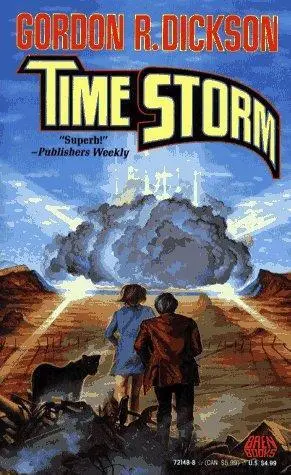
- Название:Time Storm
- Автор:
- Издательство:Baen Books
- Жанр:
- Год:1992
- ISBN:0-671-72148-8
- Рейтинг книги:4 / 5. Голосов: 1
-
Избранное:Добавить в избранное
- Отзывы:
-
Ваша оценка:
Time Storm: краткое содержание, описание и аннотация
Предлагаем к чтению аннотацию, описание, краткое содержание или предисловие (зависит от того, что написал сам автор книги «Time Storm»). Если вы не нашли необходимую информацию о книге — напишите в комментариях, мы постараемся отыскать её.
Time Storm — читать онлайн бесплатно полную книгу (весь текст) целиком
Ниже представлен текст книги, разбитый по страницам. Система сохранения места последней прочитанной страницы, позволяет с удобством читать онлайн бесплатно книгу «Time Storm», без необходимости каждый раз заново искать на чём Вы остановились. Поставьте закладку, и сможете в любой момент перейти на страницу, на которой закончили чтение.
Интервал:
Закладка:
What I searched for had to deal with the total universe, no matter what else it did. If nothing else, the track of its footsteps was undeniably there, like the track of some giant’s passing, all through the thought and creativity of the literary world.
I became avaricious, impatient to close on the quarry I hunted. My reading speed, which had been fast to begin with, increased four or five times over. I galloped through books furiously, swallowing their information in huge gulps, making a pile of unread volumes at the right of my chair in the library every morning, mentally ripping out the information they contained in chunks, and dropping the empty to the left of the same chair, in the same second that I was picking up the next book. As the winter wore on toward spring, I became like an ogre in a cave—I turned into a blind Polyphemus, made drunk by Ulysses, bellowing for books, more books.
Nonetheless, I did not lose myself in this, the way I had lost myself after Sunday’s death. I continued to dress, shower, shave, and eat my meals on time. I even pulled myself out of my search now and then when there was an administrative or social matter that needed the attention of Marc Despard. But, essentially, the winter snows and the waking year that took place around me this year were like some scene painted fresh daily on a wall at which I barely looked; and it came as a shock to me one morning to look out on the fields of April and see that the snow was gone and there was a fuzz of new green everywhere.
I had made a fresh stack of books at the end of the previous day on the right side of my chair; but the morning I first noticed the new green of the landscape, I did not reach out, as usual, to pick up the top volume and start devouring it. For some reason the Old Man was not keeping me company that day. Lately the sun, through the wall of windows, had been so warm that I had gotten out of the habit of making the fire in the fireplace. That morning a curious stillness and peace seemed to hold all the room, piled and cluttered and jumbled as it now was with the books I had demanded and discarded until it looked like a warehouse.
But out beyond the window was warm yellow sunlight; and where I sat was like a small bubble of timelessness, a moment out of eternity where anyone could catch his breath, without the moment wasted being charged against his life. Instead of reading, I found myself just sitting, looking out down the slope and over the town and the plain beyond.
I had been reading a great deal of writing on religion in the past few weeks, on yoga and Zen and all the martial arts, trying to pin down what the Chinese called Ch’i and the Japanese Ki, and which was usually translated by the English word “spirit.” As I sat staring out the window, a male cardinal flew down and perched on a feeding platform for birds which Bill had set up during the winter without my hardly noticing it. I stared at the cardinal; and it came to me that I had never seen such a beautiful color in my life as the rich red of his body feathers leading up to the black ones at his throat. He balanced on the feeder, pecked at some seeds Bill had put there, then lifted his head and was perfectly still against the high blue sky of spring.
Something happened.
Without warning, the timeless moment that enclosed me also reached out through the glass pane of the window to encompass the cardinal as well. It was not a physical thing happening, it was a moment of perception on my part—but all the same it was real. Suddenly I and the cardinal were together. We were the same, we were identical.
I reached down and picked up not one of the unread books, but the last volume that had been in my hands the evening before. It fell open near the beginning, where I had laid it face down, open, for a minute yesterday; and under the influence of the timeless moment, the words I had read before stood forward to speak to me with a voice as large as the world. They were the words of the opening paragraph of Chapter 2: THE VALUE OF OUR EXISTENCE, in the book Aikido in Daily Life by Koichi Tohei, who had founded Ki Society International, and who had himself studied under Master Morihei Ueshiba, the founder and creator of the art of Aikido.
“Our lives are a part of the life of the universal. If we understand that our life came from the universal and that we have come to exist in this world, we must then ask ourselves why the universal gave us life. In Japanese we use the phrase suisei-mushi, which means to be born drunk and to die while still dreaming, to describe the state of being born without understanding the meaning of it and to die still not understanding...
With that it all came together; not suddenly, but at once, so that it was as if it had always been together. I had been like someone born drunk, doomed to die drunk—and now I was sober. The cardinal was still on the feeder; the timeless moment still held the library; but it was as if a strange golden light had come out to flow over everything. All at once I understood that what I had been after was not just in the scraps of lines I had read in the books that had passed so hotly through my hands. It was not the fragments of ideas, the shards of wisdoms I had studied that alone were precious bits of what I sought; but that everything I had read, everything I had experienced, the world and all in it—all time and all space—were what I hunted and needed to grasp. And now I could grasp it, not by making my hands big enough to cup the universe in my palms, but by taking hold anywhere, in anything as small as a moment, a sentence, or the sight of a bird on a feeder.
With that understanding, it seemed to me that the golden light was suddenly everywhere; and I was abruptly aware of life around me as far as my mind could stretch to picture it. I could feel the rapid beating of the heart of the cardinal on the feeder. I could feel the beating hearts of the experimentals and the humans at the foot of the slope. I could feel the slow, true life in the firs and the oaks and the grasses and flowers. I could feel the blind stirring of the earthworms in the newly warmed earth. My new sensitivity ranged on and out without limit, beyond the horizon and over the whole world. I could feel life stirring everywhere, from the shark cruising the hot tropical seas, to the Weddell seal sun-bathing on the south Polar ice. The whole globe beat to the rhythms of existence, and below that beat were the quieter, more massive rhythms of the inanimate, of the soil, rock, water, wind, and sunlight. Gravity pulled. The Coriolis force spun, clockwise to the north, counterclockwise to the south. The intermixing patterns of weather sounded together like the disciplined instruments of an orchestra rendering a symphony.
I do not remember the golden light leaving and the sensitivity it had brought me. Just, after a while, it was gone and the cardinal had vanished from the feeder. I was back to feeling with merely the ordinary sensitivities of my body and mind; but within those I felt alive as I never had before. Everything seemed as if seen under a very bright light, clear and sharp. My mind was racing. I seethed with energy. I could not wait to put what I had just found to practical use. I bolted from the chair and went out of the summer palace by the entrance where the vehicles stood. There was a jeep sitting in the parking area. I climbed behind its wheel and sent it bouncing down the slope toward the town. I did not quite know where or how I was going to take hold of the universe in the new way of doing so that had just become clear to me; but now it seemed impossible that I could not find a place and a means.
But oddly, as I got close to the flat ground and the houses, a strange shyness came over me. I had been down there only briefly before on half a dozen separate occasions, and each time I had gone directly to City Hall to see Ellen, Marie, or someone else, then left again in less than an hour. It came home to me that I really had never met those who lived in the town; and I was abruptly as conscious of my stranger status as a grade school child on a first day at a new school.
Читать дальшеИнтервал:
Закладка:
Похожие книги на «Time Storm»
Представляем Вашему вниманию похожие книги на «Time Storm» списком для выбора. Мы отобрали схожую по названию и смыслу литературу в надежде предоставить читателям больше вариантов отыскать новые, интересные, ещё непрочитанные произведения.






Обсуждение, отзывы о книге «Time Storm» и просто собственные мнения читателей. Оставьте ваши комментарии, напишите, что Вы думаете о произведении, его смысле или главных героях. Укажите что конкретно понравилось, а что нет, и почему Вы так считаете.