John Schettler - Touchstone
Здесь есть возможность читать онлайн «John Schettler - Touchstone» весь текст электронной книги совершенно бесплатно (целиком полную версию без сокращений). В некоторых случаях можно слушать аудио, скачать через торрент в формате fb2 и присутствует краткое содержание. Год выпуска: 2009, ISBN: 2009, Издательство: The Writing Shop Press, Жанр: Фантастика и фэнтези, на английском языке. Описание произведения, (предисловие) а так же отзывы посетителей доступны на портале библиотеки ЛибКат.
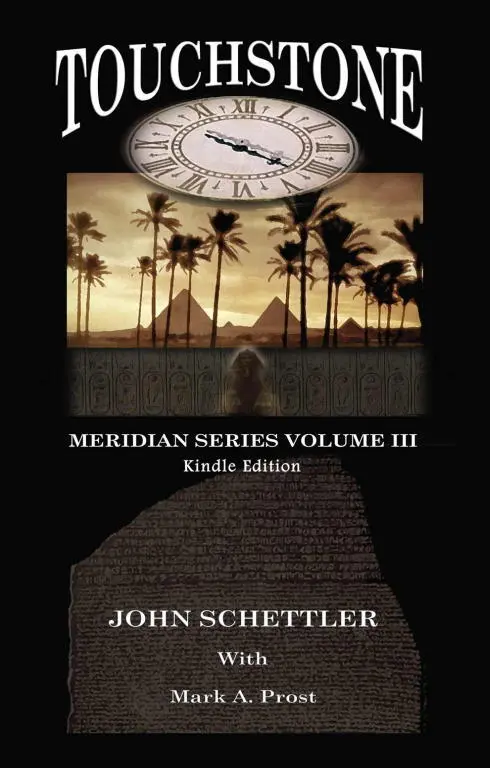
- Название:Touchstone
- Автор:
- Издательство:The Writing Shop Press
- Жанр:
- Год:2009
- ISBN:0-9713170-6-2
- Рейтинг книги:5 / 5. Голосов: 1
-
Избранное:Добавить в избранное
- Отзывы:
-
Ваша оценка:
Touchstone: краткое содержание, описание и аннотация
Предлагаем к чтению аннотацию, описание, краткое содержание или предисловие (зависит от того, что написал сам автор книги «Touchstone»). Если вы не нашли необходимую информацию о книге — напишите в комментариях, мы постараемся отыскать её.
Touchstone — читать онлайн бесплатно полную книгу (весь текст) целиком
Ниже представлен текст книги, разбитый по страницам. Система сохранения места последней прочитанной страницы, позволяет с удобством читать онлайн бесплатно книгу «Touchstone», без необходимости каждый раз заново искать на чём Вы остановились. Поставьте закладку, и сможете в любой момент перейти на страницу, на которой закончили чтение.
Интервал:
Закладка:
“Okay, stop right there.” Lindford commanded. “This is too much at once.” She paused, closed her eyes, and took a deep breath.
“Okay, one more time. Robert went through the Arch?” She flashed him a dark look, and Nordhausen swallowed hard. “You’re talking about his trip to recover Lawrence’s manuscript at Reading station, yes?”
“No. I’m talking about his trip to see H.M.S Pinafore in London—1880.”
Dorland was through helping. He had let the cat out of Schroedinger’s box and he decided to leave the rest to the professor. Nordhausen said, “Yes… I… Well, I went through the Arch, and when I came back something was different, and if I hadn’t gone we wouldn’t even know about it, so I did a good thing after all, and now we have to figure out what to do about it.” He ran out of steam, giving her a deflated look.
Maeve left him hanging for a few beats.
“Notwithstanding the fact that I only agreed to let you two start up the project again on your express promise that you would never send a person through it again without my approval,” she began, “you nevertheless secretly, and in violation of your promise to me, sent Robert through the Arch? Robert, of all people? And he did something to change history?”
“Now wait a second,” Dorland protested. “I didn’t send Robert through, this was all his own secret little plan.”
“I’m afraid that’s correct, Maeve. It was just me,” Nordhausen seconded. “Paul knew nothing about it until I told him this afternoon. He got to me just as I was returning.”
“Well suppose you just tell me now!” She was reddening with anger, secretly believing that the whole of Kelly’s dilemma was to be laid at Nordhausen’s feet.
Robert related his experience in London once more. This time he minimized his encounter with Wilde and Gilbert, and focused on the British Museum. With some contributions from Dorland, the story was worked out again, and with more details, which Maeve pried out in pointed inquisition.
Finally they were back again with Maeve and Paul paging through Robert’s hieroglyphic diaries. Maeve had vented her anger at them, but the more she came to realize that Robert’s unauthorized time jaunt had been a lucky windfall for them all, the more she composed herself.
Paul summed it up. “So if Robert hadn’t followed up his lead on Rasil’s scroll and the hieroglyphics, then we would have never stumbled on the damaged stone—the Rosetta Stone, as he claims it was called. Here, have a look at the data we pulled from the on-line RAM Bank reference. The Golems confirm Robert’s story. The stone was supposed to look like this.” He pointed to the photo on the readout they had obtained earlier. “That’s the heart of it.”
“The Rosetta Stone!” Robert exulted.
“Their touchstone,” said Paul. He pointed at the Golem files lying scattered all over Nordhausen’s study table. “He’s on to something, Maeve. The alert we got keyed on another breach in the continuum.
The professor’s eyebrows raised, wrinkling his forehead with surprise. “When? Does the report have any good data on the time?”
Paul smiled at him, the light of discovery in his eyes. “You’re going to love this,” he waded in, then jumped. “The temporal date is 1799 and the spatial locus of the breaching point is in the Middle East.”
“The Middle East?”
“In Egypt… At a place called Rosetta…”
Part IV
Time & Place
“It’s a bad plan that can’t be changed.”
—Puplilius Syrus: Maxims10
The Golem alertsubsided at exactly 2100 hours GMT, and the systems at Lawrence Berkeley Labs returned to a low standby mode. Paul got the system status call on his cell phone, and he telephoned the lab to leave a few instructions with the student interns supervising consoles there. As exhausted as they all were that night, the project team members each seemed to have something that pulled them along. Maeve took some time to settle into the meaning of all that had happened, her mind constantly diverted from the conversation with thoughts of Kelly. She decided to drive back to University Hospital and check on Kelly one more time before she turned in. They all agreed to meet at the lab at ten the following morning, where they would decide what to do about everything that had happened.
“Read every word,” she said, pointing at the scattered pages of the Golem report. “If we have to make an intervention I want temporal and spatial targeting points in the morning—and a damn good reason for any action we take. Now we don’t have Kelly, so for heaven’s sake use a computer for the math. Clear?”
Robert and Paul poured over the Golem report, for an hour, searching the data for variance flags and discussing anything that sounded serious. Amazingly, the Meridian was holding good integrity, and they had nothing above a .0013 variance report to bother with.
“These numbers are cleaner than the probabilities we ran for the Shakespeare mission,” said Paul. “It doesn’t seem like your Rosetta Stone was all that important.”
“I wouldn’t be so certain,” the professor warned. “Sure, I’ve looked at dates from 1799 to the present and found little to get upset about. Did you read the bit on Champollion?”
“I’m just getting to that.”
“Don’t bother. He leads a humdrum life, publishes a few more compilations of his findings on Egyptian artifacts, and dies three weeks early.”
Paul raised an eyebrow. “That’s odd.”
“Yes. It seems that even if you make a great discovery it only ends up extending your expected life span by three weeks. So much for the bounty of fame.”
“Then why all the fuss and bother over the hieroglyphics? How do we justify opening the continuum again with variance data this weak? You heard Maeve when she left. It’s going to be like pulling teeth at the lab with her tomorrow. She still thinks our tampering could bring Kelly down again, and that isn’t something we can dispel with good numbers.”
“She’ll just have to get over it,” Robert insisted. Besides, she’ll want us to fix this because she just can’t bear to have things amiss. It was the only reason she agreed to allow the project to continue—to keep a watch on the history and defend the integrity of the Meridian we knew.”
“True, but suppose you start by convincing me—just in case we meet resistance because of the Kelly thing. Here, I’ll play devil’s advocate.” Paul folded his arms. “Why do we need to investigate this Rosetta Stone thing? You’re off the hook, Robert. We’ve already determined that your trip did nothing to cause the damage. Why push this?”
Nordhausen gave him a long look. He started to say something, then caught himself and reached for a pen and paper instead. Paul craned his neck to see what he was writing, but the professor waved him away until he was finished. He slid the paper across the table to Paul, a smug look on his face. “Remember that?” he challenged.
The page was covered with a few neatly drawn lines of the ancient Egyptian writing. “Cute,” said Paul.
“More than that, my friend. Those are the very same characters on that scroll I found in Rasil’s backpack.”
“How could you remember something like that?”
“How could I remember? What street do you live on, Paul?” The professor wore a miffed expression.
“Alright,” Paul conceded. “So you remembered what you saw. I’ll grant you that. But what’s the big deal?”
Nordhausen frowned. He leaned heavily on the table and pointed to each character in turn as he spoke. “Here follows the word of the Lord of Time … That’s this fellow here,” he said, pointing at a larger character he had drawn. “At the time of great struggle… Eternity lies in the shadow of the Wolf… The Wolf shall go forward and prey upon the bounty of the lord… Yet if he be slain for his misdeed… For his sin,” he corrected himself. “Then all will be overthrown. Therefore —That’s this line here, Paul, and now it reads: When the Old Man returns, the Lord’s Army shall come to the Gate of the West. The Temple Priest of Time proceeds with two eyes to the Lord of Eternity . That’s the literal translation, but I would paraphrase the bit about the eyes to mean ‘look’ or perhaps ‘meet.’ Let’s read it this way: The Priest of Time shall go forth and meet the Lord of Eternity.”
Читать дальшеИнтервал:
Закладка:
Похожие книги на «Touchstone»
Представляем Вашему вниманию похожие книги на «Touchstone» списком для выбора. Мы отобрали схожую по названию и смыслу литературу в надежде предоставить читателям больше вариантов отыскать новые, интересные, ещё непрочитанные произведения.





Обсуждение, отзывы о книге «Touchstone» и просто собственные мнения читателей. Оставьте ваши комментарии, напишите, что Вы думаете о произведении, его смысле или главных героях. Укажите что конкретно понравилось, а что нет, и почему Вы так считаете.