John Sandford - Saturn Run
Здесь есть возможность читать онлайн «John Sandford - Saturn Run» весь текст электронной книги совершенно бесплатно (целиком полную версию без сокращений). В некоторых случаях можно слушать аудио, скачать через торрент в формате fb2 и присутствует краткое содержание. Город: New York, Год выпуска: 2015, ISBN: 2015, Издательство: G. P. Putnam's Sons, Жанр: Фантастика и фэнтези, на английском языке. Описание произведения, (предисловие) а так же отзывы посетителей доступны на портале библиотеки ЛибКат.
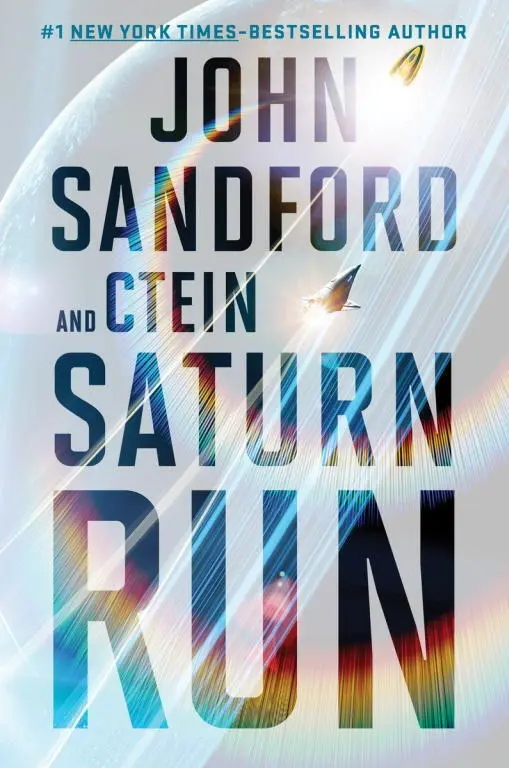
- Название:Saturn Run
- Автор:
- Издательство:G. P. Putnam's Sons
- Жанр:
- Год:2015
- Город:New York
- ISBN:978-0-698-41167-8
- Рейтинг книги:3 / 5. Голосов: 1
-
Избранное:Добавить в избранное
- Отзывы:
-
Ваша оценка:
Saturn Run: краткое содержание, описание и аннотация
Предлагаем к чтению аннотацию, описание, краткое содержание или предисловие (зависит от того, что написал сам автор книги «Saturn Run»). Если вы не нашли необходимую информацию о книге — напишите в комментариях, мы постараемся отыскать её.
—Stephen King For fans of THE MARTIAN, an extraordinary new thriller of the future from #1
–bestselling and Pulitzer Prize–winning author John Sandford and internationally known photo-artist and science fiction aficionado Ctein. Over the course of thirty-seven books, John Sandford has proven time and again his unmatchable talents for electrifying plots, rich characters, sly wit, and razor-sharp dialogue. Now, in collaboration with Ctein, he proves it all once more, in a stunning new thriller, a story as audacious as it is deeply satisfying. The year is 2066. A Caltech intern inadvertently notices an anomaly from a space telescope—something is approaching Saturn, and decelerating. Space objects don't decelerate. Spaceships do.
A flurry of top-level government meetings produces the inescapable conclusion: Whatever built that ship is at least one hundred years ahead in hard and soft technology, and whoever can get their hands on it exclusively and bring it back will have an advantage so large, no other nation can compete. A conclusion the Chinese definitely agree with when they find out.
The race is on, and an remarkable adventure begins—an epic tale of courage, treachery, resourcefulness, secrets, surprises, and astonishing human and technological discovery, as the members of a hastily thrown-together crew find their strength and wits tested against adversaries both of this earth and beyond. What happens is nothing like you expect—and everything you could want from one of the world’s greatest masters of suspense. REAL SPACE REAL SCIENCE REAL ADVENTURE
Saturn Run — читать онлайн бесплатно полную книгу (весь текст) целиком
Ниже представлен текст книги, разбитый по страницам. Система сохранения места последней прочитанной страницы, позволяет с удобством читать онлайн бесплатно книгу «Saturn Run», без необходимости каждый раз заново искать на чём Вы остановились. Поставьте закладку, и сможете в любой момент перейти на страницу, на которой закончили чтение.
Интервал:
Закладка:
From a cinematographer’s point of view, the first days were mind-blowingly boring. When you’ve photographed one status display being monitored by a furrow-browed engineer, you’ve photographed them all.
But after a week, life got interesting again. The reactors were as happy as they were ever going to be; the heat exchanger reservoir was stable at its operating temperature of just over six hundred degrees Celsius; and all the guidance sensors were nominal. Becca had taken a deep breath and given the instruction to open one slot nozzle, at minimum operating pressure.
Slowly, slowly a tenth-millimeter-thick, meter-wide ribbon of metal crawled out of the boom toward one of the spars. It wavered for a moment, wobbled, and then the guidance sensors and control magnets latched onto it. Dedicated supercomputers analyzed the ribbon’s hesitant path and issued instructions to guidance magnets to induce precisely formulated eddy currents into the ribbon. Electromagnetism did its part; the ribbon was forced back onto the straight and narrow toward the waiting spar.
After two minutes, the leading end of the ribbon reached the recovery spar, was picked up by the rollers, and fed across the spar and back down the mast.
Engineering broke out in cheers. Sandy was happy; it was dramatic. That languorous silver band creeping across four hundred meters of space was great for building tension, and Sandy planned to include every second of that footage in the final cut. Make the audience sweat the same way the engineers had.
The engineers opened the second nozzle and extruded a second meter-wide ribbon. It behaved much like the first. There were three hundred and fifty more of these to go. Allowing for pauses for status checks, the engineers would be at it for eighteen hours before all four sails were fully deployed. Sandy stuck a camera on a station-keeping pod to record the repetitive affair in real-time mode, and left for the day.
Back in the ship, he headed into a ladies’ restroom, where he found Martinez gluing a toilet-paper holder in one of the booths, while Fiorella, standing outside, was getting her hair done. She said, “You’re late.”
“But not too late,” Sandy said. “I was here earlier, I worked out the lighting.”
The Reds he was using didn’t need much light, but Sandy needed shadows—the light in the restroom was simply too flat and indirect to be interesting. He rolled his equipment case into the restroom and began sticking LED-light panels to the walls.
When they were ready, Fiorella sat on the toilet seat. On either side of her, at chest height, were two toilet paper rollers, one with a roll of toilet paper on it, the other bare; Martinez had installed the second one, and moved the first one to the right height for the shot.
They were about to start shooting when Fang-Castro stuck her head in the door and said, “I really didn’t want to know about things like this, but then somebody had to tell me. Why did they do that? Why do people tell me about things like this?”
She shook her head and disappeared again.
“Heckled from the cheap seats,” Martinez said.
Sandy had stuck his Reds to the restroom walls, controlling them from his slate, and said, “We’re on.”
Fiorella said to the cameras, “The problem was getting rid of the heat. The only feasible way to do that was to extrude extremely thin bands of molten metal into space, where, after they froze—thus getting rid of all the heat—they’d be gathered up and recycled into the ship’s reactor, where they’d be remelted….
“Think of it as working like this toilet paper roll.” She took a tab of toilet paper between her fingers and began pulling it across in front of her, toward the bare roller. “The molten metal is extruded into space, in a ribbon, like this paper. It then crosses to the other side, where it is picked up by a roller.”
Martinez had put a thin line of adhesive on the top of the roller, and Fiorella carefully stuck the paper to it, then began turning the empty roller, taking up the toilet paper.
They did it seven times before they had enough fragments of good vid that the editors could make it into one continuous segment; and it ended with Martinez on his back, under the toilet and between Fiorella’s legs, providing invisible drag on the feed roller with his fingers, while Sandy focused on bringing up the gold flecks in Fiorella’s eyes.
When they were done, and Fiorella and Martinez were back on their feet, Martinez said, “That was really pretty easy, except when the toilet paper broke.”
“That’s why we have editors,” Sandy said. “The paper won’t break on screen.”
The next morning, back in his egg, Sandy watched as four giant frosted-pewter rectangles of metal, hundreds of meters in size, ran from the spars to the booms, like square-rigged sails. The alignment was so perfect that from a distance the sails looked like single sheets instead of hundreds of parallel ribbons of radiator alloy.
He recovered his automated camera and moved it, reset it, changed memory modules: the cameras had both internal memory and simultaneous remote recording capability that went straight into a dedicated memory core in the station. Some videographers thought the equipment was now so good that no backup was really needed. Sandy had never believed that: he backed up everything.
He was outside that morning because Becca Johansson and the other engineers were finding out if their baby could walk. The reactor managers would take their plants up to twenty-five percent of rated output, the first field test of the reactors under anything close to normal operating conditions. For the time being, they’d be bypassing the turbine-generator stage. Dumping all the power into the heat exchanger would test its capabilities to over fifty percent of full capacity.
Ramping up the heat exchanger-radiator system was simple enough in concept; it just required speeding up the extruders. The faster the metal got fed into space, the faster they could dump waste heat. Currently the extruders were streaming ribbons at a leisurely three meters per second, but in full operation the ribbon velocity would be over a hundred and sixty meters per second. The plan for the day would be to take the ribbons to ninety meters per second. If that worked, the system would be taken down while Sandy and the other engineers went over every bit of data produced by the dozens of recorders watching the event.
Even at the slower ninety meters per second, everything needed to work hand in hand perfectly. The heat exchanger needed sufficient heat coming in from the reactors to keep the alloy reservoir molten. If the extruders ran too fast for the reactors, the exchanger would dump too much heat into space and the reservoir would cool down. If the temperature dropped below the six-hundred-degree melting point of the radiator alloy, the reservoir would freeze up and the engineers would have to shut it down. So the reactors depended upon the heat exchanger to keep from melting down, and the heat exchanger depended upon the reactors to keep from freezing up.
Sandy, waiting for the test to begin, focused on giving Fiorella as many different views of the station as he could, using a variety of imaging techniques. He would switch from normal real-color imaging to thermal imaging, and the sails would go to a brilliant white, set in a framework of dim, dark gray masts and booms and other station components, with a dull gray Earth in the background. When he had enough of that, he thumbed through a variety of alternative modes, doing false-color mapping, which showed sail temperatures in a rainbow of hues. Fodder for the editing session later; anything to jazz up the presentation.
When the test began, it looked like nothing. Nothing changed.
Sandy slowly panned back and forth over the station, muttering notes to himself into his throat mike, the Red dutifully capturing all that as well as multiple channels of audio from Engineering.
Читать дальшеИнтервал:
Закладка:
Похожие книги на «Saturn Run»
Представляем Вашему вниманию похожие книги на «Saturn Run» списком для выбора. Мы отобрали схожую по названию и смыслу литературу в надежде предоставить читателям больше вариантов отыскать новые, интересные, ещё непрочитанные произведения.







Обсуждение, отзывы о книге «Saturn Run» и просто собственные мнения читателей. Оставьте ваши комментарии, напишите, что Вы думаете о произведении, его смысле или главных героях. Укажите что конкретно понравилось, а что нет, и почему Вы так считаете.