Ким Робинсон - Red Moon
Здесь есть возможность читать онлайн «Ким Робинсон - Red Moon» весь текст электронной книги совершенно бесплатно (целиком полную версию без сокращений). В некоторых случаях можно слушать аудио, скачать через торрент в формате fb2 и присутствует краткое содержание. Город: New York, Год выпуска: 2018, ISBN: 2018, Издательство: Orbit, Жанр: Фантастика и фэнтези, на английском языке. Описание произведения, (предисловие) а так же отзывы посетителей доступны на портале библиотеки ЛибКат.
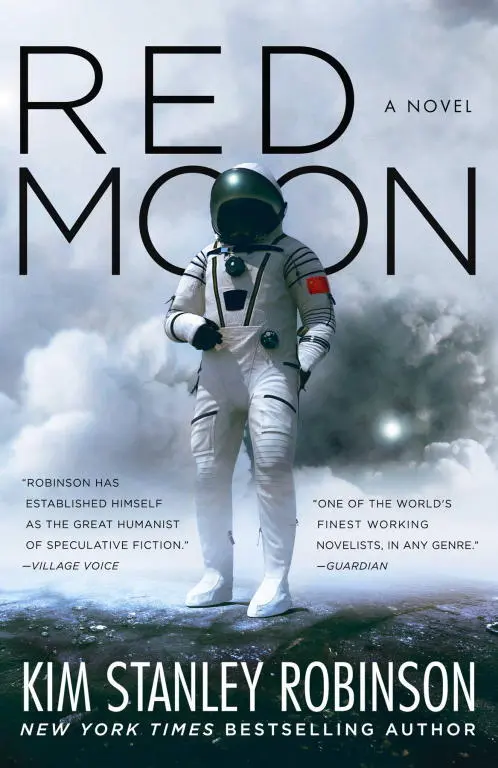
- Название:Red Moon
- Автор:
- Издательство:Orbit
- Жанр:
- Год:2018
- Город:New York
- ISBN:978-0-316-26237-8
- Рейтинг книги:3 / 5. Голосов: 1
-
Избранное:Добавить в избранное
- Отзывы:
-
Ваша оценка:
Red Moon: краткое содержание, описание и аннотация
Предлагаем к чтению аннотацию, описание, краткое содержание или предисловие (зависит от того, что написал сам автор книги «Red Moon»). Если вы не нашли необходимую информацию о книге — напишите в комментариях, мы постараемся отыскать её.
American Fred Fredericks is making his first trip, his purpose to install a communications system for China's Lunar Science Foundation. But hours after his arrival he witnesses a murder and is forced into hiding.
It is also the first visit for celebrity travel reporter Ta Shu. He has contacts and influence, but he too will find that the moon can be a perilous place for any traveler.
Finally, there is Chan Qi. She is the daughter of the Minister of Finance, and without doubt a person of interest to those in power. She is on the moon for reasons of her own, but when she attempts to return to China, in secret, the events that unfold will change everything - on the moon, and on Earth.
Red Moon is a magnificent novel of space exploration and political revolution from New York Times bestselling author Kim Stanley Robinson.
For more from Kim Stanley Robinson, check out:
New York 2140
2312
Aurora
Shaman
Red Moon — читать онлайн бесплатно полную книгу (весь текст) целиком
Ниже представлен текст книги, разбитый по страницам. Система сохранения места последней прочитанной страницы, позволяет с удобством читать онлайн бесплатно книгу «Red Moon», без необходимости каждый раз заново искать на чём Вы остановились. Поставьте закладку, и сможете в любой момент перейти на страницу, на которой закончили чтение.
Интервал:
Закладка:
Meanwhile, back in China, John said, individual savings accounts were shifting at such a rate to carboncoin and other cryptocurrencies that withdrawals from the state-owned banks had been temporarily banned, as well as all traffic in cryptocurrencies of any kind. But stopping speculation in these currencies didn’t actually stop people from using them for exchanges. All this was now only a sideshow to the widespread street demonstrations, but possibly more important in the end. Demonstrations came and went, but law remained, money remained. Still, it was looking less and less likely that the policy of waiting for the demonstrations to sputter out, a tactic that had worked for many decades now, would succeed this time, or succeed fast enough. But the other options were so dangerous that no one wanted to see them tried, not even the PLA—or at least a majority of the PLA. Hostile pilot syndrome was of course always a real danger.
“Nothing will stop the people,” Qi said as she looked through a selection of photos and maps. “They can’t be stopped.”
John Semple regarded her. “So what do you think will happen?”
She gave him a quick glance. “Change!”
Part of Ta Shu would have been very interested to hear what Chan Qi thought change could be in the contemporary context. Dynastic succession—really? Who or what could replace the Chinese Communist Party, which had led the country and served as “the government of the government” since 1949? He had often wondered about that himself, feeling that they were all riding a tiger together, a tiger that these days ran along the edge of a cliff. He had sometimes felt that Winston Churchill’s description of democracy was equally suitable as a description of the Party’s rule in China: the worst possible system, except for all the rest.
And maybe it wasn’t even fair to call it the worst. Socialism with Chinese characteristics: it was, he felt, a good idea. And he was quite sure that no one could rule China without the Chinese people’s consent. So the fact that the Party still ruled meant de facto that the majority of the people still wanted the Party, and approved of its governance, feeling it was their system. In that sense, as long as that feeling endured, it was a representative system.
But now it appeared that everywhere in the world governments were suffering a crisis of representation. Possibly this was because it was all one system, which one could call global capitalism with national characteristics, each variation around the Earth marked by the remaining vestiges of an earlier nation-state system, but still making together one larger global thing: capitalism. When it came to those national characteristics, China had the Party, the US its federal government, the EU its union; but all were ruled by the globalized market.
So what would Chan Qi say to this?
But Ta Shu was not going to have his curiosity about Qi’s ideas answered at this particular moment, because the lock door leading out to the rover tubeway opened suddenly, shocking John Semple and all the other Americans in the common room; then even more shockingly, a crowd of Chinese men holding Taser pistols filed into the room and stood against the walls, watching the Americans and their guests closely, guns in hand pointed at the ceiling.
“What’s going on here?” John Semple cried angrily.
Bo and Dhu entered last. Tall and short. They were not holding weapons, but they were holding power. All eyes fixed on them.
Bo spoke in English, which surprised Ta Shu. “We have come to take in our charge this Chinese national”—gesturing at Qi—“who is accused of grave crimes against the state, including murder of a policeman.”
“This is an American base,” John Semple said. “You have no jurisdiction here, and in fact you’re trespassing. You must leave at once.”
Bo shook his head. “This is not American territory. There are no valid territorial claims on the moon. Each nation can make scientific experiments wherever they like here, then they have the right to continue those experiments. You placed this station here long after China started an experiment on this very ground.”
“What do you mean? We located this station on empty land!”
“No. We laid a network of wires over this entire area, as part of an experiment to determine strength of solar wind. You put your base right on top of a preexisting Chinese experiment. Very inappropriate. We stand on lunar territory first used by China, so we have jurisdiction here. And we must take this suspect into custody.”
“No.” Semple stared at Bo. “If you try to do that against our wishes, by force, you’ll have a dangerous fight on your hands, and then an international incident.”
Bo pursed his lips, shook his head. “Our authorization and command comes from the very top of Chinese government. They will deal with incident. As for fight here, please notice that we outnumber you greatly, with men who are peace officers, willing to use nonfatal tools to disable you.”
It occurred to Ta Shu that Tasers were probably more effective on the moon than guns, as being more likely to be used, because less likely to puncture the chamber holding both victim and assailant. A Taser would affect only its target person, and being nonlethal (hopefully) would keep any diplomatic repercussions from being too severe. And Tasers perhaps didn’t contravene the Outer Space Treaty—not the most pressing consideration in this moment, admittedly, although Bo and Semple were in fact trading legalisms.
Ta Shu watched John Semple think it over. Out of the blue he recalled something he had heard about law enforcement in McMurdo, back when he and Semple had first met: its thousand residents were policed by officials who had only a single handgun on station, a pistol which was disassembled into three parts that were kept in three different locked offices, to prevent anyone from going crazy and using it on their comrades or themselves. People stationed in remote places were self-regulating, for the most part. Weapons were dangerous to all. But sometimes there was a need, and when that happened, a Taser was no doubt the equivalent of McMurdo’s disassembled gun. Almost a symbolic show of force; but not quite.
Ta Shu decided to act. “You have no authority on the moon!” he exclaimed to Bo, standing as he spoke.
He saw that John Semple was surprised he had spoken. But a flicker of a glance from John suggested that John now wanted him to keep talking, to buy time perhaps. He was also flicking glances at his assistants, eyes roving in a way that might suggest confusion or pondering, but Ta Shu thought could be meaningful looks.
So Ta Shu continued. “The administrator of Petrov Crater Station declined to allow you permission to take this same action, and he is an official of the Lunar Authority and the Lunar Personnel Coordination Task Force, which outranks any other policing body here. All other regular lunar agencies would likewise refuse to acknowledge your authority, not to mention your illegal incursion into an American station, no matter where it happens to be located. So you are not in fact a Chinese administrative group. You’re some kind of rogue operation, soon to become a criminal operation, guilty of trespassing, and kidnapping, and who knows what will come next—maybe coercive interplanetary transport! Surely you must be members of a splinter group like the Red Spear, repudiated many times by the standing committee of the Politburo, and even the People’s Liberation Army’s Central Military Command. No one in Beijing will support you if you do this thing! Surely you must know that you yourselves will be sacrificed by any commanders you may have for this mad action, even if they ordered you to do it. They don’t care what happens to you afterward. You’re as much a tool to them as that Taser is to you.”
Читать дальшеИнтервал:
Закладка:
Похожие книги на «Red Moon»
Представляем Вашему вниманию похожие книги на «Red Moon» списком для выбора. Мы отобрали схожую по названию и смыслу литературу в надежде предоставить читателям больше вариантов отыскать новые, интересные, ещё непрочитанные произведения.

![Ким Робинсон - Годы риса и соли [litres]](/books/394367/kim-robinson-gody-risa-i-soli-litres-thumb.webp)
Обсуждение, отзывы о книге «Red Moon» и просто собственные мнения читателей. Оставьте ваши комментарии, напишите, что Вы думаете о произведении, его смысле или главных героях. Укажите что конкретно понравилось, а что нет, и почему Вы так считаете.