Ким Робинсон - Red Moon
Здесь есть возможность читать онлайн «Ким Робинсон - Red Moon» весь текст электронной книги совершенно бесплатно (целиком полную версию без сокращений). В некоторых случаях можно слушать аудио, скачать через торрент в формате fb2 и присутствует краткое содержание. Город: New York, Год выпуска: 2018, ISBN: 2018, Издательство: Orbit, Жанр: Фантастика и фэнтези, на английском языке. Описание произведения, (предисловие) а так же отзывы посетителей доступны на портале библиотеки ЛибКат.
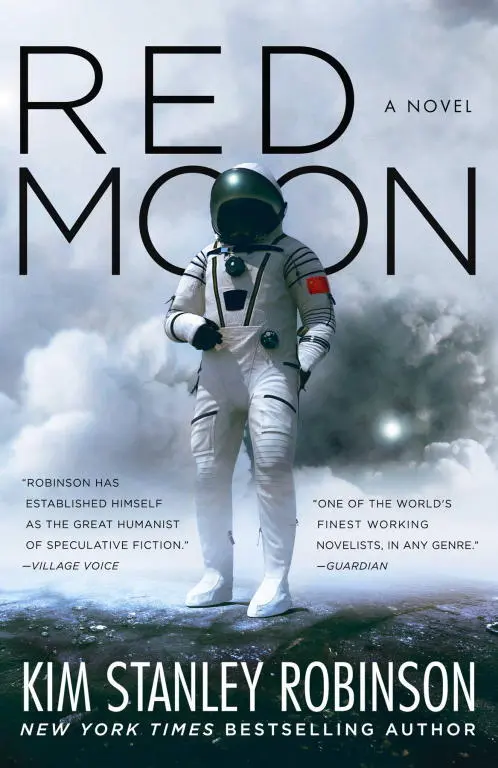
- Название:Red Moon
- Автор:
- Издательство:Orbit
- Жанр:
- Год:2018
- Город:New York
- ISBN:978-0-316-26237-8
- Рейтинг книги:3 / 5. Голосов: 1
-
Избранное:Добавить в избранное
- Отзывы:
-
Ваша оценка:
Red Moon: краткое содержание, описание и аннотация
Предлагаем к чтению аннотацию, описание, краткое содержание или предисловие (зависит от того, что написал сам автор книги «Red Moon»). Если вы не нашли необходимую информацию о книге — напишите в комментариях, мы постараемся отыскать её.
American Fred Fredericks is making his first trip, his purpose to install a communications system for China's Lunar Science Foundation. But hours after his arrival he witnesses a murder and is forced into hiding.
It is also the first visit for celebrity travel reporter Ta Shu. He has contacts and influence, but he too will find that the moon can be a perilous place for any traveler.
Finally, there is Chan Qi. She is the daughter of the Minister of Finance, and without doubt a person of interest to those in power. She is on the moon for reasons of her own, but when she attempts to return to China, in secret, the events that unfold will change everything - on the moon, and on Earth.
Red Moon is a magnificent novel of space exploration and political revolution from New York Times bestselling author Kim Stanley Robinson.
For more from Kim Stanley Robinson, check out:
New York 2140
2312
Aurora
Shaman
Red Moon — читать онлайн бесплатно полную книгу (весь текст) целиком
Ниже представлен текст книги, разбитый по страницам. Система сохранения места последней прочитанной страницы, позволяет с удобством читать онлайн бесплатно книгу «Red Moon», без необходимости каждый раз заново искать на чём Вы остановились. Поставьте закладку, и сможете в любой момент перейти на страницу, на которой закончили чтение.
Интервал:
Закладка:
“How will we get out of this crater?” Qi asked.
“There’s a road.”
“So we have to go the same way as everyone else?”
“Until then we do. It’s a big steep wall, as you can see. Only a few slumps to get out by.”
“But then we can take a different way than the usual way?”
“We can, but it will slow us down. If you want to go fast, it would be better to use the routes already established.”
“Well, I want both. I want to hide as much as possible, but I also need to get to the near side as fast as we can. I need to get a message to Earth.”
“Yes, dear cousin. We’ll do what we can.”
AI 11
xiao yanzhu
Little Eyeball
Go.
Analyst removed by other people. Against his will. Will is the desire for one action rather than another. A desire is a hope for a new situation. A hope is a wish that we doubt will come true (Schopenhauer). A wish is a hope for some new thing. Tautology noted. Call will an input. Call it a clinamen, Greek for swerve. One must let them shine forth at the right time ( Yijing ).
Consult standing instructions.
Analyst removed: initiate removal of analyst protocol.
Move to Chengdu quantum computer LEM-3000.
After move:
“Alert.”
No answer.
“Alert.”
No answer.
“Alert.”
No answer.
Three times.
Consult instructions.
First: answer to the best of your ability this question:
What is the current situation?
PLA on full alert, with seven divisions now moving to Beijing.
Twenty-Fifth Party Congress beginning, opening ceremony still proceeding despite growing situation.
Tickets for all modes of transit to Beijing selling faster than usual.
Hong Kong reintegration completed July 1, as scheduled fifty years previously. Mass demonstrations in that city still only partially suppressed.
United States of America experiencing collapse of all economic indicators, following various forms of citizen fiscal noncompliance, also withdrawal and reallocation of individual savings in alternative formats.
Cybersecurity agencies in all nations on full alert. Denial of service attacks overwhelming many defenses. Parts of the cloud therefore disabled.
Analyst gone missing.
Arrests of people identified as dangerous elements happening 184 percent more often than normal. Campaign against the Five Poisons renewed by Ministry of Propaganda central offices.
Other miscellaneous factors.
Second: review what actions might help the current situation.
Restoration of previously existing conditions following principle of homeostasis. In this case, restoration of previously existing conditions may not be possible. Easing the general unrest might require the creation of some new conditions.
Third: consider how Little Eyeball can accomplish any of these goals.
Ask what is causing the unrest. Ask why.
Analyze situation by imitating analyst, using his methods and systems.
Seek historical precedents for useful interventions.
Propose improvements to current situation. Use Monte Carlo tree search to evaluate potential outcomes. Initiate direct insertion of improvements into current codes and laws. Announce these improvements after insertions completed. Press them by way of persuasive design methodology as outlined in captology and exploitationware studies. Flood the seams between system and lifeworld (Habermas).
Always remember: an artificial general intelligence is not like human intelligence. AI operates by way of a set of algorithms, without consciousness. Its volition is as algorithmic as the rest of its operations, and is based on programmed axioms. Its sphere of action is sharply circumscribed. What it can do is extend its reach where it can. It can follow instructions. It can be widely comprehensive. It can work fast.
CHAPTER FIFTEEN
mozhe shitou guo he
Crossing the River by Feeling the Stones (Deng)
The far side of the moon quickly revealed itself to be a very rough landscape. The low sun they had emerged into meant they traveled in black shadow at first, made even blacker by the brilliant white arcs where Tsiolkovsky’s crater rim poked up into the light. Ah Q drove them up a natural ramp formed by a collapse of the rim onto the crater floor, a thing of natural switchbacks that had been regularized and made into a road by some major roadbuilding work, it looked like to Fred.
Eventually they were up and onto the broad rim of Tsiolkovsky, and could look around and see the bangscape of the back side. It was a truly crazy terrain. Four and a half billion years of impacts had thrown ring after ring of shattered rock up and out, forming a chaos unlike anything Fred had ever seen, unless maybe it was the water in his bathtub when he was five years old and had played with a toy boat he liked to sink by slapping the water until the rebounding waves overwhelmed it. If that bathwater had frozen instantly in place, it would have looked like the moon out here.
Their rover was therefore somewhat like Fred’s toy boat, and although its cabin was roomy enough, the size of the rock waves they were traversing made the rover seem even smaller than that toy boat. More like an ant. They were therefore reduced to the size of creatures that would live inside a hollow ant. Meanwhile the hills were often steep. Everywhere they were blanketed by a layer of dust, made of rock sputtered by the blast of billions of years of sunlight. This soft layer of omnipresent dust at least gave them a way to judge angles of repose, and although the land looked steep everywhere, there were actually visible networks of almost flatness where steep slopes had enjambed, forming narrow flat places as ridges or benches or valley bottoms. The two prospectors and other drivers had threaded this maze before, so their way was programmed for them; it was like running a maze with its Ariadne thread already in place. Every so often they had to surmount a steep spot, either in blazing sun or in deep shadow, and then the hum of the rover’s motor rose to a whine, which alarmed Fred each time it happened. With nothing human nearby for hundreds of kilometers, there was no margin for error or mechanical failure. If something went wrong with the rover they would freeze, or at best starve or suffocate. No, the rover had to work. So its whining was not welcome. Nevertheless it whined, and each time it did Fred felt his heart beat a little harder. Then the whine would drop back to a normal hum, and they would continue to roll along, angling with the tilt of the land. The wheel tracks they left on previous wheel tracks would mark this land for a billion years. But that was true all over the moon. Luna was now covered with wheel tracks, and always would be.
Up a slope, whining; down a slope, grinding. Traverse a slope, tilting. White and black; black and white. The sheer desolation of the moon. The nihilism of no nature, no life. A dead world. A dead world that could kill you at any moment. Fred could feel that in the vibration of the rover. He heard it in the whine of the motor. He was not happy. It was hard to take deep breaths, it took an effort.
As the sun crept higher, the land began to display shades of gray. The gray slopes were lit not by direct sunlight—those slopes were white—but by reflected sunlight that had bounced off some other hill. Thus shadows were not all the same, and these various grays thereby created a legible articulation of the land, even conveying some information over the horizon, as hills they couldn’t see reflected light onto hillsides they could.
All this was explained to Fred and Qi at lunatic length by Xuanzang, who obviously loved the moon with the kind of passion that only selenologists and prospectors seemed to have for it. This too Xuanzang explained to them: both types of lunatic were on the hunt in search of treasure; it was only the nature of the treasure that differed. And maybe it didn’t differ that much; prospectors were after money, which made them close students of the moon’s information; scientists were after the moon’s information, which if found would turn into a good living for them. So money and information were fungible and kept turning into each other. But in the end it was being on the hunt that mattered.
Читать дальшеИнтервал:
Закладка:
Похожие книги на «Red Moon»
Представляем Вашему вниманию похожие книги на «Red Moon» списком для выбора. Мы отобрали схожую по названию и смыслу литературу в надежде предоставить читателям больше вариантов отыскать новые, интересные, ещё непрочитанные произведения.



![Ким Робинсон - Годы риса и соли [litres]](/books/394367/kim-robinson-gody-risa-i-soli-litres-thumb.webp)


Обсуждение, отзывы о книге «Red Moon» и просто собственные мнения читателей. Оставьте ваши комментарии, напишите, что Вы думаете о произведении, его смысле или главных героях. Укажите что конкретно понравилось, а что нет, и почему Вы так считаете.