Ким Робинсон - Red Moon
Здесь есть возможность читать онлайн «Ким Робинсон - Red Moon» весь текст электронной книги совершенно бесплатно (целиком полную версию без сокращений). В некоторых случаях можно слушать аудио, скачать через торрент в формате fb2 и присутствует краткое содержание. Город: New York, Год выпуска: 2018, ISBN: 2018, Издательство: Orbit, Жанр: Фантастика и фэнтези, на английском языке. Описание произведения, (предисловие) а так же отзывы посетителей доступны на портале библиотеки ЛибКат.
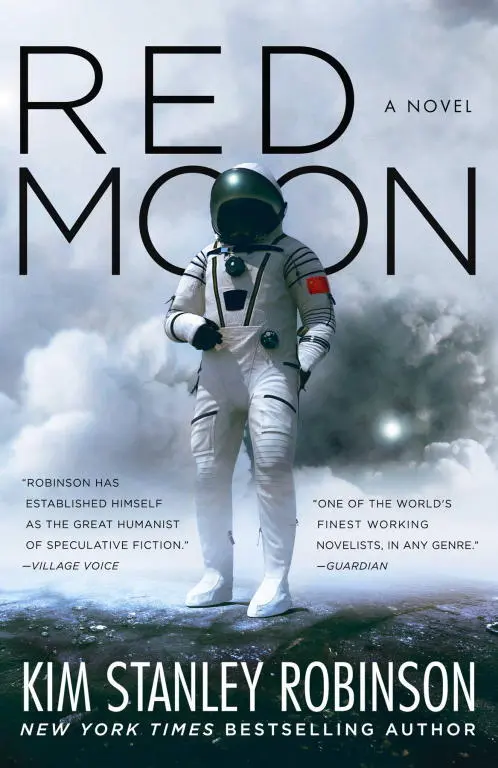
- Название:Red Moon
- Автор:
- Издательство:Orbit
- Жанр:
- Год:2018
- Город:New York
- ISBN:978-0-316-26237-8
- Рейтинг книги:3 / 5. Голосов: 1
-
Избранное:Добавить в избранное
- Отзывы:
-
Ваша оценка:
Red Moon: краткое содержание, описание и аннотация
Предлагаем к чтению аннотацию, описание, краткое содержание или предисловие (зависит от того, что написал сам автор книги «Red Moon»). Если вы не нашли необходимую информацию о книге — напишите в комментариях, мы постараемся отыскать её.
American Fred Fredericks is making his first trip, his purpose to install a communications system for China's Lunar Science Foundation. But hours after his arrival he witnesses a murder and is forced into hiding.
It is also the first visit for celebrity travel reporter Ta Shu. He has contacts and influence, but he too will find that the moon can be a perilous place for any traveler.
Finally, there is Chan Qi. She is the daughter of the Minister of Finance, and without doubt a person of interest to those in power. She is on the moon for reasons of her own, but when she attempts to return to China, in secret, the events that unfold will change everything - on the moon, and on Earth.
Red Moon is a magnificent novel of space exploration and political revolution from New York Times bestselling author Kim Stanley Robinson.
For more from Kim Stanley Robinson, check out:
New York 2140
2312
Aurora
Shaman
Red Moon — читать онлайн бесплатно полную книгу (весь текст) целиком
Ниже представлен текст книги, разбитый по страницам. Система сохранения места последней прочитанной страницы, позволяет с удобством читать онлайн бесплатно книгу «Red Moon», без необходимости каждый раз заново искать на чём Вы остановились. Поставьте закладку, и сможете в любой момент перейти на страницу, на которой закончили чтение.
Интервал:
Закладка:
Then it suddenly seemed he actually did hear it, right out loud in the air. He shuddered in the bodysuit. In fact the room was quiet. He thought about what it would be like if he really did hear her voice calling him from the next room, how it would feel to hear a ghost speak; suddenly he was scared to be alone there in her place with her gone. Then that wave of fear passed, and he knew he was truly alone there, that there was nothing to fear. There was only sadness.
He was going to have to empty the place. Give away the furniture, the clothing, the kitchen implements. Give things away or throw them away. She had kept such a lot of junk. But there were always people who needed such things. These things would live on in other lives. They lived longer than people.
Then there was a meow at his feet, and he groaned. Was this cat hers? Was it a neighborhood stray that she fed scraps to? He would have to find out.
He sat on her bed. The cat rubbed against his ankles. He got up and found some cat food to put in a bowl for it, and it ate hungrily, making a crunching noise that filled the apartment. He looked down at it. He was exhausted and wanted to sleep, but felt reluctant to get in her bed. He lay down on top of it in his bodysuit, napped until he got cold. Then he got up, went to the bathroom, started cleaning up. First himself, then the place. As he knocked around he thought of an old poem that had always impressed him, first of all because of its title, “The Rain Cleared and the Breeze and Sunshine Are Superb as I Stroll Outside the Gate.” By Lu Yu, Song dynasty:
Old Chang, sick three years, finally died;
Grandpa one evening went where he couldn’t hear us.
I alone, with this body strong as iron,
Lean on the gate, looking at green evening hills.
He found as he went through her desk and bedside table that she had kept little notebooks to write in. None of them were dated, and he couldn’t tell when she had written what. Some contained day poems, like the brief Buddhist things that widows had written in their old age for centuries. Most were filled with lists and brief notes to herself. Occasionally for a month or three she had written down brief accounts of her days, then she had appeared to tire of that and give up. One sequence of these diary notes had lasted longer than most, and by their content he saw that they came from the time right after his father had died. One line stuck him like a thorn:
Alone in the house. Must get used to it.
He stared at her crabbed handwriting. He saw how it must have been, and sat down in the nearest chair. A spasm of sorrow passed through him, followed after a while by a wash of relief, as he realized that his mom was now finally freed of the intense burden of staying happy after his father was gone. Twenty years of driven, relentless effort.
He sat there in the chair and thought about what a human life turned out to be. In the old days, women were said to go through stages—men too of course, but for women it was structured very particularly: milk teeth, hair pinned up, marriage, children, rice and salt, widowhood. Most of those stages were so social, so busy, every moment all entangled with people and work and talk; and then at the end suddenly there you were alone in a room, like a prisoner serving time in solitary. Just because of the passage of time, in the ordinary course of things. It was strange. He should have come home more often.
The old outskirts of Beijing were long gone, buried under the remorseless spread of the city in all directions. To the east the endless high-rises of Jing-Jin-Ji had replaced the mountains of trash where Ta Shu had once upon a time taken things to acquaintances he liked among the junk dealers who lived in the landfills they mined. Those people had built their shacks out of discarded materials, then as the landfills filled they had moved with them and rebuilt in the new sites. Now Jing-Jin-Ji filled all the gaps, making a supercity bigger than Luxembourg, bigger than New England. An early manifestation of the urbanization that was threatening to pave all China, then the entirety of planet Earth.
Now stuff like his mom’s had to be taken south to the Fuxing Garbage Station, where a big yard was home to giant sorting containers and compactors. So after first dividing his mother’s things into categories, Ta Shu did that.
The sorting itself was hard. First came things that could still be used by her neighbors and friends; that was a lot of it, thankfully. Someone volunteered to take the cat, which was a relief. But there was still so much that could not be given away, much less sold, not that he was in the mood to sell anything. The neighbors came in and took all the furniture, shabby though it was; also much of her clothing. A group of women friends came in and packed her underclothes in boxes to throw away, so that he wouldn’t have to. This was what happened when you didn’t have daughters. The little clothing that remained he gave to a local charity shop. Same with kitchen utensils and implements, although she had saved everything she had ever owned, it seemed, and there were cabinets filled with boxes containing broken dishes, woks, pots and pans, glasses and so on. These were dangerous boxes to fish around in, but he carefully removed everything of any value, and then was left with a few boxes of useless stuff. All junk, all trash; she had saved even her trash.
When everything was sorted into its proper category, he used his wristpad to rent a bike and trailer from a local line of them locked in a row, then tied the boxes of trash onto the trailer. When all was ready he headed south through the crowded streets toward Fuxing Road.
This slow pedal through the heavy gravity of his grief quickly took on the nature of a penance or a funeral march. Almost always when sadness came to him he felt it as an emptying out, a going away. Occasional stabs of sorrow struck, but mostly he was gone and did not feel things; that emptiness was his sadness. It always made him want to feel something, anything, because anything would be less sad than the emptiness. So sometimes he would inflict things on himself in times like this, do hard things like this bike ride through the insane traffic of Beijing, risking his life with every turn of the handlebars. It would have been obviously crazy if there weren’t so many other people doing it. Traffic on the smaller streets was still quite heavy, and small trucks and cars predominated everywhere. Often in the crush of gridlocked cars, people threading their way forward on bikes made better time. The vehicles on the streets were all electric now, which was good for the air but bad for safety; they made almost no sound, just a kind of singing hum that the government had ordered added to them, a hum that did not clearly Doppler its approach and departure as the old rumbling gas engines had. A very dangerous world, therefore, these streets. But that was just what he wanted, so it was perfect for his mood. Dangerous, dolorous, finicky, frustrating. Weave through the traffic jams, avoid being crushed like a bug under the big singing lorries, all carrying their goods and people around the infinite city. Ah Mother! He really should have come back more often. All his life he had been a wanderer, seldom going home; his dad hadn’t cared and so he hadn’t cared. But his mom had cared, and now here he was pedaling her sad old junk to the trash heap. Sad, sad, sad. Maybe he was feeling it this time.
Then three or four near misses, with big trucks screeching their air brakes and sometimes shouting abuse at him, left him rattled and afraid. It was such a heavy world, and he did not actually want to get killed in this act of penance. His mother would not like that either.
By the time he got to the garbage station, he was feeling it would have been smarter to pay someone to take these things away. Even more so after pushing the bike into the Fuxing yard and finding that none of the junk dealers there were the ones he had known in the old days. Dustless garden, where to find? He thought of Fang Fei’s Chinese dream, up there on the moon; and here was the Chinese reality. That wasn’t fair, of course. No doubt there had been trash heaps and shambles and abattoirs in the Tang era also. But this one was huge, and smelled bad. It smelled of death.
Читать дальшеИнтервал:
Закладка:
Похожие книги на «Red Moon»
Представляем Вашему вниманию похожие книги на «Red Moon» списком для выбора. Мы отобрали схожую по названию и смыслу литературу в надежде предоставить читателям больше вариантов отыскать новые, интересные, ещё непрочитанные произведения.

![Ким Робинсон - Годы риса и соли [litres]](/books/394367/kim-robinson-gody-risa-i-soli-litres-thumb.webp)

Обсуждение, отзывы о книге «Red Moon» и просто собственные мнения читателей. Оставьте ваши комментарии, напишите, что Вы думаете о произведении, его смысле или главных героях. Укажите что конкретно понравилось, а что нет, и почему Вы так считаете.