Ким Робинсон - Red Moon
Здесь есть возможность читать онлайн «Ким Робинсон - Red Moon» весь текст электронной книги совершенно бесплатно (целиком полную версию без сокращений). В некоторых случаях можно слушать аудио, скачать через торрент в формате fb2 и присутствует краткое содержание. Город: New York, Год выпуска: 2018, ISBN: 2018, Издательство: Orbit, Жанр: Фантастика и фэнтези, на английском языке. Описание произведения, (предисловие) а так же отзывы посетителей доступны на портале библиотеки ЛибКат.
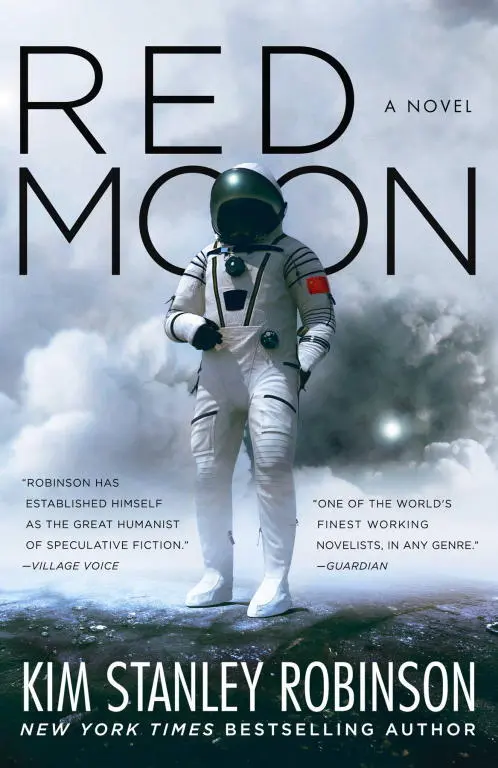
- Название:Red Moon
- Автор:
- Издательство:Orbit
- Жанр:
- Год:2018
- Город:New York
- ISBN:978-0-316-26237-8
- Рейтинг книги:3 / 5. Голосов: 1
-
Избранное:Добавить в избранное
- Отзывы:
-
Ваша оценка:
Red Moon: краткое содержание, описание и аннотация
Предлагаем к чтению аннотацию, описание, краткое содержание или предисловие (зависит от того, что написал сам автор книги «Red Moon»). Если вы не нашли необходимую информацию о книге — напишите в комментариях, мы постараемся отыскать её.
American Fred Fredericks is making his first trip, his purpose to install a communications system for China's Lunar Science Foundation. But hours after his arrival he witnesses a murder and is forced into hiding.
It is also the first visit for celebrity travel reporter Ta Shu. He has contacts and influence, but he too will find that the moon can be a perilous place for any traveler.
Finally, there is Chan Qi. She is the daughter of the Minister of Finance, and without doubt a person of interest to those in power. She is on the moon for reasons of her own, but when she attempts to return to China, in secret, the events that unfold will change everything - on the moon, and on Earth.
Red Moon is a magnificent novel of space exploration and political revolution from New York Times bestselling author Kim Stanley Robinson.
For more from Kim Stanley Robinson, check out:
New York 2140
2312
Aurora
Shaman
Red Moon — читать онлайн бесплатно полную книгу (весь текст) целиком
Ниже представлен текст книги, разбитый по страницам. Система сохранения места последней прочитанной страницы, позволяет с удобством читать онлайн бесплатно книгу «Red Moon», без необходимости каждый раз заново искать на чём Вы остановились. Поставьте закладку, и сможете в любой момент перейти на страницу, на которой закончили чтение.
Интервал:
Закладка:
They left the apartment and went down its stairs. Right next to their concrete cube stood a tall multicolored brick building. Gray bricks held an inset of brick-colored bricks, which framed a gray doorway in which gold-leaf tree trunks were set. Some kind of shrine, it appeared. Gold Chinese characters covered the doorframe and lintel.
“What is this?” Fred asked.
“Ta Hu,” Qi explained. “The goddess who protects those who go to sea.”
“In what religion?”
She shrugged. “Chinese religion.”
“Daoist? Buddhist?”
“Older than those, I think.”
They followed the little harbor’s only sidewalk to the long tarp roof that covered all the restaurants. Qi chose one of them to enter, speaking briefly to a waiter. He nodded and led them to a small table at the railing overlooking the water. It was near sunset, light frilly clouds turning yellow and pink overhead. Another waiter approached and Qi ordered something. “I ordered us a variety,” she said. “You can try a little of everything.”
“Sounds good,” Fred lied.
The waiters brought out dishes and water and tea for each of them, then tureens of soup and plates of rice, and after that, dish after dish of other food. Some things Fred recognized, especially an entire fish, that was easy, of course; but a lot of the dishes were filled with foods he couldn’t identify. Clumps of greenery; squares and balls of maybe tofu, or gelatin, or pork belly, or what have you. Gamely Fred tried everything, concealing from Qi as best he could that this was very difficult for him. He hated new foods. And many of the tastes, as with the appearances, completely baffled him. He had eaten a few times in China before, but never like this; he had protected himself by eating mostly rice and chicken. Now clams arrived, followed by mussels, then more cooked lumps of who knew what.
Around them the sunset turned to dusk, and the string of lights edging the tarp overhead grew brighter. Their restaurant was almost completely empty. On the other side of the sidewalk running along the back of the restaurants, tall banks of lit fish tanks glowed like an aquarium wall. Fred watched as the waiters or cooks stood on ladders to maneuver nets around in the tanks, scooping up fish with deft quick turns and then taking them back where presumably the kitchens were. Fresh fish indeed.
Then their waiter brought out two plates that held crustaceans so big they overhung the plates on all sides. Bigger than lobsters, with more legs than lobsters, sporting spikier shells that were blond in color. They both laughed. The scissors provided to cut through these shells were as heavy-duty as tin snips. Fred had a little experience with eating lobsters, so he accepted with some interest the challenge of getting to the meat of this armored beast. He had to be careful not to poke or slice his fingers in the effort. For a while they were both silent as they snipped away, making loud cracks when they succeeded in bringing enough pressure to bear. The meat tasted like crab, or lobster, or something like those.
“What is this thing?” Fred asked.
“Shrimp.”
“Really? This big?”
“Around here that’s how big they get.”
“Hard to believe.”
“And yet here it is.”
“I’m trying to imagine the first person who hauled one of these out of the ocean and said, Oh yeah, let’s eat this.”
She laughed again. “My dad used to say, we Chinese eat everything with legs except the table.”
Later, when they had shifted into the realm of unidentifiable desserts, they sat back in their chairs and watched twilight breathing on the bay and the hills.
“What do you think will happen?” Fred asked.
She frowned. “To us, you mean?”
“Yes.”
“I’m not sure yet. I don’t think it’s the right moment yet for the movement to act. And I can’t see a way to get a truly private word to my dad.”
“You two don’t have some private line?”
She shook her head. “Even if I did, his security team is always listening.”
Fred thought it over as he picked through the desserts, hoping for something he liked enough to fill up on; despite his attempt to seem normal, he had eaten very little. His taste buds by now were terrifically confused, and he felt just slightly ill.
He ventured to say, “Do you think the heavy surveillance comes from having a one-party state?”
She stared at him. “Why would you say that?”
“It’s not true?”
“It is true. But all one-party states have problems. That’s why America is so messed up.”
“What do you mean?”
“I mean America is more of a one-party state than China. It’s entirely ruled by the market. Actually the market is the only party in the world now, or it wants to be. So every nation has to deal with that in its own way.”
“They usually say we have a two-party system,” Fred mentioned.
“Your parties are just factions. That’s why people in your country are so angry. They can see it’s just one party, and one-party states are always corrupt. Polyarchies are better because power gets distributed to various groups. They’re inefficient and messy, with lots of turf battles, but that’s the cost of distributing power. It’s better than concentrated power.”
Fred tried to think this over. His brain was as confused as his tongue. “I’m not sure,” he confessed.
“No one is. All I’m really saying is that these names for systems that we use, they disguise all kinds of similarities. China and America are both one-party states, and they’re both polyarchies. Those are the two kinds of rule that are always struggling for dominance.”
“So are you hoping the two of them will kind of…?”
“Influence each other? Combine?”
“I don’t know.”
“Maybe. People talk about the G2 now, as if we’re the only ones that matter, at least in economic terms. And in some ways we mirror each other. So if you could take the best of each…”
“Good idea.”
She looked up at him as if to see if he was being sarcastic. But Fred was never sarcastic, as she should have known by now; and maybe she did. She looked down, poked around on her plate as if looking for something appealing.
“Ready to go?” he asked.
“I guess so, yes.”
“This has been nice. Thank you for this.”
“Thank you for sticking with me,” she said.
“What do you mean?”
“You could leave.”
“No. I’m in just as much trouble as you are. If not more.”
“I guess. But we could probably get you into an American consulate now.”
Fred shrugged. He knew immediately he didn’t want that.
She stared at him curiously.
They sipped tea. Dusk turned the water of the bay a glossy black. She paid the waiter with one of the wristpads her friends had given them in Beijing. They got up and walked back toward their little concrete refuge.
At the end of the row of restaurants, she stopped and put her hand to his arm.
“What?”
She turned him around with a hard pull, began to walk the other way with her hand still pulling his arm.
“What?”
She lowered her head as they passed a couple, then said, “There are people waiting in our doorway. We have to get out of here. Stay quiet again.”
“Damn,” Fred said, feeling a jolt of dismay. But I liked that place! he almost said. I wanted to stay there. I wanted time to stop there.
Again they were leaving everything behind. By now that wasn’t much more than their toothbrushes from the train, but still. To only have the clothes on your back. “Where will we go?”
“There’s a little ferry at the end of this dock that runs people back to the city after they eat at these restaurants. We’ll take that and hope they don’t have anyone on it.”
Читать дальшеИнтервал:
Закладка:
Похожие книги на «Red Moon»
Представляем Вашему вниманию похожие книги на «Red Moon» списком для выбора. Мы отобрали схожую по названию и смыслу литературу в надежде предоставить читателям больше вариантов отыскать новые, интересные, ещё непрочитанные произведения.




![Ким Робинсон - Годы риса и соли [litres]](/books/394367/kim-robinson-gody-risa-i-soli-litres-thumb.webp)



Обсуждение, отзывы о книге «Red Moon» и просто собственные мнения читателей. Оставьте ваши комментарии, напишите, что Вы думаете о произведении, его смысле или главных героях. Укажите что конкретно понравилось, а что нет, и почему Вы так считаете.