Ким Робинсон - Red Moon
Здесь есть возможность читать онлайн «Ким Робинсон - Red Moon» весь текст электронной книги совершенно бесплатно (целиком полную версию без сокращений). В некоторых случаях можно слушать аудио, скачать через торрент в формате fb2 и присутствует краткое содержание. Город: New York, Год выпуска: 2018, ISBN: 2018, Издательство: Orbit, Жанр: Фантастика и фэнтези, на английском языке. Описание произведения, (предисловие) а так же отзывы посетителей доступны на портале библиотеки ЛибКат.
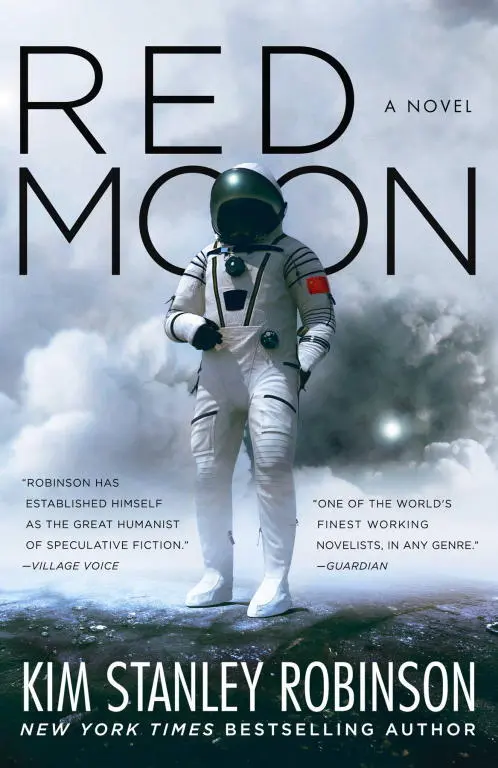
- Название:Red Moon
- Автор:
- Издательство:Orbit
- Жанр:
- Год:2018
- Город:New York
- ISBN:978-0-316-26237-8
- Рейтинг книги:3 / 5. Голосов: 1
-
Избранное:Добавить в избранное
- Отзывы:
-
Ваша оценка:
Red Moon: краткое содержание, описание и аннотация
Предлагаем к чтению аннотацию, описание, краткое содержание или предисловие (зависит от того, что написал сам автор книги «Red Moon»). Если вы не нашли необходимую информацию о книге — напишите в комментариях, мы постараемся отыскать её.
American Fred Fredericks is making his first trip, his purpose to install a communications system for China's Lunar Science Foundation. But hours after his arrival he witnesses a murder and is forced into hiding.
It is also the first visit for celebrity travel reporter Ta Shu. He has contacts and influence, but he too will find that the moon can be a perilous place for any traveler.
Finally, there is Chan Qi. She is the daughter of the Minister of Finance, and without doubt a person of interest to those in power. She is on the moon for reasons of her own, but when she attempts to return to China, in secret, the events that unfold will change everything - on the moon, and on Earth.
Red Moon is a magnificent novel of space exploration and political revolution from New York Times bestselling author Kim Stanley Robinson.
For more from Kim Stanley Robinson, check out:
New York 2140
2312
Aurora
Shaman
Red Moon — читать онлайн бесплатно полную книгу (весь текст) целиком
Ниже представлен текст книги, разбитый по страницам. Система сохранения места последней прочитанной страницы, позволяет с удобством читать онлайн бесплатно книгу «Red Moon», без необходимости каждый раз заново искать на чём Вы остановились. Поставьте закладку, и сможете в любой момент перейти на страницу, на которой закончили чтение.
Интервал:
Закладка:
“So there’s some kind of infighting?”
Peng Ling nodded, looking at him over her teacup. She tested it with a tiny sip.
Ta Shu said, “Do you think Chan Guoliang could have had anything to do with it?”
“Of course. It may have been his security people who sent her back from the moon. I think he’s the one who sent her up there in the first place.”
“Why would he do that?”
“She’s a troublemaker. Involved with some dissident groups.”
“Oh my. Tail Wags Dog?”
“Both Hong Kong and mainland groups. While she was in China, Chan could never be sure he had gotten her away from them, so he sent her off to the moon. Or so I heard. But apparently she is capable of getting into trouble wherever she goes.”
“And out of it too.”
“Maybe. That will be hard to tell, until we find her again.”
“Are you going to look?”
“Yes. I like Chan Guoliang. We’ve been working together pretty well, we are allies on the standing committee. And I need to know what’s going on. If one of Chan’s enemies gets hold of his daughter, he could be forced to do their bidding. That could be bad for both of us.”
“Isn’t Chan a New Leftist?”
“I don’t like these names, but he is sympathetic to that line.”
“And you?”
She sipped again at her tea. “Try it, it’s good.”
He ventured a sip; it had cooled just enough for him to abide it. A white tea called Handful of Snow, Ling said. One of her favorites from Yunnan. Subtle but distinct, with a delicate fragrance. He took a bigger sip, enjoying the sense of being back on Earth, immersed in its substance. Grounded. And he seldom drank a white tea.
After this pause for sipping, and possibly reflection, Peng Ling said, “You know me, Master. I am always for weiwen . Maintenance of stability. All the old virtues. Lean to the side. Harmonious society. Scientific outlook on development. All the best old ways.”
“It’s really Daoism,” Ta Shu said.
“Confucius too. Or really it’s Neo-Confucian. Like Deng Xiaoping. I like it. It suits me, because I’m a practical person. But now we have the New Leftists, wanting to steer us back toward socialism.”
“Socialism with Chinese characteristics,” Ta Shu added. This was what every system since 1978 had called itself.
“Of course. And don’t get me wrong, I like the New Leftists for that very reason. It’s a way to stay free of the snares of globalism. To keep us all together here in China. So I lean that way, just between you and me. Not so much toward the liberals, because they seem to want Western values imposed on us, and thus they become part of the globalization package. That said, the liberalizers have some good points too. Their best suggestions need to be taken into account. We need some kind of integration of both, or all.”
“Finding the pattern,” Ta Shu said. “Yin and yang.”
“All your feng shui patterns, sure. Harmonious balance. The triple strand.”
“And yet things are always slightly out of balance, being alive. So which do you like most of the liberalizers’ ideas?”
“That’s easy. The rule of law.”
“Including independent judges? I’m surprised you would say that.”
“Just between us, I do say it. I don’t see how rule of law can hurt the Party. Not the way the constitution is written. It would only mean a big clampdown on cronyism and corruption. Really, I think anything above the law is wrong.”
“You say that!”
“I do.”
“But the Party is above the law.”
“The Party makes the law, but then it shouldn’t be above it. Party members shouldn’t be above the law, that’s the important point. The people have to be able to trust the Party.”
Ta Shu sipped his tea, regarded her. “Isn’t this part of Tail Wags Dog?”
“Maybe it is. Rule of law was always Hong Kong’s great advantage over the mainland. They got it from the British, and they kept it during the fifty years of transition as best they could. That’s why they did so well. We built up Shanghai to try to make it a rival financial center and cut Hong Kong down a little, but Shanghai was always a Party town, so it’s never been trusted by the outside world like Hong Kong is. In that sense you could say that rule of law is an economic value. It makes us stronger.”
“When you say us, you don’t mean the Party?”
“I mean China.”
“This seems like a dangerous thing for one of the seven to be saying!”
“I don’t say it to everyone. I trust you will keep this between us, and this room is privatized. I want you to hear my views.”
“So far, I hear that you want to stabilize things by agreeing to the New Leftists in their direction, and to the liberalizers in their direction. Feeling the stones indeed!”
“Well, we do have to get across the river.”
“Isn’t it just whateverism, like Hua?”
“No. Hua meant we should just do whatever Mao might have wanted. That was whateverism. The two whatevers! Come on, Master, I’m better than that. I’m doing what we have to do to keep China from falling into chaos.”
“Was going to the moon your idea too?”
She laughed. “Please! I’m not that old! I was still in your class when they started that!”
“I know. But it was a good move. So that makes me think it’s your kind of thing.”
“Thank you for your vote of confidence. But tell me why you think it’s a good move.”
“Mainly because it’s the moon, plain as that. That makes what we do up there important, because it’s a symbol of our national achievement.”
She laughed again. “I’m remembering now why I did so poorly in your class. I don’t really get feng shui, or any kind of symbolic thought.”
“But think how China has always been Zhongguo, the Middle Kingdom. That middle was always said to be halfway between Earth and heaven. Now, with us on the moon, it seems to be coming true. China really is between Earth and heaven.”
“So it wasn’t symbolic after all.”
“Well, the Chinese language is always symbolic.”
“To me Chinese is always concrete. But then I’m a concrete thinker.”
Ta Shu nodded, thinking of her poetry so long ago. Bureaucratic memos, written down in classic forms; he used to laugh at her, but affectionately. She had taught him new things about poetic possibilities. “So okay, back on Earth, feet on ground, very concrete. What do you think should be done?”
She sipped her tea and thought. “Here’s how I see it. If the Party is going to continue to run the country, it has to run it demonstrably better than any other system could. And without Party members benefiting much more than anyone else. It’s quite a balancing act, so we have to feel the stones, yes, and pick a careful way. Go left then right, find out what works. Practice is the only criterion of truth, isn’t that another one of Deng’s sayings?”
“Yes. But I always wondered about that one. Practice has to have some guiding principles, and truth needs to be true to something.”
“Well, but all Deng’s sayings are like that. Just like most Party sayings, or the Yijing for that matter, or the Dao de jing . They’re general, you have to interpret them.”
“True,” Ta Shu admitted. “‘Do the appropriate thing to get the desired result!’” He sipped his tea as she laughed. She seemed in a good mood, so he asked, “Do you have particular allies on the standing committee?”
“Chan Guoliang, as I said. We make a good team.”
“And President Shanzhai?”
She frowned, gave him a knowing look: even in private, some things couldn’t be said. “We deal with him and his people as best we can.”
“His people being?”
Читать дальшеИнтервал:
Закладка:
Похожие книги на «Red Moon»
Представляем Вашему вниманию похожие книги на «Red Moon» списком для выбора. Мы отобрали схожую по названию и смыслу литературу в надежде предоставить читателям больше вариантов отыскать новые, интересные, ещё непрочитанные произведения.


![Ким Робинсон - Годы риса и соли [litres]](/books/394367/kim-robinson-gody-risa-i-soli-litres-thumb.webp)

Обсуждение, отзывы о книге «Red Moon» и просто собственные мнения читателей. Оставьте ваши комментарии, напишите, что Вы думаете о произведении, его смысле или главных героях. Укажите что конкретно понравилось, а что нет, и почему Вы так считаете.