Ким Робинсон - Red Moon
Здесь есть возможность читать онлайн «Ким Робинсон - Red Moon» весь текст электронной книги совершенно бесплатно (целиком полную версию без сокращений). В некоторых случаях можно слушать аудио, скачать через торрент в формате fb2 и присутствует краткое содержание. Город: New York, Год выпуска: 2018, ISBN: 2018, Издательство: Orbit, Жанр: Фантастика и фэнтези, на английском языке. Описание произведения, (предисловие) а так же отзывы посетителей доступны на портале библиотеки ЛибКат.
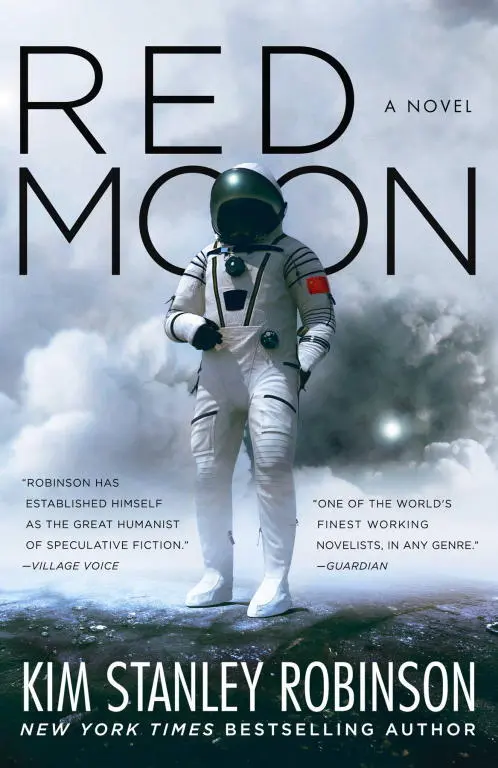
- Название:Red Moon
- Автор:
- Издательство:Orbit
- Жанр:
- Год:2018
- Город:New York
- ISBN:978-0-316-26237-8
- Рейтинг книги:3 / 5. Голосов: 1
-
Избранное:Добавить в избранное
- Отзывы:
-
Ваша оценка:
Red Moon: краткое содержание, описание и аннотация
Предлагаем к чтению аннотацию, описание, краткое содержание или предисловие (зависит от того, что написал сам автор книги «Red Moon»). Если вы не нашли необходимую информацию о книге — напишите в комментариях, мы постараемся отыскать её.
American Fred Fredericks is making his first trip, his purpose to install a communications system for China's Lunar Science Foundation. But hours after his arrival he witnesses a murder and is forced into hiding.
It is also the first visit for celebrity travel reporter Ta Shu. He has contacts and influence, but he too will find that the moon can be a perilous place for any traveler.
Finally, there is Chan Qi. She is the daughter of the Minister of Finance, and without doubt a person of interest to those in power. She is on the moon for reasons of her own, but when she attempts to return to China, in secret, the events that unfold will change everything - on the moon, and on Earth.
Red Moon is a magnificent novel of space exploration and political revolution from New York Times bestselling author Kim Stanley Robinson.
For more from Kim Stanley Robinson, check out:
New York 2140
2312
Aurora
Shaman
Red Moon — читать онлайн бесплатно полную книгу (весь текст) целиком
Ниже представлен текст книги, разбитый по страницам. Система сохранения места последней прочитанной страницы, позволяет с удобством читать онлайн бесплатно книгу «Red Moon», без необходимости каждый раз заново искать на чём Вы остановились. Поставьте закладку, и сможете в любой момент перейти на страницу, на которой закончили чтение.
Интервал:
Закладка:
They passed through row after row of food, all unrefrigerated, all freestanding in the warm humid air. Skinned bodies of chickens, ducks, small pigs, lambs, unidentifiable animals. Was that the carcass of a turtle unshelled? A hedgehog? Rabbits? Whatever they had been while alive, surely most of this meat would have to sell this very day in order to be fresh enough to eat, or so it seemed to Fred. But maybe it would be. An ordinary Chinese city—did that mean two million people? Ten million? And they all had to eat. Suddenly the amount of food went from looking like far too much to nowhere near enough.
By the time they had finished crisscrossing the market, every animal and plant ever consumed by humans seemed to have made an appearance, filling one stall after another. Maybe it was Fred’s time on the moon, or his illness and incarceration there, or Qi’s hand crushing his now, or Earthly gravity, or simply his hunger—whatever the cause, the supersaturated colors all around him were pulsing harder and harder. Everything looked like it was bursting with itself. He felt stunned, crushed. He was hammered raw, and could barely make himself walk. Everything was pulsing.
Qi had stopped at half a dozen stalls and filled her string bag with various small purchases. Now she led him out of the market by a lane on its far side, then crossed a big street jammed with little electric cars and bikes, and took off down another winding street. On both sides of this street iron-railed balconies were frequently draped with drying laundry. Shops on the ground floor opened directly onto the street, which had no sidewalks. Just as bicyclists shared the big roads with buses and trucks, pedestrians here shared the narrow streets with shop inventories on tables and racks, also bikes attached to carts, creeping supply trucks, roving dogs, and old people seated on upturned buckets, talking things over as if seated in a kitchen somewhere.
At the end of that long winding lane they emerged into a green park, and Fred was yet again amazed. In the center of the park was a lake that looked like it could have been taken from a Chinese landscape painting. Ancient willow trees and pines stood on its grassy banks; an arcing bridge extended over a neck of water; some white herons high-stepped through reeds in the shallows, just offshore from people sprawled on picnic blankets.
In a grove of old plane trees across the little bridge, a big circle of people surrounded a group making music. When Qi saw that she pulled Fred toward it. They stopped at the high point of the bridge, where they could see that the lake and its surrounding ring of trees were backed by much taller concrete buildings; these were overtopped by construction cranes, busily lifting parts of even taller buildings into the sky. Higher still, in the distance past the cranes, a steep green mountain stood against a white morning sky, its ridgeline topped by three or four little pagodas. A thousand years of Chinese history coexisted in a single view.
Fred said, “Is this normal? Do all Chinese cities have parks and lakes like this?”
“A lot of them do, sure. Like anywhere, right?”
They crossed the bridge and joined the crowd ringing the musical group. The band consisted of about thirty people, most of them sitting on folding chairs or plastic boxes, and either reading music from spindly stands or playing without sheet music. All of them paid close attention to a conductor who stood before them waving his arms and singing. Many of the musicians played stringed instruments that looked like skinny cellos; most of these had two strings, which their players bowed enthusiastically. The musicians sitting closest to Fred and Qi blew into instruments that looked a bit like panpipes, but the pipes were arranged in rounded shapes like immense garlic bulbs, and had valves on them that looked like saxophone valves. Other instruments were also unfamiliar, and indeed when he finished looking at each player in turn, Fred had to conclude that he had never before seen a single one of the instruments being played. It was like the unidentifiable fruits or vegetables in the market. He had not known there were musical instruments unfamiliar to him. And as he listened to the sounds the players were creating, he realized that these too were new to him—thin reedy sounds, orchestral but not, and either dissonant or harmonic in ways as unfamiliar to him as the instruments. Foreign—even a bit alien. Fred leaned forward and stared, quivering with the intensity of his attention.
One row of the string players seemed to consist of disabled people, some with Down’s syndrome, it looked like, others deformed or odd in other ways, with open mouths, and gazes rapt to the point of glassiness. All the players appeared to be transported by the joy of creating music. It looked like this was the high point of their week, even their reason to live. Or possibly just a nice thing, a fun hour. He had no way of knowing. But his mother had made him take saxophone lessons and play in the school band, a very unsuccessful and brief experiment, thoroughly unpleasant except for the playing of the instrument itself, which, when in his room alone, he had liked. And now he found he wanted to try one of the panpipe things. He wanted to be able to play it like one of these players, or like John Coltrane would have played it. He studied the disabled players in their musical ecstasy. He could feel in his facial muscles that the expressions on their faces were like those on his own face when he was feeling good about something. He only had to give in to it, to release his resistance to it, and those same expressions would be on his face—when he relaxed, or felt happy, or even right now—that was his look, right there before him to be seen. His cheeks burned with some strange mixture of shame and affinity. He was so often amazed or stunned, so often moved by simple things, obscure things. He was more like these musicians than he had ever been like the people in his own hometown. As he felt the truth of that he clutched Qi’s hand. He was a stranger in a strange land. With his free hand he wiped away tears falling unexpectedly from his eyes.
She glanced at him, wondering. She squeezed his hand. “Here come my friends,” she warned under her breath.
A couple passed behind them and Qi followed them, tugging the stunned Fred behind her. Out of the park on the far side of the lake, into an alley, then into a shop selling all kinds of plastic household goods, bowls and cups and so on, stacked to the ceiling on every shelf and in every possible nook, such that one had to walk sideways to get between them. Then up a narrow staircase and through a doorway, with the door quickly closed behind them and some people from the shop. At that point Qi and the others fell on each other. She hugged each in turn, all of them talking at once.
Qi eventually stopped and said to them in English, “This is Fred, he helped me get here. He was in trouble on the moon too.”
“Nice to meet you,” everyone said, almost in unison. They laughed at that; it was one of their first English-class phrases, they let him know, now finally put to use. For most of them it proved to be all they could say in English. Those who knew more invited him to sit down, asked him if he wanted tea. Their English was not as good as Qi’s, and seemed neither British nor American in accent, something more purely Chinese, angled a bit perhaps by the accent of whoever had taught them. Classroom English, used for a job, maybe, but never lived in. Suddenly Fred could hear better the fact that Qi had lived some of her life in English, and for quite some time too. Presumably in those Swiss boarding schools. An international person, a worldly person.
He answered their questions as best he could, feeling completely exhausted. He didn’t want to say he had been accused of murder on the moon; in this context it would sound absurd, horrible. Qi seemed to see this, and steered the conversation away from him and toward their next move. They were not to stay with these friends long; there were chaoyangqunzhong everywhere, they said, and Qi, they all agreed, was too beautiful to disguise. “Such fat cheeks, very easy for the facial recognition program!”
Читать дальшеИнтервал:
Закладка:
Похожие книги на «Red Moon»
Представляем Вашему вниманию похожие книги на «Red Moon» списком для выбора. Мы отобрали схожую по названию и смыслу литературу в надежде предоставить читателям больше вариантов отыскать новые, интересные, ещё непрочитанные произведения.



![Ким Робинсон - Годы риса и соли [litres]](/books/394367/kim-robinson-gody-risa-i-soli-litres-thumb.webp)


Обсуждение, отзывы о книге «Red Moon» и просто собственные мнения читателей. Оставьте ваши комментарии, напишите, что Вы думаете о произведении, его смысле или главных героях. Укажите что конкретно понравилось, а что нет, и почему Вы так считаете.