Tham Cheng-E - Surrogate Protocol
Здесь есть возможность читать онлайн «Tham Cheng-E - Surrogate Protocol» весь текст электронной книги совершенно бесплатно (целиком полную версию без сокращений). В некоторых случаях можно слушать аудио, скачать через торрент в формате fb2 и присутствует краткое содержание. Город: Singapore, Год выпуска: 2017, ISBN: 2017, Издательство: Epigram Books, Жанр: Фантастика и фэнтези, Триллер, Современная проза, на английском языке. Описание произведения, (предисловие) а так же отзывы посетителей доступны на портале библиотеки ЛибКат.
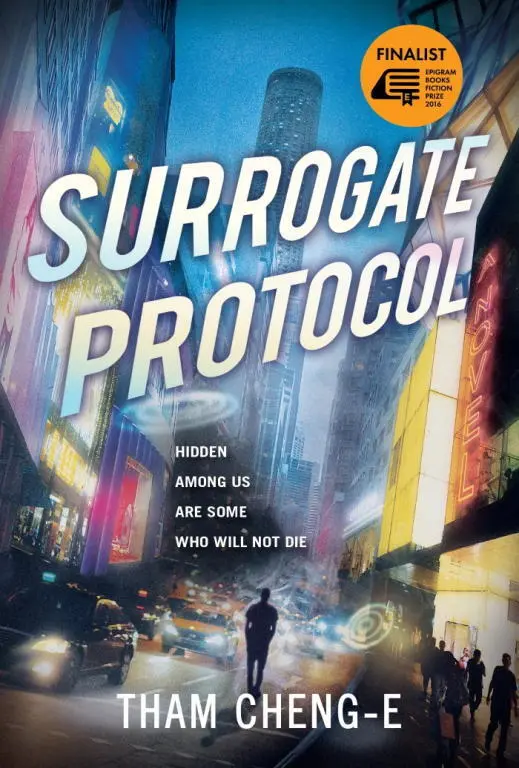
- Название:Surrogate Protocol
- Автор:
- Издательство:Epigram Books
- Жанр:
- Год:2017
- Город:Singapore
- ISBN:978-981-17-0091-0
- Рейтинг книги:5 / 5. Голосов: 1
-
Избранное:Добавить в избранное
- Отзывы:
-
Ваша оценка:
Surrogate Protocol: краткое содержание, описание и аннотация
Предлагаем к чтению аннотацию, описание, краткое содержание или предисловие (зависит от того, что написал сам автор книги «Surrogate Protocol»). Если вы не нашли необходимую информацию о книге — напишите в комментариях, мы постараемся отыскать её.
Landon Locke is no ordinary barista. A man of many names and identities, he has lived though many lifetimes, but his memory spans only days.
Danger brews as Landon struggles to piece together reality through his fog of amnesia. A mysterious organisation called CODEX bent on hunting him down, a man named John who claims to be a friend, and women from Landon’s past who have come back to haunt him.
As CODEX closes in, he finds himself increasingly backed into a corner. Battling an unreliable memory, Landon is forced to make a choice: who can he trust?
Surrogate Protocol — читать онлайн бесплатно полную книгу (весь текст) целиком
Ниже представлен текст книги, разбитый по страницам. Система сохранения места последней прочитанной страницы, позволяет с удобством читать онлайн бесплатно книгу «Surrogate Protocol», без необходимости каждый раз заново искать на чём Вы остановились. Поставьте закладку, и сможете в любой момент перейти на страницу, на которой закончили чтение.
Интервал:
Закладка:
After lunch a photographer arrived and gathered them before the portico. A bursting flash captured their smiles in a collodion print, and Vivian was delighted to be standing in the front row. It was to be her first photographic portrait.
In time they sat down near the pond to a round of port. Under normal circumstances the men would have retired to the smoking room for an exchange of politics and business. It was to the suspicion of the ladies that the men stayed on account of Ning Yan’s presence.
“And I say, ingenuity is survival.” So said a young, suave gentleman who looked too eager to impress. “An old policy it was, some thirty years ago. Then it was a cent for three rats. Now the Straits Government pays them three cents for a single dead rat and the downtrodden coolies made a business out of it!” He leaned back and took a draw from his pipe. “By which one coolie earned himself a small fortune. Astounding but true.”
“An expensive solution to the rat problem,” said an older gentleman, belching on his port. “We overpay coolies and turn them into rat-catchers.”
“Not a small problem, Edward,” said a plump, tight-lipped lady, his wife perhaps. “I’ve seen them. Those rats are large as cats!”
Ning Yan stretched her lips politely when the lady looked at her as if seeking validation for her claim. She couldn’t help noticing that most of the ladies appeared somewhat haggard and blowsy compared to the men.
Young Vivian, having eaten her fill of honeyed hams, olives, greens, figs and an assortment of tarts, cakes and sweetmeats, began to drowse while sitting upright on the chair beside her Mama. As the conversation staled Ning Yan was introduced to another dashing young man who sat beside her and appeared somewhat embarrassed by her beauty.
“William here just got off the steamer two days ago,” said a man, presumably a friend. He was wearing a woven country hat and squeezing the young man named William on the shoulders. “Tell us your opinion of this place, William.”
“Well,” he began, stealing a diffident sidelong glance at Ning Yan. “I find it a rather—handy city.”
“A very apt description, William.” A slightly tipsy Langfield remarked agreeably.
Ning Yan forced a smile. The heat was getting to her.
“Speaking of coolies,” the man named Edward said, plucking the pipe from his lips. “I’ve heard of another tiger attack last week at a place called Passier Rice —somewhere east, I believe. Yet we’ve heard no attacks on European hunters however plump and well-fed they are. It appears that the tigers here have acquired quite a penchant for the leaner flesh of coolies!”
“Flavoursome,” the eager young man offered. “Like salted dried fish.”
The remark roused a round of laughter. And when it died away Langfield smiled dreamily at Ning Yan and asked her opinion on that matter.
“Well.” Ning Yan surveyed the anticipation in her audience that would’ve intimidated any common guest. “If only Europeans would labour in the jungles the tigers would have developed a greater penchant for European fat. Wouldn’t you agree?”
From the unsettling silence rose a faint chuckle. The ladies began smiling nervously at one another and a large-bellied man shoved a quid of tobacco between his molars and began chewing it avidly.
“You mentioned Latin,” came Mrs Langfield’s tentative and genteel voice. “Would you care to recite some?”
Ning Yan saw, in Mrs Langfield’s words, a subtle intent to repay the humiliation. “Why certainly, Mrs Langfield.” She roused Vivian from her sleep and whispered something into her ear.
Drowsily Vivian greeted them with a dimpled smile and recited a phrase.
Damnant quod non intellegunt.
Mrs Langfield lifted her chin thoughtfully. “That sounded very good,” she said, despite a cautionary grunt from her husband. “Would you care to elucidate its meaning?”
“They condemn what they do not understand,” said Ning Yan, rising from her chair and taking Vivian’s hand. “It has been a most wonderful luncheon, Mrs Langfield, Chairman. But we must impose on you no more.”
At the portico Ning Yan hailed an empty hackney carriage that waited nearby. Vivian willingly entered the carriage because she knew her mother was splurging on account of her birthday. So it was only appropriate that she reciprocated the generosity with gratitude. “You were very brave back there, Mama,” she said, gathering her skirt through the door.
“Was I?” Ning Yan lifted her brows and touched her chest, miming surprise. “I was scared to death.”
Vivian giggled and looked outside the curtained window as the carriage, drawn by a single white horse, began rattling down the path and back towards Tanglin Road.
“I feel like a queen in this,” said Vivian.
Ning Yan pulled her close. “You already are, my dear.”
Along the way they passed an emaciated Kling who, by the side of the road, was conducting a tumbril drawn by buffaloes. The tumbril was heaped with fresh, pungent manure, and the buffaloes’ legs were cased in mud.
From somewhere up the hillocks they caught a faint roar of boisterous laughter. Ning Yan could almost hear the clink of champagne glasses that so often went with it.
After shedding their dresses, Vivian and her Mama were tremendously relieved to slip back into their cotton blouses with the Mandarin fabric buttons and huge, airy sleeves. That evening they settled down to a spread of greens and roasted pork—a feast compared to their regular staple of rice gruel and pickles.
It was customary for the Chinese to consume a bowl of longevity noodles on their birthdays. Supposedly the noodle strands were stretched unbroken from a single slab of dough and cooked in its full length. Vivian had a bowl to herself—a delightful microcosm of sweet broth, chives and a smooth, glistening boiled egg.
By the illumination of two kerosene lamps and huddled in a partitioned room at the upper level of a mouldering shophouse, Ning Yan and her foster daughter dined like royalty. They made fun of the ang mohs whose arrogance they thought would be the cause of their eventual decline, whenever that might be. They made animal caricatures of them: blonde gibbons and auburn orang utans, and tittered till their tummies hurt.
After dinner Vivian read by lamplight into the hour before drowsiness took hold. And with an embrace Ning Yan tucked her into bed. She lingered beside her daughter, watching her lovely, dimpled cheeks.
“Aren’t you going to bed?” asked Vivian.
“In a short while.” Ning Yan stroked her daughter across the forehead. “Happy fifteenth birthday, darling.”
Vivian returned a sleepy smile and Ning Yan leaned over to kiss her between the eyes.
“It feels nice,” said Vivian.
“Really?” Ning Yan’s lower lip trembled. She was choking back on tears with immense effort. “I could kiss you again.”
And kissed Vivian she did, for the last time.
Vivian slipped away just before the first teardrop fell upon her arm. Ning Yan reeled off the bed weeping bitterly; though behind thin walls she could afford only whimpers. She made it count and expended as much sorrow as she could by clasping both hands tightly over her mouth. Tears gushed like a deluge from a broken dam. Fits of violent sobbing racked her shoulders and drained all strength from her limbs.
When it all finally ebbed Ning Yan returned to her daughter to find her asleep with an angelic visage. She touched her hand and felt an unsettling chill. She passed a quivering hand over her face and felt no breath. Trembling she pressed her cheek upon her daughter’s chest and listened to a dark, eternal stillness.
Ning Yan fell over and expelled her dinner all over the floor. Her sorrow might have been assuaged if only she’d smashed the kerosene lamp and its burning fuel on herself. But she didn’t. Her heart went cold, and in a state of stoic calm she began gathering up Vivian’s papers and documents and shoving them into a lacquered box that chimed to a melody when opened. She had given it to Vivian on her last birthday, and it made her weep anew. She retrieved the omnicron from a hidden compartment behind the wardrobe, threw on a cloak and left the tenement.
Читать дальшеИнтервал:
Закладка:
Похожие книги на «Surrogate Protocol»
Представляем Вашему вниманию похожие книги на «Surrogate Protocol» списком для выбора. Мы отобрали схожую по названию и смыслу литературу в надежде предоставить читателям больше вариантов отыскать новые, интересные, ещё непрочитанные произведения.








Обсуждение, отзывы о книге «Surrogate Protocol» и просто собственные мнения читателей. Оставьте ваши комментарии, напишите, что Вы думаете о произведении, его смысле или главных героях. Укажите что конкретно понравилось, а что нет, и почему Вы так считаете.