Tham Cheng-E - Surrogate Protocol
Здесь есть возможность читать онлайн «Tham Cheng-E - Surrogate Protocol» весь текст электронной книги совершенно бесплатно (целиком полную версию без сокращений). В некоторых случаях можно слушать аудио, скачать через торрент в формате fb2 и присутствует краткое содержание. Город: Singapore, Год выпуска: 2017, ISBN: 2017, Издательство: Epigram Books, Жанр: Фантастика и фэнтези, Триллер, Современная проза, на английском языке. Описание произведения, (предисловие) а так же отзывы посетителей доступны на портале библиотеки ЛибКат.
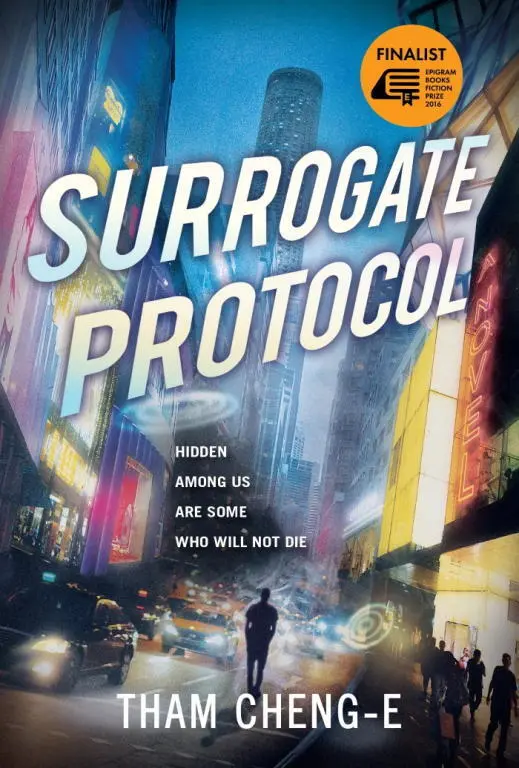
- Название:Surrogate Protocol
- Автор:
- Издательство:Epigram Books
- Жанр:
- Год:2017
- Город:Singapore
- ISBN:978-981-17-0091-0
- Рейтинг книги:5 / 5. Голосов: 1
-
Избранное:Добавить в избранное
- Отзывы:
-
Ваша оценка:
Surrogate Protocol: краткое содержание, описание и аннотация
Предлагаем к чтению аннотацию, описание, краткое содержание или предисловие (зависит от того, что написал сам автор книги «Surrogate Protocol»). Если вы не нашли необходимую информацию о книге — напишите в комментариях, мы постараемся отыскать её.
Landon Locke is no ordinary barista. A man of many names and identities, he has lived though many lifetimes, but his memory spans only days.
Danger brews as Landon struggles to piece together reality through his fog of amnesia. A mysterious organisation called CODEX bent on hunting him down, a man named John who claims to be a friend, and women from Landon’s past who have come back to haunt him.
As CODEX closes in, he finds himself increasingly backed into a corner. Battling an unreliable memory, Landon is forced to make a choice: who can he trust?
Surrogate Protocol — читать онлайн бесплатно полную книгу (весь текст) целиком
Ниже представлен текст книги, разбитый по страницам. Система сохранения места последней прочитанной страницы, позволяет с удобством читать онлайн бесплатно книгу «Surrogate Protocol», без необходимости каждый раз заново искать на чём Вы остановились. Поставьте закладку, и сможете в любой момент перейти на страницу, на которой закончили чтение.
Интервал:
Закладка:
Emboldened by the presence of the crowd, Anton ventured a closer inspection of the corpses and became particularly interested in the hairless one. It was wearing a dark jacket resembling that of a clergyman, with hemming that reached beyond the knees. Everything about it was large; hands, feet, face and all. Its skin exuded a waxy, almost translucent appearance. Beneath bony, protuberant brows a pair of dead eyes sat half-opened in their sockets; the pupil in one of them was yellow and the other a bright emerald-green. On the grass not far from him lay a felt Homburg hat.
Anton seemed to have discovered something in the dead face, and the longer he stared at it the more frightened of it he became. He thought he had seen the dead face alive. In shreds of disjointed memories he saw that it had once breathed and spoken, and they filled him with a desperate need to absolve himself of an unfathomable guilt.
A black Austin drove up to them in a stream of yellow dust and the crowd now turned their attention upon the marvel of an automobile. A dapper Chinese man stepped out of the back, sporting a white cotton jacket, white flannel trousers and a white Panama hat. His attire contrasted sharply with his round-rimmed eyeglasses of flat, smoky quartz. A light moustache grew over his fair, scholarly face.
He crouched by the hairless corpse and laid his hand over its bloodied chest. Then he removed his hat and held that position for a few seconds as if in mourning. When he finished he slid a hand under the corpse’s coat and retrieved a chromium object the size of a pocketwatch. No one seemed to have noticed the crafty move but Anton caught it all and out went his finger, firm and accusing.
“Thief!” he cried.
The accusation alarmed the man at first, but he kept his hands in his trouser pockets and regarded his accuser amusedly with a slight tilt of head. When the constables hustled over to him he raised nothing in defence. Anton seized the sleeve of one of the constables and said vehemently: “I saw this man take the dead man’s pocketwatch! It must be inside one of his pockets now. Search him and you’ll see!”
“He’s a detective,” said the constable. “We know him.”
“Detective or not I saw him slip something into his pocket when you weren’t looking!” Anton insisted. “He can sell such things. I know his kind; stealing from the dead and pawning them for money.”
The constables wouldn’t suffer to hear any more of Anton’s petition and began dispersing the crowd. They might have been offered a cut in the shady enterprise and Anton, although much chagrined, knew he was powerless against such collusion. Before entering his black Austin, the thief picked out Anton over the eyeglasses that hung low over his nose. Their eyes met, and he smiled and touched the rim of his Panama hat in parting.
37
ANTON
15th September 1867, Sunday
I shall turn 30 in two years, and with Origen’s counsel I have made preparations by means of a birth registration duplicate, which I had very fortuitously procured two days earlier from a sagacious ally who interns at the Office of Health and Statistics. I named this duplicate Anton, after my doctor, Anton MacCain.
Dr MacCain said the name Anton came from the Romanic name Antonius, a variant of Anthony. I have immense respect for people who comprehend the context of their names; they often seek a meaning to life, pursue a definitive purpose in the tasks they perform. Undoubtedly Dr MacCain was very good at what he did. Our acquaintanceship, however, did not last, and he has since returned to Scotland to serve in the Board of a hospital there.
It is strange to think that I should be left a house and land and have so little money to spend. Just two years earlier my life had fallen into disrepair when I lost most of my possessions to a consistently-poor hand. They were days of decrepitude which I shall not suffer to commit to memory but for the rule that I shall never again enter a gaming-house or cockpit. This entry shall be a lasting testament to my resolve.
Day count to Anton, day 2 of 5,475 days.
38
MAY 1860
ALL GAMING HOUSES along Kiau Keng Kau stank. It didn’t matter which one you got into. Everything reeked of greed and vice, of sweaty feet and belched breaths. Outside one of them, a gharry stopped and the horse blew a snort. A man alighted, robed in blue silk and a black Chinese cap. He had a thin neck and a moustache that hung past the corners of his mouth. Inside the gharry sat another man of a fair, scholarly appearance—thoroughly Chinese but dressed as a European—in a dark jacket and top hat. He pointed to the murky interior of the gaming house and in it went the moustached man.
The floor teemed with throngs of pigtailed gamblers sweating in the humidity and at the outcome of their stakes. On a straw mat a game of pai gow was in progress, illuminated by kerosene lamps that hung from rafters blackened by soot.
Aldred, mildly inebriated on cheap Chinese wine, perched himself on a stool and played on credit, drowned in the delusion that he might win himself a sufficient fortune to pay his debts. Through the air muddied in opium smoke he struggled to make sense of his hand, his sight alternating between the tiles, his exhausted mind incapable of conjuring any form of strategy. The croupier was a skeletal, bucktoothed man who wore his pigtail around his forehead—an appearance that belied cunning ingenuity. Pokerfaced, he waited for Aldred to reveal his last few tiles before breaking into a gangly grin and declaring the round a croupier’s win, and Aldred’s fourth loss in a row.
“Ee mm see dng lang lah! Bey hiao sng!” said the croupier to everyone else but Aldred. It drew a round of wild, riotous laughter. Aldred comprehended that remark, though he amazed himself in his ability to snub the humiliation. It had to be the wine.
Life had dealt him bitter blows. In the years leading to his mother’s death a debilitating disease struck his family’s nutmeg plantation and withered the fruits before they had time to ripen. All the other blighted plots on Mount Harriet had been divided and sold. Aldred’s plot was the only one that stood in the way of a new barracks compound which the colonial administration had been planning for years.
He turned to cultivating gambier. When those crops also failed he succumbed to the draw of gambling. The goons and dealers, having sensed the rawness in him, tried talking him into deals that would allow them to siphon his latent wealth and bleed him dry. Their plan was to indulge him in vats of wine, only to fail in their attempts to out-drink him. Aldred was always the last to leave the table, sober as ever, and often before an eclectic assemblage of swooned drunkards. The Ghee Hin Kongsi was clever enough to have lured Aldred into one of the many gaming houses it operated. The triad achieved success in bleeding him out on the tables; by the time he left the pai gow game, he had already chalked up a debt large enough to rival the price of his family plot.
A scrawny sharp-faced man approached Aldred as he was hovering over a fan-tan table. “You no pay, no borrow more money,” said he in a short, reedy voice.
“I don’t need more money,” said Aldred, ignoring the man and watching the croupier separate little glossy black buttons four at a time until one was left. It roused the gamblers to a cacophony of cheers and moans.
“You don’t want more money also must pay,” the sharp-faced man insisted.
Aldred swatted at him like he would a fly. “I’ll give you something tomorrow,” he said, thinking that perhaps he could find an old vase or an infant’s ankle chain somewhere that he could pawn.
Читать дальшеИнтервал:
Закладка:
Похожие книги на «Surrogate Protocol»
Представляем Вашему вниманию похожие книги на «Surrogate Protocol» списком для выбора. Мы отобрали схожую по названию и смыслу литературу в надежде предоставить читателям больше вариантов отыскать новые, интересные, ещё непрочитанные произведения.








Обсуждение, отзывы о книге «Surrogate Protocol» и просто собственные мнения читателей. Оставьте ваши комментарии, напишите, что Вы думаете о произведении, его смысле или главных героях. Укажите что конкретно понравилось, а что нет, и почему Вы так считаете.