Tham Cheng-E - Surrogate Protocol
Здесь есть возможность читать онлайн «Tham Cheng-E - Surrogate Protocol» весь текст электронной книги совершенно бесплатно (целиком полную версию без сокращений). В некоторых случаях можно слушать аудио, скачать через торрент в формате fb2 и присутствует краткое содержание. Город: Singapore, Год выпуска: 2017, ISBN: 2017, Издательство: Epigram Books, Жанр: Фантастика и фэнтези, Триллер, Современная проза, на английском языке. Описание произведения, (предисловие) а так же отзывы посетителей доступны на портале библиотеки ЛибКат.
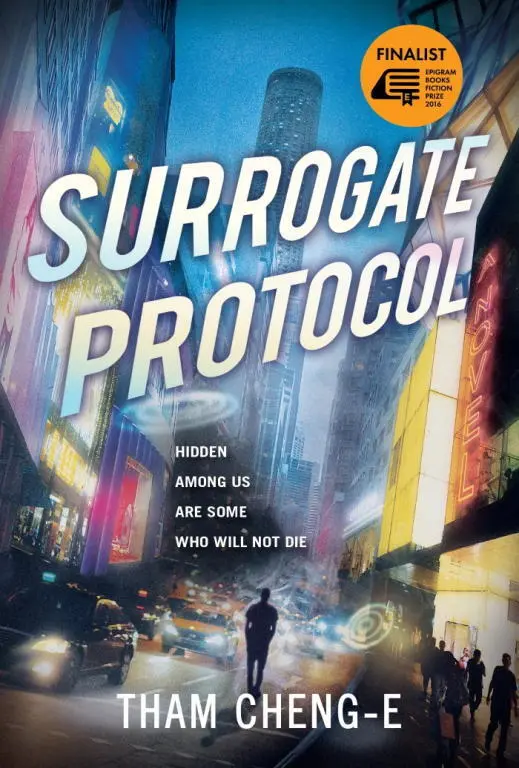
- Название:Surrogate Protocol
- Автор:
- Издательство:Epigram Books
- Жанр:
- Год:2017
- Город:Singapore
- ISBN:978-981-17-0091-0
- Рейтинг книги:5 / 5. Голосов: 1
-
Избранное:Добавить в избранное
- Отзывы:
-
Ваша оценка:
Surrogate Protocol: краткое содержание, описание и аннотация
Предлагаем к чтению аннотацию, описание, краткое содержание или предисловие (зависит от того, что написал сам автор книги «Surrogate Protocol»). Если вы не нашли необходимую информацию о книге — напишите в комментариях, мы постараемся отыскать её.
Landon Locke is no ordinary barista. A man of many names and identities, he has lived though many lifetimes, but his memory spans only days.
Danger brews as Landon struggles to piece together reality through his fog of amnesia. A mysterious organisation called CODEX bent on hunting him down, a man named John who claims to be a friend, and women from Landon’s past who have come back to haunt him.
As CODEX closes in, he finds himself increasingly backed into a corner. Battling an unreliable memory, Landon is forced to make a choice: who can he trust?
Surrogate Protocol — читать онлайн бесплатно полную книгу (весь текст) целиком
Ниже представлен текст книги, разбитый по страницам. Система сохранения места последней прочитанной страницы, позволяет с удобством читать онлайн бесплатно книгу «Surrogate Protocol», без необходимости каждый раз заново искать на чём Вы остановились. Поставьте закладку, и сможете в любой момент перейти на страницу, на которой закончили чтение.
Интервал:
Закладка:
He last remembered taking a walk outside his house after penning a journal entry. The air raid siren had gone off; on the way to a trench shelter an exploding bomb knocked him into a ditch and sent salvos of metal and wood into his legs. He remembered screaming at the pain but he hadn’t panicked because he knew an Air Raid Precaution post was nearby. And true enough, shortly after the bombers passed an ambulance arrived wailing and ferried him to the Alexandra Military Hospital.
The doctors didn’t do much beyond a bit of disinfecting and suturing. Anton found that he could still walk, albeit very stiffly. They were keeping him in hospital as a precaution against gangrene. Otherwise his wounds did not even warrant a bed. They laid him on a broken litter.
He fell back to sleep and awoke again, this time to sunlight and activity. The ground-floor ward was noisy with chatter and the clatter of soles upon the linoleum flooring. The ward had twelve beds, each complemented by a metal spittoon painted in reds and florals. A corridor passed outside the ward and beyond which lay a luxurious expanse of lawn under the sprawling canopies of raintrees.
A number of Malay and Chinese patients reclined on litters laid out in the spaces between the beds, which were occupied mostly by Caucasian patients in varying degrees of wretchedness. A few read, some groaned, and the rest either went on sleeping or lying on their sides and seeing nothing.
One of them, a handsome young man with ginger hair and a moustache, habitually pinched an unlit pipe between his lips as he flipped a page of a novel. He had a leg wound near the ankle, where the dressing bulged with copious layers of gauze. It took Anton a moment to realise that it had been an amputation.
“Hi, Anton,” a voice sang.
He looked: it was a nurse dressed in the white drill and red-blue armband of the Medical Auxiliary Service. A white headdress adorned her pincurls. A sense of recognition, though vague, rendered him speechless. “Hey, I…” he fumbled and wagged his forefinger at her. “I know you…”
The nurse put a hand to her hip and gave a teasing chuckle, her eyes arching into half-moons. “Have you really forgotten me? It’s been what, two years?”
He went on wagging his forefinger, failing miserably in his attempt to recollect.
The nurse couldn’t wait. “Vivian,” she said.
“Vivian!” Anton declaimed like an operatic paramour on stage. He gestured at her uniform with open hands, shrugging. “Were you doing this before?”
Vivian frowned in disbelief. “Taxi-dancing? Bootlegging? Remember?”
“Vaguely,” Anton lied, but his blank countenance gave it away.
“Good morning, lovely,” said the handsome man with the ginger-coloured moustache. He removed his pipe and rested it on his belly.
Anton saw Vivian roll her eyes, not from annoyance but amusement, as if she was enjoying the attention. “Good morning, Monty.”
“Oh, Vivian,” Moustache Monty moaned like a jilted lover, his arms falling limply to the sides. “Is that all you could say? I’d gladly lose a leg to acquire a lifetime of you.”
More like an ankle , Anton thought.
Vivian had her attention on the clipboard and did not look at him. “For that you’d have to lose more than a leg, Monty.”
“Anything for you, love,” said Moustache Monty, deliberately souring his face. “Come,” he patted out a spot on his mattress. “Surely you could afford a morning chat?”
Vivian looked cheekily at him over a shoulder. “Later, Monty.”
A streak of jealousy wormed its way into Anton when he saw the kind of glances they exchanged. “You know him?” said he.
“He’s been here longer than you think,” Vivian reached over and retrieved a few tin spools of adhesive plaster from a cabinet. Anton leaned aside for her. “They’re all the same: expecting some wheedling from anything female, plus a kiss or two.” She checked her clipboard and resumed looking at Anton. “You really don’t remember how we left things off?”
“No,” said Anton. “I supposed you—went away?”
“Goodness, did you see a doctor?”
Anton gave a shrug of disinterest. “You’ll have to fill me in.”
“I was dancing at Great World until the requisition order came.” Vivian held the clipboard to her chest. “Then I heard they needed people for the MAS and I signed up.”
“As a nurse?”
“I helped at the mobile canteens,” said Vivian. “Then they gave me some training and registered me as a nurse about a month ago. They were rather desperate for nurses once the wounded started pouring in.”
“Must be hard.”
“Only when someone dies on you.” She turned to the window when a thump of artillery was heard. “You know what’s the best way to observe Death?”
The question took Anton by surprise. “No.”
“Poison a house gecko with insecticide from a spray pump.” Vivian gave a smile that didn’t match her words. “Death comes slowly enough for you to appreciate its presence.”
Anton, dumbfounded, chuckles uncomfortably. “Well, I—”
The sight of a scrawny Kling halted his speech. The Kling passed by the doorway, and having seen Anton, floundered into the ward. He was carrying a small wicker basket and looking a little flustered.
“Amal!” cried Anton. “How’d you find me?”
The Kling ran his fingers through his oiled, curly locks. “Can’t find you in your house lah.” He made little wavering movements of his head as he spoke. “Got people say bomb kena somebody near your place and the ARP ambulance brought him here. So just come and check out lah. Sekali you really here! So what happened?”
“Shrapnel. Nothing serious.” Anton gestured at Vivian. “Amal, meet Vivian.”
Amal looked astonished. “Hey!” he cried, taking Vivian’s hand. “You? A nurse?”
“Long story, Amal.”
Anton shifted his gaze from one to the other. “You knew each other?”
Someone along the corridor shouted for a nurse, and Vivian’s flight couldn’t have been timelier. She took the opportunity to gainfully excuse herself. “I’m so sorry. We’ll speak again.” She gave an apologetic frown and flitted out of the ward, much to Anton’s and Moustache Monty’s dismay.
“Excellent timing, Amal,” said Anton.
Amal wiggled his head. “So your flirting habis lah?”
“You knew her?”
“She help us with the liquor, remember?” said Amal. “She help open the backdoor and transfer the payment as a buffer mah. At the cabaret where we sell the goods , remember? You even danced with her.”
“I did?”
Amal retrieved a cracker from its thin, filmy wrapping, popped it into his mouth and dusted off the crumbs on his shirt. “Drink my syrup and you will remember better.”
Anton rejected a cracker. “I don’t think the syrup’s working, Amal.”
Their conversation was interrupted by a series of three successive thuds—the third having rattled the window louvers. Everyone fell silent and turned their eyes to the windows but quickly lost interest and resumed their activities. There were two more heavier-sounding thuds, then they started coming farther and fewer in between.
“Cannons,” said Amal. He meant artillery. “Don’t know Japs or ours.” He seemed to have recovered from a reverie and resumed his speech in earnest, “Yes, drink the syrup. You know I always bring you good stuff. Remember, don’t see a doctor.”
“You’re not making sense.”
“I tell you many times the ang moh medicine no good for your body lah. Last time you see doctor your memory got better? No? So try mine lah.”
Amal spent the rest of the time before lunch nattering about the benefits of an emerging black market and how they could profit from it, if only they could get their wits around obtaining raw supplies from merchants with a war going on. He said that with Anton’s mixed looks they could even run businesses for the Japanese if they occupied this country. Strictly business, he was fond of saying. It’s about serving one master or the other, and that their ethnicities could be advantageous since the Japanese were known to be more tolerant towards Indians and Malays than the Chinese.
Читать дальшеИнтервал:
Закладка:
Похожие книги на «Surrogate Protocol»
Представляем Вашему вниманию похожие книги на «Surrogate Protocol» списком для выбора. Мы отобрали схожую по названию и смыслу литературу в надежде предоставить читателям больше вариантов отыскать новые, интересные, ещё непрочитанные произведения.







Обсуждение, отзывы о книге «Surrogate Protocol» и просто собственные мнения читателей. Оставьте ваши комментарии, напишите, что Вы думаете о произведении, его смысле или главных героях. Укажите что конкретно понравилось, а что нет, и почему Вы так считаете.