Tham Cheng-E - Surrogate Protocol
Здесь есть возможность читать онлайн «Tham Cheng-E - Surrogate Protocol» весь текст электронной книги совершенно бесплатно (целиком полную версию без сокращений). В некоторых случаях можно слушать аудио, скачать через торрент в формате fb2 и присутствует краткое содержание. Город: Singapore, Год выпуска: 2017, ISBN: 2017, Издательство: Epigram Books, Жанр: Фантастика и фэнтези, Триллер, Современная проза, на английском языке. Описание произведения, (предисловие) а так же отзывы посетителей доступны на портале библиотеки ЛибКат.
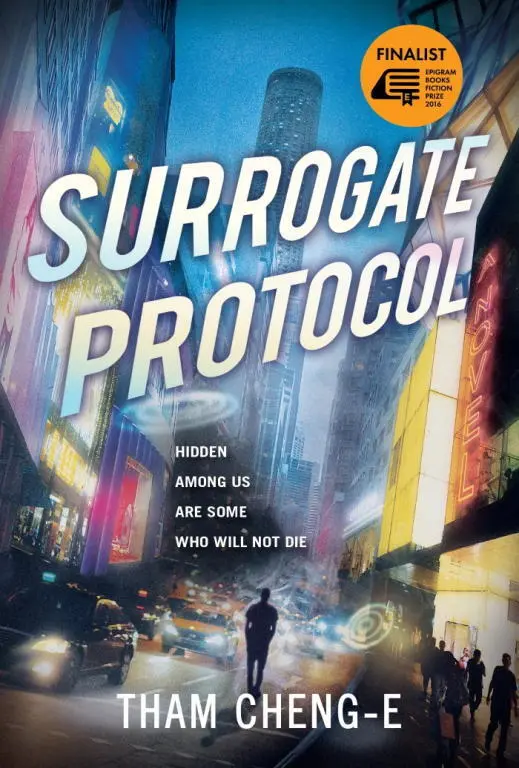
- Название:Surrogate Protocol
- Автор:
- Издательство:Epigram Books
- Жанр:
- Год:2017
- Город:Singapore
- ISBN:978-981-17-0091-0
- Рейтинг книги:5 / 5. Голосов: 1
-
Избранное:Добавить в избранное
- Отзывы:
-
Ваша оценка:
Surrogate Protocol: краткое содержание, описание и аннотация
Предлагаем к чтению аннотацию, описание, краткое содержание или предисловие (зависит от того, что написал сам автор книги «Surrogate Protocol»). Если вы не нашли необходимую информацию о книге — напишите в комментариях, мы постараемся отыскать её.
Landon Locke is no ordinary barista. A man of many names and identities, he has lived though many lifetimes, but his memory spans only days.
Danger brews as Landon struggles to piece together reality through his fog of amnesia. A mysterious organisation called CODEX bent on hunting him down, a man named John who claims to be a friend, and women from Landon’s past who have come back to haunt him.
As CODEX closes in, he finds himself increasingly backed into a corner. Battling an unreliable memory, Landon is forced to make a choice: who can he trust?
Surrogate Protocol — читать онлайн бесплатно полную книгу (весь текст) целиком
Ниже представлен текст книги, разбитый по страницам. Система сохранения места последней прочитанной страницы, позволяет с удобством читать онлайн бесплатно книгу «Surrogate Protocol», без необходимости каждый раз заново искать на чём Вы остановились. Поставьте закладку, и сможете в любой момент перейти на страницу, на которой закончили чтение.
Интервал:
Закладка:
Marco nods, his hairless head gleaming under the fluorescent lights. “The gas or smoke probably killed him before the flames got to him. In fact, for this reason we hope to obtain a statement from you, if you don’t mind.”
“No, I don’t.”
“Thank you,” says Marco graciously. His aide takes a step forward and pulls out the stylus from the tablet he is holding.
In the course of the exchange Landon learns that the police suspect someone tapped illegally into the gas mains and tampered with the meters. He admits that from time to time Raymond tended to doze off at his desk. In such situations gas poisoning is at its deadliest.
“I’m quite certain I didn’t smell anything,” says Landon.
Marco nods as his aide scribbles on. “So how did you end up working in FourBees?”
“I kicked up a fuss at the Kinos Café once, about the quality of its Arabica, the grind, that sort of stuff.” Landon pauses to think before he continues. “I insisted they didn’t blanch the filter paper because I could taste it in my cup. I wanted them to replace my coffee and they almost threw me out. Then someone came over, dropped his own cup on my table and told the manager if he hasn’t got a qualified barista at the back to challenge my claims he’d better change my cup and his as well.”
Marco laughs briskly at the story.
Landon continues, “Then this person sat down in front of me and told me how annoyingly anal I was with that coffee, and that he would like to offer me a job if I truly was a qualified barista. I offered him a taste test and that was it.”
“It’s one account you’ve remembered very well,” says Marco.
“Staying on the job helps. But now that I’ve lost it I don’t think I’ll remember it for long. Besides,” Landon takes a sip of water and grimaces as he swallows, “that person who offered me the job was Raymond.”
“I’m sorry to hear. How did you find Raymond, as a person?”
“Honest man. A hard worker. Drives you up like cattle over the manic weekends, but then who doesn’t? Seriously I don’t see him as someone who would tap illegally on anything.”
“You liked working with him?”
Landon shrugs. “He takes care of us.”
The aide is scribbling on his tablet. Marco takes a perfunctory glance at him and turns back to Landon. “You sound educated, but we didn’t find any school records to your name.”
“I was in school since I was five.” Landon dictates the account which he has rehearsed many times over. “I was born in 1972. School was made compulsory only in the year 2003. The administration must’ve missed it.”
“How far did you go?”
“I dropped out of secondary school.”
“And where did you learn that barrister thing?”
Landon knows he means barista, and considers it prudent to omit the part about his stint at the Ace Café in London. “Got trained on the job, a little bit self-taught. It’s a passion thing.”
Marco chuckles and nods. “I might have made the comment before but I must say you look extremely youthful for someone over forty.”
“Good genes.” Landon smiles.
“Well, I shouldn’t be bothering you any longer.” Marco rises from the chair and bids farewell with a shallow bow. “I must thank you for putting up with us for the second time. It is such coincidence, Mr Lock.”
He shakes Landon’s hand again and turns to depart when Landon suddenly calls out to him. “I was hoping you could help me with something.”
Marco steps away from the door. “At your service.”
“There’s someone who follows me around and says he’s supposed to protect me from some danger.” Landon lapses briefly into silence as he considers his words. “I was wondering if it’s an official police thing.”
Marco’s good eye appears to sparkle with interest. “To my knowledge no such operation exists. I’d be wary of him if I were you. Did you see his pass?”
“No,” says Landon. “That guy said he’s some… pseudo-policeman or detective.”
“Sounds like a fraud,” Marco concludes. “Even twelve-year olds are trained to spot them. If he sticks to you I’d advise you to call the police right away.”
“I’m not in any danger, am I?”
“Your case smells of foul play, Mr Lock.” Marco looks across his thick shoulder at him. “But there’s certainly no urgency to send you a bodyguard, yet. If any, I think the immediate danger lies with whoever’s tailing you.”
“I understand.”
Marco backtracks just as he is stepping out. “Before I forget,” he says. “Leave the press to the police. Don’t speak to them even if they approach you. They’ll distort the facts right from the tip of your hair to the head of your dick.”
22
AUGUST 1963
ALONG THE FIVE-FOOT ways of conjoined shophouses Poppy bungled his way past rows of itinerant hawkers peddling trinkets, and the crate-tables of letter writers. Scraggy fortune-tellers, themselves denied of fortune, lobbied for business behind their wicker baskets of ink, coloured paper and hollowed tortoise shells.
Arthur grabbed Poppy from the five-foot way just as he hobbled past Prosperous Hong . For the audacious escapade the child received a stinging slap to his bottom. Then, to coax him back to his rightful play space at the back of the eatery, Arthur gave him sips of orange soda.
A row of bell jars containing sweet confections lined the front of Arthur’s coffee stall. Water boiled inside steel pots. Coffee-tainted filter socks hung flaccid by the tiled wall. There weren’t any labels or brands whatsoever. The aroma of Arthur’s brew alone was sufficient marketing.
Shortly before noon the clatter of clogs heralded the arrival of a podgy woman dressed in a white cotton coat and black silk trousers. She wore her hair in a long braid that reached the small of her back and was equipped with the usual paraphernalia of an amah: a wicker basket and a waxed umbrella. Curiously, however, she also had a Baby Brownie camera slung from her shoulder.
A noodle-seller greeted her. “Ah Pou, gam zou lei, mei sek ah?”
The woman whom they called Ah Pou, and whom Arthur recognised as a laundress working for a wealthy family living in Bendemeer Road, was a rather companionable patron at the eatery. Once she made the newspapers for her pursuit of photography—a rather singular and noteworthy hobby for someone of such humble vocation, and was reported to have allegedly used up hundreds of rolls of film. A week ago the owner of Prosperous Hong had chanced upon her on one of his rare visits and unabashedly asked for a portrait of himself. Ah Pou gladly acceded to the request, and ended taking portraits of every stallholder.
“Mou see gan sek la.” Ah Pou, all clammy from the sweltering tropical heat, fanned herself with flicks of her wrist. “Gam yat lei bei nei dei seung pin mah.”
The noodle-seller laughed. “Nei mou gong ngor dou mm gei dak.”
The laundress began dishing out the monochromatic photographs like they were pay cheques. Everyone received theirs with bows of the head and gilded words, probably because most of them never had their photograph taken, especially one that required no payment.
With similar conduct Arthur received his photograph from the laundress. It showed him sitting on one of the wooden stools at the eatery and resting an elbow on the marble table. Poppy was perched on his left thigh wearing the grandiose smile of a simpleton, his head thrown pompously upwards.
The portrait, well-composed and proportioned, revealed its photographer’s skill. If it weren’t for the newspaper article Arthur wouldn’t have believed that the portrait had been the work of a common laundress. He offered Ah Pou cakes and tea in return for the photograph, and instead attracted a salvo of laughter for his mispronounced Cantonese. For the rest of her visit Arthur spoke no more.
Читать дальшеИнтервал:
Закладка:
Похожие книги на «Surrogate Protocol»
Представляем Вашему вниманию похожие книги на «Surrogate Protocol» списком для выбора. Мы отобрали схожую по названию и смыслу литературу в надежде предоставить читателям больше вариантов отыскать новые, интересные, ещё непрочитанные произведения.










Обсуждение, отзывы о книге «Surrogate Protocol» и просто собственные мнения читателей. Оставьте ваши комментарии, напишите, что Вы думаете о произведении, его смысле или главных героях. Укажите что конкретно понравилось, а что нет, и почему Вы так считаете.