Tham Cheng-E - Surrogate Protocol
Здесь есть возможность читать онлайн «Tham Cheng-E - Surrogate Protocol» весь текст электронной книги совершенно бесплатно (целиком полную версию без сокращений). В некоторых случаях можно слушать аудио, скачать через торрент в формате fb2 и присутствует краткое содержание. Город: Singapore, Год выпуска: 2017, ISBN: 2017, Издательство: Epigram Books, Жанр: Фантастика и фэнтези, Триллер, Современная проза, на английском языке. Описание произведения, (предисловие) а так же отзывы посетителей доступны на портале библиотеки ЛибКат.
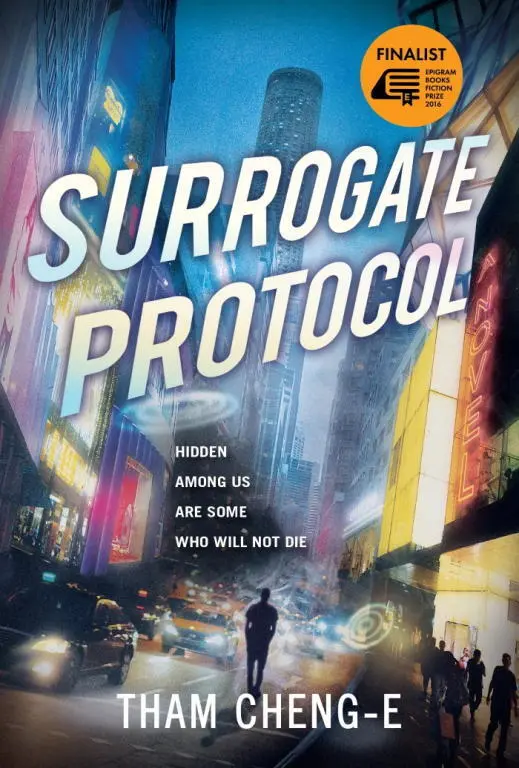
- Название:Surrogate Protocol
- Автор:
- Издательство:Epigram Books
- Жанр:
- Год:2017
- Город:Singapore
- ISBN:978-981-17-0091-0
- Рейтинг книги:5 / 5. Голосов: 1
-
Избранное:Добавить в избранное
- Отзывы:
-
Ваша оценка:
Surrogate Protocol: краткое содержание, описание и аннотация
Предлагаем к чтению аннотацию, описание, краткое содержание или предисловие (зависит от того, что написал сам автор книги «Surrogate Protocol»). Если вы не нашли необходимую информацию о книге — напишите в комментариях, мы постараемся отыскать её.
Landon Locke is no ordinary barista. A man of many names and identities, he has lived though many lifetimes, but his memory spans only days.
Danger brews as Landon struggles to piece together reality through his fog of amnesia. A mysterious organisation called CODEX bent on hunting him down, a man named John who claims to be a friend, and women from Landon’s past who have come back to haunt him.
As CODEX closes in, he finds himself increasingly backed into a corner. Battling an unreliable memory, Landon is forced to make a choice: who can he trust?
Surrogate Protocol — читать онлайн бесплатно полную книгу (весь текст) целиком
Ниже представлен текст книги, разбитый по страницам. Система сохранения места последней прочитанной страницы, позволяет с удобством читать онлайн бесплатно книгу «Surrogate Protocol», без необходимости каждый раз заново искать на чём Вы остановились. Поставьте закладку, и сможете в любой момент перейти на страницу, на которой закончили чтение.
Интервал:
Закладка:
Landon stows the ladder and checks the kitchen. Its white tiled walls gleam. Copper pans of different sizes hang glittering from stainless steel hooks. The stoves sit silent. Everything smells faintly of grease and detergent. No hisses. “Nothing,” he says.
Raymond gathers up his papers, drains his glass and pushes it to Landon. “I’ll be in the office.”
The lights at the dining area go off. The bar is now accented in a pleasant, sleepy glow from the remaining few downlights. Landon didn’t see Clara today. In fact, he hasn’t seen her since the day they met. He retrieves the paper napkin from his wallet and reads her beautiful, leaning script:
P.S. Be wary of the one who warns.
The memory of that day is fading. He knows that because he has already forgotten much of their conversation. On hindsight he should’ve written everything down: every detail, every sliver of speech. An incomplete memory is like an earworm. Part of the melody repeats itself in your head, the rest of it at most a shadow. The words on the napkin are music that remains incomplete, and the prospect of completing them seems impossibly remote.
Landon rests wearily upon the cold granite top, his eyes lingering on the script. At last he strengthens his resolve, crushes the napkin and tosses it into the bin. It doesn’t hurt as much as he thinks. Perhaps despair and solitude mask everything. When you’ve given up hope on something it no longer hurts. It just feels dead.
But he also feels light-headed. He tries to ignore it by taking stock of the liquor on the hardwood shelf behind him. When his head starts floating he abandons the task and dodders over to Raymond’s office to bid him goodbye. It’s his day off tomorrow and he might just sleep in.
He enters the office and finds Raymond dead.
He swivels the chair and Raymond’s corpse thuds to the floor. It looks as if it is asleep, except that the skin has a deadened pallor to it. For a full minute Landon sees nothing but the dead gecko and its grey flesh and a wave of nausea sweeps him. There is a cordless telephone on Raymond’s desk, but he does not use it. He rushes over to the bar, snatches up the phone there and dials the emergency number.
A tremendous blast decimates the liquor shelves behind the bar and throws Landon over the countertop. A fireball billows from the kitchen doorway like the tongue of a fiery demon and tears out the timber frames.
The spilled liquor ignites the bar area and sends flames blasting to the ceiling like a furnace. Landon hears the ceiling boards crack and snap; seconds later the lights go out. A rippling canopy of black smoke gathers, and amid the sooty welters he sees flashes of flame.
Burning liquor bleeds towards him. He presses his glass-riddled back against the counter. Blood paints half of his face and stings his eye. The smoke gathers and charring ceiling boards crackle and fall like black snow. He begins to crawl desperately towards what he thinks might be the exit.
The birch panels pop and snap; a great split runs through the middle of the Baa Baa Black Brew chalkboard as it warps in the heat. Falling debris ignites the tablecloths. The flames jump from one table to the next. Landon sees no exit and expects no aid. He clambers to his feet and falls right back down, overwhelmed by a sudden, debilitating wave of heat. He presses his cheek to the floor, which remains comparatively cool. A flashover isn’t far off now. In a few seconds his senses will be dulled and death should quickly follow.
Oh, Rachel…
20
SEPTEMBER 1964
THE STREETS WERE empty on the morning Poppy got really ill. Between mangy rows of two-storey tenements a prodigious assortment of pole-hung laundry swayed like festival ribbons. Beyond their rooflines loomed the blue cylindrical hulk of a massive gasholder. On the ground floor businesses sat barricaded behind rusting diamond-lattice grilles.
Four-year old Poppy hugged his biscuit tin and pattered behind Arthur on slippered feet, his head hung penitently. His scalp glistened with sweat beneath spiny stubs of cropped hair, his upper lip smeared with goo, his brows hot to the touch.
A solitary mongrel foraged along the open drain beside the five-foot ways. By the street burnt-out shells of Morrises and Volvos bore testament to the brutality of the riots. Then an old air raid siren moaned, proclaiming the lifting of yet another curfew and portending fresh violence. A hate-infused mob might be waiting to cudgel necks and leave heads hanging on fleshy hinges.
But what could I do, let his fever burn?
They found the medical hall on the ground floor of a shophouse, closed. Arthur knew that whoever ran it lived upstairs. His fists, thumping against the grilles, obliterated the morning calm.
Nothing stirred.
Now that the curfew was lifted anyone would associate the ruckus with knife-welding maniacs out for blood. Whoever ran the place must’ve holed themselves up in a room praying that the grilles would hold up. Every waiting moment drove Arthur to greater fits of rage, and he hammered still harder on the grilles.
At the same time Poppy broke out in a barrage of coughing. The whooping bouts intensified and made him throw up his breakfast. When Arthur took him in and thumped his back he latched quietly onto Arthur’s shoulders for comfort.
He simply refused to cry—that tough little sprog.
But it worked a miracle. Seconds later they heard the clank of a key, and behind the grilles, a panel of the folding metal doors flipped open to reveal the pale, cadaverous face of an old physician.
Arthur’s heart sprang alive. In sputters of broken dialect and hideously simplified English he conveyed Poppy’s ailment and midway through it the physician hustled them in. Arthur heard the metallic snap of a lock behind him. And in its wake came the faint buzz of electric light bulbs.
It was a darkwood cavern redolent of bitter herbs. Behind cloudy glass counters rose a repository—a massive lattice of wooden square drawers, each inscribed with a single line of calligraphic Mandarin script on yellowed paper. There were crates crammed full of sundried figs, hawthorn, rhubarbs, reishi mushrooms, antlers and so on. At one end of the counter huge steamy glass vats held macerated liquor, one of them containing the coiled carcass of a cobra.
The physician began examining Poppy by pressing him all over like he was a ball of dough and then taking his pulse from the wrist. He reprovingly scrunched his face, got up with a laboured grunt and dawdled behind the counter, retrieving an assortment of herbs from the labelled drawers and measuring them out with a daching scale, mumbling unintelligibly to himself the whole way. Then he began explaining to Arthur the types and qualities of each herb with a pedantic, admonishing scowl, as if the ignorance of them was an unpardonable sin.
Arthur nodded meaningfully at the appropriate intonations in the physician’s speech, having understood little except to brew the contents of each pink paper packet for an hour and administer the concoction every three hours.
With the clatter of an abacus the physician worked out the payment. Arthur paid with four crinkly notes and hoped in vain that they would get him some change in return. From the physician’s unyielding disposition he knew there was a premium to be paid for services rendered outside business hours. When it was all done Arthur and Poppy were spat out through the narrow opening in the grilles, which then sealed itself with considerable haste.
The eatery was tucked into the ground level of a corner shophouse, at the crossroad between Kallang and Crawford Streets. Arthur, his arm sore from Poppy’s weight, passed under a large pair of Mandarin ideograms cast into the lintel plasterwork. It read Prosperous Hong .
Читать дальшеИнтервал:
Закладка:
Похожие книги на «Surrogate Protocol»
Представляем Вашему вниманию похожие книги на «Surrogate Protocol» списком для выбора. Мы отобрали схожую по названию и смыслу литературу в надежде предоставить читателям больше вариантов отыскать новые, интересные, ещё непрочитанные произведения.








Обсуждение, отзывы о книге «Surrogate Protocol» и просто собственные мнения читателей. Оставьте ваши комментарии, напишите, что Вы думаете о произведении, его смысле или главных героях. Укажите что конкретно понравилось, а что нет, и почему Вы так считаете.