Tham Cheng-E - Surrogate Protocol
Здесь есть возможность читать онлайн «Tham Cheng-E - Surrogate Protocol» весь текст электронной книги совершенно бесплатно (целиком полную версию без сокращений). В некоторых случаях можно слушать аудио, скачать через торрент в формате fb2 и присутствует краткое содержание. Город: Singapore, Год выпуска: 2017, ISBN: 2017, Издательство: Epigram Books, Жанр: Фантастика и фэнтези, Триллер, Современная проза, на английском языке. Описание произведения, (предисловие) а так же отзывы посетителей доступны на портале библиотеки ЛибКат.
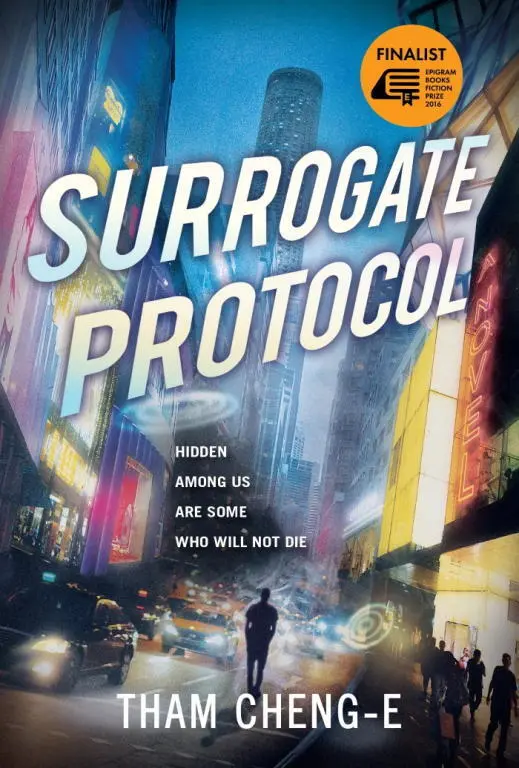
- Название:Surrogate Protocol
- Автор:
- Издательство:Epigram Books
- Жанр:
- Год:2017
- Город:Singapore
- ISBN:978-981-17-0091-0
- Рейтинг книги:5 / 5. Голосов: 1
-
Избранное:Добавить в избранное
- Отзывы:
-
Ваша оценка:
Surrogate Protocol: краткое содержание, описание и аннотация
Предлагаем к чтению аннотацию, описание, краткое содержание или предисловие (зависит от того, что написал сам автор книги «Surrogate Protocol»). Если вы не нашли необходимую информацию о книге — напишите в комментариях, мы постараемся отыскать её.
Landon Locke is no ordinary barista. A man of many names and identities, he has lived though many lifetimes, but his memory spans only days.
Danger brews as Landon struggles to piece together reality through his fog of amnesia. A mysterious organisation called CODEX bent on hunting him down, a man named John who claims to be a friend, and women from Landon’s past who have come back to haunt him.
As CODEX closes in, he finds himself increasingly backed into a corner. Battling an unreliable memory, Landon is forced to make a choice: who can he trust?
Surrogate Protocol — читать онлайн бесплатно полную книгу (весь текст) целиком
Ниже представлен текст книги, разбитый по страницам. Система сохранения места последней прочитанной страницы, позволяет с удобством читать онлайн бесплатно книгу «Surrogate Protocol», без необходимости каждый раз заново искать на чём Вы остановились. Поставьте закладку, и сможете в любой момент перейти на страницу, на которой закончили чтение.
Интервал:
Закладка:
Poppy was clutching a little pink ticket with a hole punched into a spot where the number “4” used to be, his arms resting over a biscuit tin that contained his prized possessions. Restlessness quickly got to him and he started scraping his finger at the grit and cigarette ends that choked the tracks of the sliding window. Arthur wrenched his arm away and delivered a stinging slap to his thigh. Scoldings wouldn’t work because Poppy couldn’t hear very well.
Poppy blew raspberries in protest and left his tongue between his lips. When he became bored he laid himself against Arthur. Rocked by the bumps, he soon fell asleep. Arthur drew him up against his arm and patted him.
They alighted at a bus stop that consisted of a single slab of concrete under zinc roofing. The bus went sputtering away into the traffic, spitting black exhaust from its side. Then the lights turned and a parade of automobiles roared down Scotts Road and poured into Orchard Road.
Poppy’s right leg was two inches shorter than his left; it gave him a limp and slowed him. So Arthur had to carry him through the perilous traffic to where Shaw House stood. The tower was a hulk of a building with vertical rows of angular fenestration. Its forecourt was an open car park, studded with Technicolour rows of Datsun Bluebirds, Mini Minors, Borgward Arabellas, Renault Dauphines, Ford Taunuses, and Austin A40s. In front of them stood a line of coconut palms proudly rustling their spindly fronds. Beyond the russet roofs of whitewashed shophouses peeked the upward-curving tips of a department store building, painted green to resemble bamboo.
They turned west along Orchard Road and continued past a stretch of shophouses, up to the slope of Orange Grove Road. Realising he was late, Arthur widened his stride. In good time they conquered the incline and arrived at the circular driveway of an oblong, modernist building. A concrete canopy ran the length of the façade just above the first storey. Tubular neon signage proclaimed in winding script: Orchard Hotel . Large steps ran up to heavyset doors of dark glass set into silver frames.
There was nothing of interest at the lobby except for a few very tall Caucasians whom Arthur almost mistook for mannequins. They paid no attention to Arthur when he passed them and instead tracked Poppy with shameless curiosity, apparently unable to reconcile his physical appearance with his infantile dribbling. A carpeted spiral staircase led to the basement. A few more steps ushered them past a bust of Milo de Venus, through heavy oak doors and into the Golden Venus Club.
A dance floor sat empty, circumscribed by plush crimson seats with tables, while the cheaper seats, bereft of backrests, occupied the rear. Private rooms lined the perimeter of the club, and at the front of everything there was a stage of lacquered timber. On golden drapes hung a sign of foam crusted in blue glitter: Beat and Blues . Under it a drum set glimmered. On one side of the stage a board on an easel peddled the resident band— Checkmates and the Cyclones, featuring Vernon Cornelius and Brian Neale; Sunday from 2.30pm to 6.00pm.
Along a corridor wedged between the private rooms and the club’s back-of-house Arthur punched in his card while Poppy scaled the empty stage. His covert little operation was betrayed by the juvenile rapping of the snare drum, and he was promptly whisked offstage. They proceeded to the kitchen and Poppy greeted, rather ardently, a group of chambermaids who returned token, awkward pleasantries.
This was a Wednesday, and the aftermath of Sunday’s tea dance session—a prodigious assortment of glasses and dishes—awaited Arthur in green plastic crates piled against a tiled wall. He took grudgingly to the soaping and rinsing. Arthur used to make coffee at a popular joint until a fateful incident consigned him to a job of a “lower profile”. Scarcely a month into it he had already learned how much stolidity was involved in getting through the repetitious, humdrum routine in an isolated basement chamber. Reading too much into his job prospects would make anyone neurotic.
Poppy excelled in it because his simple mind needed nothing to satisfy it beyond assisting Arthur in drying the dishes and placing them on clean trays. He took to the tasks with fervour and the height of his accomplishments consisted of breaking no glassware by day’s end.
Lost in such monotony, Arthur didn’t realise they had been washing and drying for three hours straight until the maître d’hôtel called out to him from the raised threshold that separated the washing area from the other parts of the kitchen.
The maître d’ was a middle-aged Chinese man, slightly plump at the waist and spiffy in his dressing. He wore fashionable glasses with a top frame. Arthur got up and Poppy, who was crouching beside him, waddled aside to let him pass. He was drying a cocktail glass with immense concentration, his tongue protuberant, his eyes slightly crossed.
“There’s someone looking for you,” said the maître d’ .
Arthur dried his hands on his apron. “Who?”
“You tell me.” The maître d’ pushed up his glasses with a thumb and forefinger.
Beyond the grand oak doors of the club’s entrance a man was standing by the foot of the spiral staircase, dressed in a crisp white shirt with cropped sleeves and black trousers hiked high above his waist. He had a rather flat face and a long jaw that gave him an affable appearance. His hair was combed and oiled and his tanned skin glowed with a healthy sheen.
“Arthur Lock.” The man held out his hand.
From the tone of his voice Arthur knew it wasn’t a question. He shook the man’s hand and put on a slightly puzzled expression.
“I’m Helio,” said the man. “It’s regarding your asylum.” “I don’t understand.”
“This concerns your life, and I need you to do exactly as I say.”
The stranger named Helio related the instructions sotto voce to Arthur and departed. In compliance with them, Arthur lobbied successfully for an extended lunch break. At precisely two-thirty in the afternoon he set off with Poppy for the Magnolia Snack Bar next to the Cold Storage self-serve mart, a 15-minute walk away. Both joints were on the ground floor of a pair of flagging shophouses. Dark clouds were gathering even though the afternoon baked. It was a fifteen-minute walk.
With three scoops of vanilla ice-cream Arthur negotiated a deal with Poppy to wait at the snack bar because he was required to rendezvous alone. The child had sufficient wit to comprehend the deal, and though swayed by the rare treat he was palpably distressed over the prospect of being left alone. Arthur paid the man behind the counter and got him to dispense the triple treat one at a time. But as he turned to leave, Poppy lashed out at his leg and stubbornly held on to it.
Twice Arthur coddled him, and at the third attempt Poppy finally lowered his teary gaze into a dubious glare and gave approval for him to depart. In his pudgy fingers Poppy clasped the icy steel cup and refused to touch the ice-cream until Arthur was out of sight.
The Cold Storage wasn’t crowded at this time of the day and there were a few empty tills where cashier ladies sat nattering to one another. Arthur went up a narrow wooden staircase, and at the top he found the boutique called Hilda’s. It was furnished in dark oak, had a British flair to it and had neat rows of fabric displayed across the length of its rear wall. Behind an oak-panelled counter a woman was leaning over a newspaper. She had hair like a beehive and glasses shaped like owl’s eyes.
She looked up and Arthur cursed his moth-eaten memory. He stole a glance at a piece of paper and tentatively recited the words, “I need buttons for an Arabian fabric.”
Читать дальшеИнтервал:
Закладка:
Похожие книги на «Surrogate Protocol»
Представляем Вашему вниманию похожие книги на «Surrogate Protocol» списком для выбора. Мы отобрали схожую по названию и смыслу литературу в надежде предоставить читателям больше вариантов отыскать новые, интересные, ещё непрочитанные произведения.










Обсуждение, отзывы о книге «Surrogate Protocol» и просто собственные мнения читателей. Оставьте ваши комментарии, напишите, что Вы думаете о произведении, его смысле или главных героях. Укажите что конкретно понравилось, а что нет, и почему Вы так считаете.