John Karr - Detonation Event
Здесь есть возможность читать онлайн «John Karr - Detonation Event» весь текст электронной книги совершенно бесплатно (целиком полную версию без сокращений). В некоторых случаях можно слушать аудио, скачать через торрент в формате fb2 и присутствует краткое содержание. Город: New York, Год выпуска: 2019, ISBN: 2019, Издательство: Rebel Base Books, Жанр: Фантастика и фэнтези, на английском языке. Описание произведения, (предисловие) а так же отзывы посетителей доступны на портале библиотеки ЛибКат.
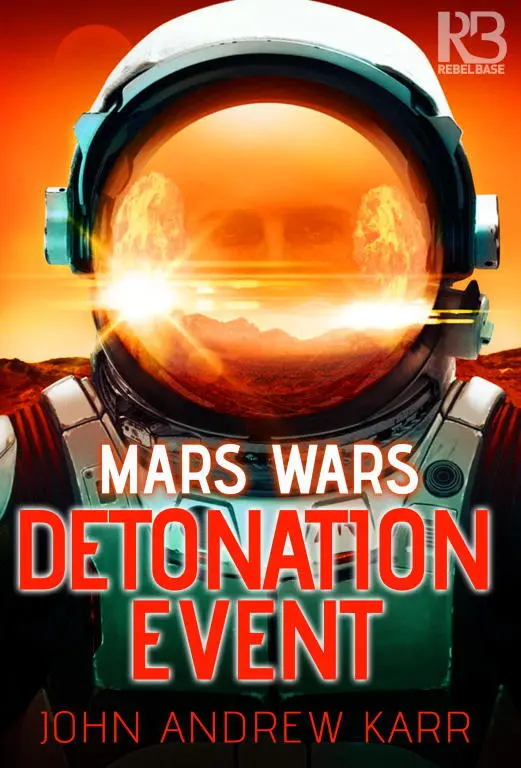
- Название:Detonation Event
- Автор:
- Издательство:Rebel Base Books
- Жанр:
- Год:2019
- Город:New York
- ISBN:978-1-63573-068-5
- Рейтинг книги:4 / 5. Голосов: 1
-
Избранное:Добавить в избранное
- Отзывы:
-
Ваша оценка:
Detonation Event: краткое содержание, описание и аннотация
Предлагаем к чтению аннотацию, описание, краткое содержание или предисловие (зависит от того, что написал сам автор книги «Detonation Event»). Если вы не нашли необходимую информацию о книге — напишите в комментариях, мы постараемся отыскать её.
DETONATION EVENT
Battle-hardened Captain Ry Devans and his crew of the Mars Orbiter Station One (MOS-1) are part of a bold plan: resurrect the active molten cores of the Red Planet with synchronized thermonuclear explosions, and terraform the hell out of that iron-oxide rock for future generations. It’ll change history. So will the strands of carbon-based Martian cells that have hitched a ride on the ship.
Dr. Karen Wagner knows the microbes’ resistance to virus is incredible. It’s the unknowable that’s dicey. Her orders: blow them into space. But orders can be undermined. Two vials have been stolen and sent hurtling toward the biosphere. For Devans and Wagner, ferreting out the saboteurs on board is only the beginning. Because there are more of them back on Earth—an army of radical eco-terrorists anxious to create a New World Order with a catastrophic gift from Mars.
Now, one-hundred-and-forty-million miles away from home, Devans is feeling expendable, betrayed, a little adrift, and a lot wild-eyed. But space madness could be his salvation—and Earth’s. He has a plan. And he’ll have to be crazy to make it work.
Detonation Event — читать онлайн бесплатно полную книгу (весь текст) целиком
Ниже представлен текст книги, разбитый по страницам. Система сохранения места последней прочитанной страницы, позволяет с удобством читать онлайн бесплатно книгу «Detonation Event», без необходимости каждый раз заново искать на чём Вы остановились. Поставьте закладку, и сможете в любой момент перейти на страницу, на которой закончили чтение.
Интервал:
Закладка:
He felt a stab of emptiness.
Come on, you’ve only been with her a night and a day.
Yeah, but there’s something there. She didn’t have to check in with me almost daily during quarantine, and our conversations were more than just microbe-related.
Over the next twenty minutes of waiting for her flight to take off, he tried Cal several more times with his arm computer phone and mindtext. All went unanswered.
Karen texted that her flight was in the air now.
Devans set his jaw and headed out.
A river of people flowed along the wide hallways of the arrival and departure gates. He slipped through gaps and made his own way with a dividing hand when necessary, at first muttering a word of apology and then forgetting it altogether when met with angry replies. Escalators and people movers were damming points, but he could at least make headway on the stairs and walkways.
No sooner did Devans realize this when the airport—always a place of grand-scale bustle—turned into a house of mass indecision and rising panic. People clogged the hallways. Sometimes there were lines of movement, sometimes they came to a standstill. Workers attempted to usher people along. Announcements came that flight after flight was now cancelled. Murmurs rose to shouts and became a perpetual roar. Glass shattered in a gift shop window. The two men with chairs in their hands didn’t bother fleeing. Instead they vanished inside. The shock of this quieted the hall for a few moments; then the roar resumed.
Then came gunfire, screaming, and smoke.
Airport police ran through, shouting for people to run for the exits.
Devans stopped before another gift shop. The owner or manager was pulling down on the metal mesh to block the entrance, but it hit a snag at waist-level and would descend no more. On the display counter was a set of pocket tools. One was opened to revealed pliers, knife blades, screwdrivers, finger clipper.
“A hundred credits for one of those!” Devans shouted, reaching for his wallet.
“Damn EFF. Should just leave. Not sure there’ll be anything left after today.” The manager shook his head and tried to kick the gate down. He paused as Devans strode toward him. “Hey, you’re the Mars guy, right? Help me with this damn thing and I’ll give you ten of ’em.”
“Deal, but just the one.”
The manager ducked under the gate, unlocked the display case, and grabbed one of the items still in its small box. He slid it out to Devans, who opened the box and pocketed it. With the manager back on the crazy side of the gate, they reached and pushed down on the gate with their combined force. The metal mesh screeched over a catch point, then rolled down to slam against the floor. The manager placed a foot on the handle and locked it. He shouted to be heard over the rush of feet and voices around them. “Thanks, spaceman! Watch your ass. From the links I watched, it’s all going to crap at light speed now.”
“Get a seat on a shuttle and head to one of the orbiters,” Devans said. “Link me when you get to Lunar One and I’ll get you through.”
A woman fell with a cry, purse and bag skidding away from her splayed arms. Devans and the manager helped her up and grabbed a few of her items that hadn’t disappeared in the crowd. Without a word she took her stuff and limped back into the flow of frightened humanity.
“There’s a couple shuttles ready for takeoff, just down at the end.” Devans pointed.
“Thanks, but I got kids. Maybe it won’t be so bad. Good luck!” The manager clapped Devans on the shoulder and vanished through a side door.
“Good luck,” Devans echoed after him. He took off down the hallway along with thousands of others.
Finally they spilled out into the wider areas like cattle on prairie. The press of humanity divided into lower baggage claim or headed outside where passenger pickup and the hover rental companies resided.
The offices were dark. People pounded on the glass and called out, but the desperate summons went unheeded. Devans stood and looked around in disbelief, even as he was nudged and jostled. None of the rental companies were loaning out vehicles. As he pondered his next move, the people in front of him dispersed, leaving a sudden gap. Before others filled in, he caught a glimpse of a white board propped in the window. Scrawled upon it in red marker and all caps was:
EFF SHUT US DOWN.
Red finger and handprints marred the sign. It did not look like paint.
He ran. Twelve lanes designated by laser lights were set aside for drop-off or pickup of arriving and departing passengers. Enter a lane without proper signaling and alarms would go off and a fine hit your bank account. Such was not an issue at the moment. All of the lane alarms were going off, and the people streaming forth could not care less about a fine. People leaped onto rising and lowering hovers, urged the drivers to fly away at once. The autopilots issued warnings via exterior speakers. The owners did likewise. The operating systems took evasive actions. The vehicles shot up and down and tilted and swayed to shake off the strangers, while the frightened occupants frantically tried to locate whomever they had hoped to meet.
The crowd ran beneath the hovers. The auto sensors prevented crushing incidents. En masse they flew off, twenty feet from the ground, the highest legal altitude.
Sensing the crowd as an obstacle, no other vehicles entered. The twelve lanes consisted of human traffic only.
Glass walls popped with holes and shards as lead and plasma bullets tore through.
New cries rang out.
Devans ran toward the fences at the edge of the airport grounds. There were vehicles parked in the decks, but he was reluctant to take someone else’s ride. These outer zones were set aside for the rental companies. He leaped onto the fence and scrambled up and over, silently thanking whoever installed it for not using razor wire. In the Third Middle East War this had not been the case, but then he had blown the fence with a grenade and strode in. He grabbed the multitool from his pocket, wishing he also had a gun. He didn’t waste time trying to finesse his way into the first hover. A decorative stone from the nearby landscaping met the rear passenger-side window with force, and a thousand tiny cubes cascaded inward. With the alarm blaring, he reached in, pressed the unlock switch, and went inside, shutting the door behind him.
The operating system’s bot’s voice warned him to vacate the vehicle as he pried the dash control panel open. He didn’t have an auxiliary wire this time, so he used the flat head of the screwdriver to pop out the auto-drive chip. The dash monitor was about eighteen inches wide and six in height, and fully interactive by touch or voice. A driver could leave the driving to the bot and work or play on the galaxynet.
He tapped at the control center holo and killed the alarms. He pressed start and flew the hover above the other rentals and out over the fence. He left the chaos of the airport.
At first he merged into the designated air lanes of northern Virginia. In the map finder he plugged in Cal Devans’ address, only a few miles away.
Slow going was replaced by halted traffic. The hovercraft around him descended from twenty feet to just inches above the old asphalt, typical of a traffic jam in this overpopulated area.
Smoke trails rose along the shoulders.
Some people remained inside their parked hovers, others hung around them, uncertainty upon their features. Other abandoned their vehicles to walk quickly or run along the old roadways. Dozens of police cars with flashing lights were on the sides of the roads, doors flung open. People with guns were jumping on hovers, firing into the air and taking potshots at other vehicles. Uniformed bodies were draped over guardrails and sprawled along grassy shoulders. Then Devans saw civilian bodies in and around their vehicles.
Читать дальшеИнтервал:
Закладка:
Похожие книги на «Detonation Event»
Представляем Вашему вниманию похожие книги на «Detonation Event» списком для выбора. Мы отобрали схожую по названию и смыслу литературу в надежде предоставить читателям больше вариантов отыскать новые, интересные, ещё непрочитанные произведения.











Обсуждение, отзывы о книге «Detonation Event» и просто собственные мнения читателей. Оставьте ваши комментарии, напишите, что Вы думаете о произведении, его смысле или главных героях. Укажите что конкретно понравилось, а что нет, и почему Вы так считаете.