John Karr - Detonation Event
Здесь есть возможность читать онлайн «John Karr - Detonation Event» весь текст электронной книги совершенно бесплатно (целиком полную версию без сокращений). В некоторых случаях можно слушать аудио, скачать через торрент в формате fb2 и присутствует краткое содержание. Город: New York, Год выпуска: 2019, ISBN: 2019, Издательство: Rebel Base Books, Жанр: Фантастика и фэнтези, на английском языке. Описание произведения, (предисловие) а так же отзывы посетителей доступны на портале библиотеки ЛибКат.
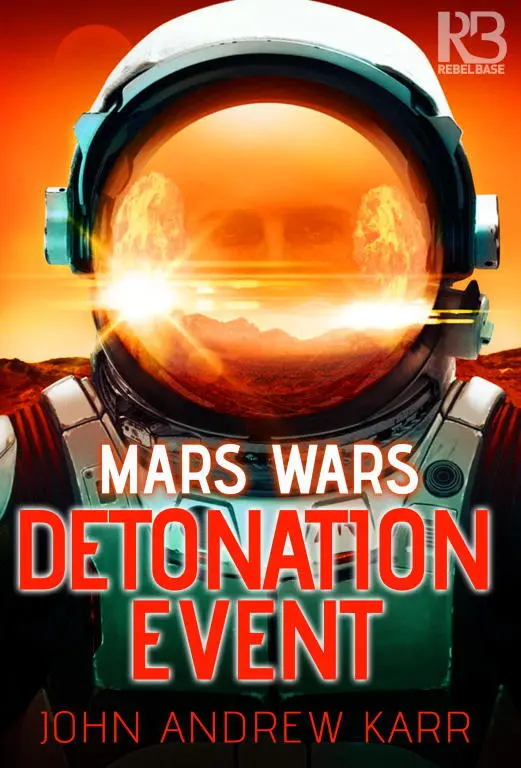
- Название:Detonation Event
- Автор:
- Издательство:Rebel Base Books
- Жанр:
- Год:2019
- Город:New York
- ISBN:978-1-63573-068-5
- Рейтинг книги:4 / 5. Голосов: 1
-
Избранное:Добавить в избранное
- Отзывы:
-
Ваша оценка:
Detonation Event: краткое содержание, описание и аннотация
Предлагаем к чтению аннотацию, описание, краткое содержание или предисловие (зависит от того, что написал сам автор книги «Detonation Event»). Если вы не нашли необходимую информацию о книге — напишите в комментариях, мы постараемся отыскать её.
DETONATION EVENT
Battle-hardened Captain Ry Devans and his crew of the Mars Orbiter Station One (MOS-1) are part of a bold plan: resurrect the active molten cores of the Red Planet with synchronized thermonuclear explosions, and terraform the hell out of that iron-oxide rock for future generations. It’ll change history. So will the strands of carbon-based Martian cells that have hitched a ride on the ship.
Dr. Karen Wagner knows the microbes’ resistance to virus is incredible. It’s the unknowable that’s dicey. Her orders: blow them into space. But orders can be undermined. Two vials have been stolen and sent hurtling toward the biosphere. For Devans and Wagner, ferreting out the saboteurs on board is only the beginning. Because there are more of them back on Earth—an army of radical eco-terrorists anxious to create a New World Order with a catastrophic gift from Mars.
Now, one-hundred-and-forty-million miles away from home, Devans is feeling expendable, betrayed, a little adrift, and a lot wild-eyed. But space madness could be his salvation—and Earth’s. He has a plan. And he’ll have to be crazy to make it work.
Detonation Event — читать онлайн бесплатно полную книгу (весь текст) целиком
Ниже представлен текст книги, разбитый по страницам. Система сохранения места последней прочитанной страницы, позволяет с удобством читать онлайн бесплатно книгу «Detonation Event», без необходимости каждый раз заново искать на чём Вы остановились. Поставьте закладку, и сможете в любой момент перейти на страницу, на которой закончили чтение.
Интервал:
Закладка:
The DEOS was a hundred-thousand-mile expanse where two man-made mini-planets would linger while Mars sorted itself out. It was out of reach of radioactive spikes and provided ample time to spatz any possible Martian asteroids.
With one leg behind the other and both straight, Gwen Wagner bent at the waist. The black, faux-leather pants creaked slightly, in concert with her groan. She pulled with her arms, tightening the twin tattoos of racing comets that ran from elbow to shoulder.
Her sleeveless top was a mesh of cotton and nylon and made no sound. It was more of an undergarment for the jacket she had slung onto the back of the pilot’s chair. A shoulder chain gleamed in one of the narrow light beams. Just outside the hull, the temperature was beyond freezing, yet she found the bridge too warm. She suspected Cricks over the cleaning crew. Despite a curvaceous build, the woman was always cold. She had boarded first out of the three-person crew to link up the communications while Gwen was still having coffee with Trent near Columbus Bay.
She noticed the veneer of her boots had gotten dull.
Time for some buffing, she thought.
Since she was a dualie, she got away with her own clothing preferences while on the clock. The fact that she was adept at both vocations allowed her leeway for her “less than business attire,” as her supervisors phrased it. The standard jumpsuits SCONA encouraged for science employees, and even the ones for flight officers, made for a bland conformity that threatened to put her in a coma.
She wasn’t a hardcore rebel, however. The armbands just below her elbows were color-coded blue and black to match those of the jumpsuits of her professions. It was a small capitulation for the opportunity to live and work beyond the confines of Earth. Janai Cricks was also a dualie, but preferred the bland jumpsuit for her primary vocation as astrobiologist. Wagner suspected it not only served the woman’s conformist tendencies, but in juxtaposition, her enjoyment of attention. Drab garb was no match for the woman’s curves, and both men and women could hardly help but notice.
Whatever. Gwen Wagner’s audience was Gwen Wagner. Anybody else could go choke on comet dust.
Except maybe Norquist. She doubted the ship’s engineer even thought about his clothing preferences all that much. The Aussie farmboy seemed more of a grab-and-go type, though she’d seen him after hours at the gym and couldn’t help but notice the tattoos adorning his arms and calves. And the lean canvas they were etched upon.
Wagner held the stretch then switched legs, this time raising her head to gaze at the hologram. She straightened, arms overhead. Her gaze rose above the holo to the view panes of the shuttle nose.
There, she watched a celestial show. A thousand stars gleamed like diamonds in the blackness of space. Tens of thousands of planets were in orbit around these, unseen with her eyes but documented via physics and the prowess of modern telescopes. The universe was expanding, but some small part of her still wondered why all the suns and planets didn’t just plunk down on a cosmic floor and roll into a vast shiny clump together, like the marbles she’d played with as a child.
She passed through the holo and found herself at the nose of the shuttle. Asteroid mapping showed a clear path for their five-day flight, so she had withdrawn the shields.
“Computer.”
“Queued and waiting for command.”
“Turn off lights in the bridge except for the consoles and hologram.”
“Executing.”
The bridge plunged into relative darkness. The stars through the panes glowed brighter. Surrounded by transparent panes, she appeared to stand in space, with stars even beside her boots. It was like taking a star shower.
A tiny light blinked in her periphery, but not a star. She double-blinked on the mind message.
Gonna eat?
A slight smile formed on Gwen’s lips. Norquist, looking out for her. He was doing more of that lately, which was slightly troublesome. Cricks was professional, but she wasn’t friendly like the Aussie. Gwen caught her glancing in Norquist’s direction for no apparent reason. It seemed a fairly recent development, and there were subtle undercurrents of tension among them as they worked as a team. It was never a great idea to have physical relationships with co-workers, and Gwen didn’t want to get between them if something was developing. She wondered if she should go ahead and request a transfer to MOS-1 and stay closer to Trent. It’s not like she and her brother would be in each other’s business all the time on the same orbiter. Gwen had gone to MOS-2 because she wanted space piloting experience and the real veterans had taken all the positions on the first orbiter around Mars.
In a little while , she replied, pupils finding the letters. You and Cricks go ahead.
She blinked to send. A few seconds later came the reply.
We showered this morning. At least I did. Mineral water squeezed from some unnamed asteroid wandering through space on a lonely path through millennia. And now I’ve washed in it!
Poetic! Gwen appended a smiley face.
STILL no go?
Not right now, thx.
Okay, but you’re gonna miss out on the freshest lab lettuce, tomato, pseudo-dressing, and sliced protein stuff loosely termed “meat” this side of Mars.
Save some!
No guarantees. Winking smiley face.
Her smile faded as she turned away from space and toward the pilot holos and the communication station. It was no exaggeration to say SCONA was on the brink of history—either a historical failure or an achievement without equal. The ultimate danger to Earth was new asteroids jettisoned from Mars after the explosions. But SCONA had used computer models to convince skeptics that the effects of the tunnel bombs, while powerful on a scale never experienced before, would largely be limited to the interior of Mars.
Besides, they had the means to hunt and atomize stray asteroids. That’s how SCONA had sold the world on the idea creating and using such powerful atomic bombs—by saving the home planet. They had atomized two asteroids that had been headed toward Earth. The Earth First Faction still opposed the idea of terraforming Mars, but SCONA repeatedly dropped this message on them:
Ask a dinosaur if asteroid busting is a big deal. From Mars we can reach asteroids before they threaten life on Earth.
Saviors get leeway.
And even then, the bombs could only be manufactured in stages on the orbiters, then assembled on the asteroid or Martian surface. Nuclear scientists were both physically present and remote, and all of it protected by Special Forces from the United States military.
She wondered about her younger brother. Worried was more apt. Trent was always volunteering for the surface missions to Mars. She wondered if he even considered the dangers as anything but a means for exhilaration. As in, there could be permanent ramifications that involve an arrested heartbeat.
Thirteen hours earlier, and forty-five minutes before the traditional day shift began (SCONA rotated the orbiters to simulate night and day), they had greeted each other with a brief hug at the coffee shop near Columbus Bay on MOS-1. They sidestepped through the milling patrons and claimed one of the tall tables whose surface area was little larger than a dinner plate. They set their coffees down, covering several of the tiny lights embedded in the black plastic. The lights swirled up the long stem of the table and spilled out onto the top to emulate a galaxy.
Gwen and Trent Wagner eschewed the stools and stood. No sense getting too comfortable.
A couple guys and several women said hello to Trent, who returned their greetings. A couple asked if he and his “companion” cared to share a table.
Читать дальшеИнтервал:
Закладка:
Похожие книги на «Detonation Event»
Представляем Вашему вниманию похожие книги на «Detonation Event» списком для выбора. Мы отобрали схожую по названию и смыслу литературу в надежде предоставить читателям больше вариантов отыскать новые, интересные, ещё непрочитанные произведения.









Обсуждение, отзывы о книге «Detonation Event» и просто собственные мнения читателей. Оставьте ваши комментарии, напишите, что Вы думаете о произведении, его смысле или главных героях. Укажите что конкретно понравилось, а что нет, и почему Вы так считаете.