Clifford Simak - A Death in the House - And Other Stories
Здесь есть возможность читать онлайн «Clifford Simak - A Death in the House - And Other Stories» весь текст электронной книги совершенно бесплатно (целиком полную версию без сокращений). В некоторых случаях можно слушать аудио, скачать через торрент в формате fb2 и присутствует краткое содержание. Год выпуска: 2016, Издательство: Open Road Media Sci-Fi & Fantasy, Жанр: Фантастика и фэнтези, на английском языке. Описание произведения, (предисловие) а так же отзывы посетителей доступны на портале библиотеки ЛибКат.
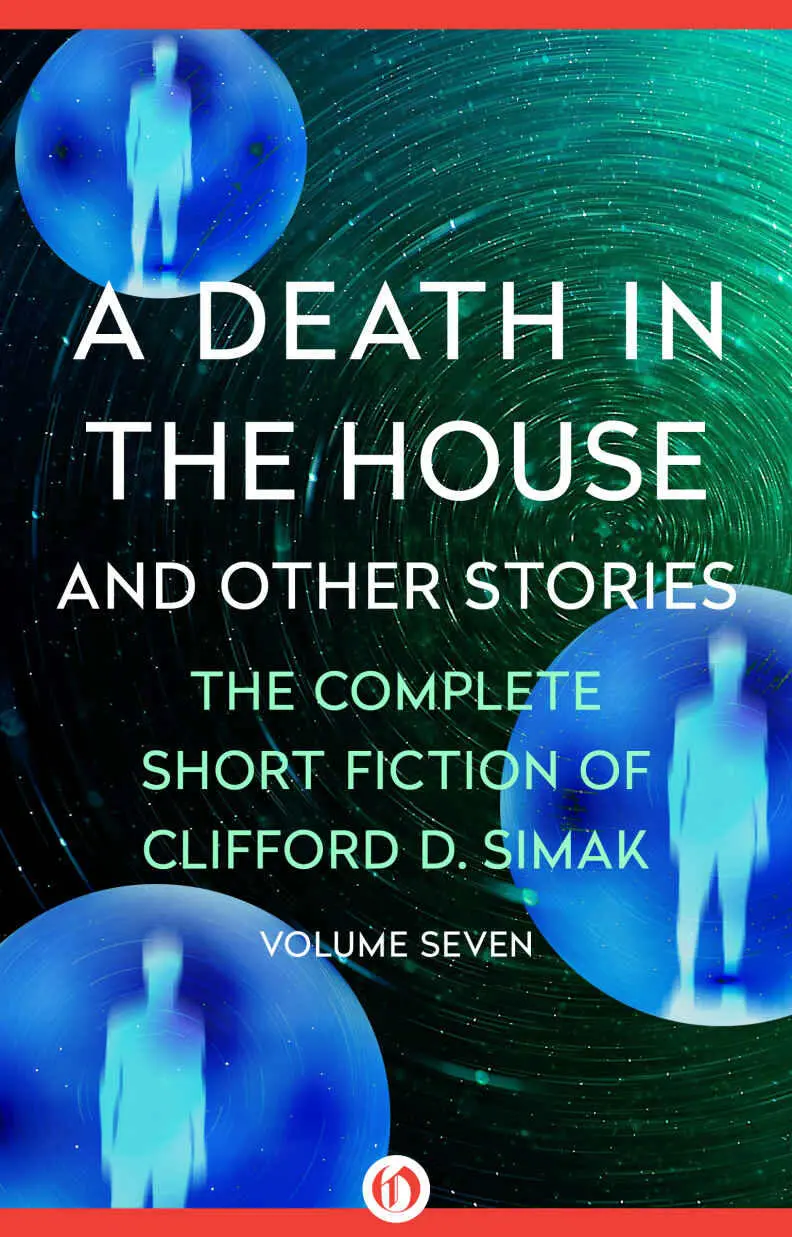
- Название:A Death in the House : And Other Stories
- Автор:
- Издательство:Open Road Media Sci-Fi & Fantasy
- Жанр:
- Год:2016
- ISBN:нет данных
- Рейтинг книги:4 / 5. Голосов: 1
-
Избранное:Добавить в избранное
- Отзывы:
-
Ваша оценка:
A Death in the House : And Other Stories: краткое содержание, описание и аннотация
Предлагаем к чтению аннотацию, описание, краткое содержание или предисловие (зависит от того, что написал сам автор книги «A Death in the House : And Other Stories»). Если вы не нашли необходимую информацию о книге — напишите в комментариях, мы постараемся отыскать её.
to Isaac Asimov’s Foundation series to Philip K. Dick’s stories of bizarre visions of a dystopian future, the latter half of the twentieth century produced some of the finest examples of speculative fiction ever published. Yet no science fiction author was more highly regarded than Grand Master Clifford D. Simak, winner of numerous honors, including the Hugo and Nebula Awards and a Bram Stoker Award for Lifetime Achievement.
This magnificent compendium of stories, written during science fiction’s golden age, highlights Simak at his very best, combining ingenious concepts with his trademark humanism and exploring strange visitations, remarkable technologies, and humankind’s destiny in the possible worlds of tomorrow. Whether it’s an irascible old man’s discovery of a very unusual skunk that puts him at odds with the US Air Force, a county agent’s strange bond with the sentient alien flora he discovers growing in his garden, the problems a small town faces when its children mature too rapidly thanks to babysitters from another galaxy, or the gift a lonely farmer receives in exchange for aiding a dying visitor from another world, the events detailed in Simak’s poignant and beautiful tales will thrill, shock, amuse, and astonish in equal measure.
One of the genre’s premier literary artists, Simak explores time travel and time engines; examines the rituals and superstitions of galactic travelers who have long forgotten their ultimate purpose; and even takes fascinating detours through World War II and the wild American West in a wondrous anthology that no science fiction fan should be without.
A Death in the House : And Other Stories — читать онлайн бесплатно полную книгу (весь текст) целиком
Ниже представлен текст книги, разбитый по страницам. Система сохранения места последней прочитанной страницы, позволяет с удобством читать онлайн бесплатно книгу «A Death in the House : And Other Stories», без необходимости каждый раз заново искать на чём Вы остановились. Поставьте закладку, и сможете в любой момент перейти на страницу, на которой закончили чтение.
Интервал:
Закладка:
Then, one night, we were sitting on the back steps, listening to the first crickets of the season.
The ship came down without a sound. I didn’t see it until it was about at treetop level. It floated down and landed between the house and toolshed.
I was startled for a moment, but not frightened, and perhaps not too surprised. In the back of my head, I’d wondered all the time, without actually knowing it, whether Plant’s pals might not ultimately find him.
The ship was a shimmery sort of thing, as if it might not have been made of metal and was not really solid. I noticed that it had not really landed, but floated a foot or so above the grass.
Three other Plants stepped out and the oddest part of it was that there wasn’t any door. They just came out of the ship and the ship closed behind them.
Plant took me by the arm and twitched it just a little, to make me understand he wanted me to walk with him to the ship. He made little comforting thoughts to try to calm me down.
And all the time that this was going on, I could sense the talk between Plant and those other three—but just grasping the fringe of the conversation, barely knowing there was talk, not aware of what was being said.
And then, while Plant stood beside me, with his hand still on my arm, those other plants walked up. One by one, each took me by the other arm and stood facing me for a moment and told me thanks and happiness.
Plant told me the same, for the last time, and then the four of them walked toward the ship and disappeared into it. The ship left me standing there, watching it rise into the night, until I couldn’t see it any longer.
I stood there for a long time, staring up into the sky, with the thanks and happiness fading and loneliness beginning to creep in.
I knew that, somewhere up there, was a larger ship, that in it were many other Plants, that one of them had lived with me for almost six months and that others of them had died in the hedges and fence corners of the neighborhood. I knew also that it had been the big ship that had scooped out the load of nutritious soil from Pete Skinner’s field.
Finally, I stopped looking at the sky. Over behind the toolshed I saw the whiteness of the yellow rose in bloom and once again I thought about the basics.
I wondered if happiness and kindness, perhaps even emotions that we humans do not know, might not be used on Plant’s world as we use the sciences.
For the rose bush had bloomed when I thought kindly thoughts of it. And the African violet had found a new life in the kindness of a human.
Startling as it may seem, foolish as it may sound, it is not an unknown phenomenon. There are people who have the knack of getting the most out of a flowerbed or a garden. And it is said of these people that they have green thumbs.
May it not be that green thumbness is not so much concerned with skill or how much care is taken of a plant, as with the kindliness and the interest of the person tending it?
For eons, the plant life of this planet has been taken for granted. It is simply there. By and large, plants are given little affection. They are planted or sown. They grow. In proper season, they are harvested.
I sometimes wonder if, as hunger tightens its grip upon our teeming planet, there may not be a vital need for the secret of green thumbness .
If kindness and sympathy can cause a plant to produce beyond its normal wont, then shouldn’t we consider kindness as a tool to ward off Earth’s hunger? How much more might be produced if the farmer loved his wheat?
It’s silly, of course, a principle that could not gain acceptance.
And undoubtedly it would not work—not in a plant-utilizing culture.
For how could you keep on convincing a plant that you feel kindly toward it when, season after season, you prove that your only interest in it is to eat it or make it into clothing or chop it down for lumber?
I walked out back of the shed and stood beside the yellow rose, trying to find the answer. The yellow rose stirred, like a pretty woman who knows she’s being admired, but no emotion came from it.
The thanks and happiness were gone. There was nothing left but the loneliness.
Damned vegetable aliens—upsetting a man so he couldn’t eat his breakfast cereal in peace!
When It’s Hangnoose Time in Hell
As with most of Clifford D. Simak’s Western stories, the title under which this story was originally published was not the one that was on it when it was submitted to the magazine; but when I say that, I cannot tell you what the author’s title for this story was. The titles of most of his Westerns were changed after they left his hands, and most of them were written within a period of a few years; thus, although I’ve been trying, I haven’t had much luck matching what little I know about those stories’ dates of mailing with the publication dates of many of the stories.
This story first appeared in the April 1946 issue of .44 Western Magazine , but although I can tell you that Cliff was paid sixty dollars in 1943 for a story entitled “Sixgun Gamble,” and was paid one hundred and sixty in 1946 for a story entitled “Walk in the Middle of the Street,” I also have to tell you that he sold at least ten other Westerns during the period between those two stories—and no copy of any of those manuscripts is known to exist.
Nonetheless, I can tell you that, true to his preferences, Cliff made this story rather unconventional: Its protagonist is a riverboat gambler who was far from the Mississippi, and he is honest.
He is also blunt: “Shoot or wade,” Culver says.
—dwwCHAPTER ONE
Death Pays for an Insult
Grant Culver was walking along, minding his own business and thinking of Nancy Atwood, when the man bumped into him and sent him staggering off the sidewalk into mud that was Gun Gulch’s main street.
Culver lit flat on his back. His hat flew off and was ground beneath the wheels of a passing wagon. His carpetbag slipped out of his hand and splashed into a waterhole a good six feet away. On the porch of the Crystal Bar a crowd of loafers laughed uproariously, bent over, slapping one another on the back.
Culver sat up, the cold ooze seeping through his clothing, and eyed the laughing crowd. Sort of an initiation, he figured. A joke they played on tenderfeet.
He rose to his feet and singled out the man who had pushed him, a bear of a man who was roaring with laughter.
Culver waded to the boardwalk, mud and water dripping from his clothes. He gained the walk and stood wiping his hands on the front of his coat. The laughter quieted and the man who had bumped him turned around and faced him. Culver studied him, saw the sneer on his face.
“I presume,” Culver said, “that it was an accident.”
The man took his time in answering, his little pig-eyes small and red and watchful.
“Hell, no,” he said. “I done it on purpose.”
Deliberately, Culver wiped the back of his right hand against his coat and as the hand traveled down the fabric it became a fist, a fist that struck with savage, blistering speed.
It came so fast the man didn’t even duck. It smacked against his chin with a hollow, thudding sound to lift him from his feet and slam him back. He landed in the mud with a splash that sent yellow water geysering high into the air.
Culver snapped a quick look over his shoulder at the jaspers on the porch, but they had not moved. They stood like frozen men, waiting for the earth to open underneath their feet.
Out in the street Culver’s antagonist had lumbered upright, was heaving himself back onto the boardwalk. He stood there, shaking his hands to rid them of the clinging mud and on the porch back of Culver the silence was deep.
Читать дальшеИнтервал:
Закладка:
Похожие книги на «A Death in the House : And Other Stories»
Представляем Вашему вниманию похожие книги на «A Death in the House : And Other Stories» списком для выбора. Мы отобрали схожую по названию и смыслу литературу в надежде предоставить читателям больше вариантов отыскать новые, интересные, ещё непрочитанные произведения.






Обсуждение, отзывы о книге «A Death in the House : And Other Stories» и просто собственные мнения читателей. Оставьте ваши комментарии, напишите, что Вы думаете о произведении, его смысле или главных героях. Укажите что конкретно понравилось, а что нет, и почему Вы так считаете.